
ASU's eNavi Cuts Robot Navigation Errors in Half When Lights Go Out
A new dataset and imitation learning policy show that fusing event cameras with RGB helps mobile robots keep following people when the lights go out.
 Pro
Takeaways
- eNavi releases a TurtleBot 2 person-following dataset with synchronized event, RGB, and odometry streams.
- Roughly two hours of data over 175+ episodes across three indoor maps and mixed lighting conditions.
- ENP policy uses dual MobileNetV3-Small encoders fused by a Transformer to predict differential-drive velocities.
- Fusion cuts multi-path mixed-light MAE from 0.0707 (RGB) to 0.0370, and converges in 20-35 epochs.
- Event and fusion policies generalize zero-shot to low light where RGB-only baselines degrade sharply.
- Dataset, sync pipeline, and models are open source at the eNavi GitHub repo.
Indoor robots that rely on standard cameras have a well-known weakness: when the lights drop or the scene moves too fast, the image sensor smears, underexposes, and the policy driving the robot loses the thread. A team at Arizona State University is proposing a fix by pairing an RGB camera with an event camera and training a behavioral cloning policy that leans on whichever modality is more informative at any given moment. Their project, called eNavi, ships a real-world person-following dataset, a synchronization pipeline, and a family of trained policies.
Event cameras report per-pixel brightness changes asynchronously with microsecond latency instead of producing frames on a fixed clock. That gives them very high dynamic range and effectively no motion blur, which is why they have been popular in SLAM and pose estimation. What has been missing, and what this paper targets, is end-to-end control policies that actually consume those asynchronous streams to drive a robot.
Inside the data collection rig
The hardware is deliberately modest. A TurtleBot 2 with a Kobuki base carries an NVIDIA Jetson Orin Nano running ROS 2, a Prophesee Metavision EVK4 event camera built around the IMX636 sensor at 1280x720 with sub-220 microsecond latency, and a Flir Spinnaker RGB camera at the same resolution. Both cameras sit behind a beam splitter so they share an optical axis and produce approximately pixel-aligned observations. A joystick teleoperates the robot while it follows a human, and odometry is logged alongside the two camera streams.

The dataset covers three distinct indoor environments and two different human subjects walking at varied speeds and along varied trajectories. It totals roughly two hours of driving segmented into more than 175 episodes, recorded under both normal and low-light conditions. One map is held out for in-distribution testing and the other two are reserved for generalization experiments, so trained policies get evaluated on layouts they have never seen.
The preprocessing pipeline handles the awkward part of mixing a frame-based sensor with an event stream. Raw ROS 2 bag files are parsed to temporally align event windows with RGB frames, and ground-truth linear and angular velocities are reconstructed from odometry so the imitation learner has clean action labels to regress against.
ENP: late fusion for two very different sensors
The Event-based Navigation Policy (ENP) is a late-fusion architecture with two parallel MobileNetV3-Small encoders. The RGB encoder uses frozen pretrained weights, while the event encoder is trainable and operates on a 2-channel event representation so it can learn features suited to the sparse, high-temporal-resolution data. Each encoder emits a feature vector that is tokenized, concatenated into a 2-token sequence, and passed through a Transformer encoder block whose self-attention lets the policy adaptively weight RGB context against event dynamics on a per-sample basis.

The fused representation feeds an MLP head that predicts continuous differential-drive commands, linear velocity v and angular velocity omega. Training uses PyTorch with AdamW at a learning rate of 2e-4 and weight decay of 3e-4, batch size 64, an 80/10/10 split, and early stopping with patience 8 up to 50 epochs. To measure what event data actually contributes, the authors train 12 variants: three architectures (RGB-only, Event-only, RGB+Event fusion) across four dataset subsets spanning single-path to multi-path and normal-light to mixed-light.
What the numbers say
Two patterns show up consistently across the ablations:
- Faster convergence with events. RGB-only models run out the full 50-epoch budget on harder settings, while Event-only and Fusion variants typically trigger early stopping between epochs 20 and 35.
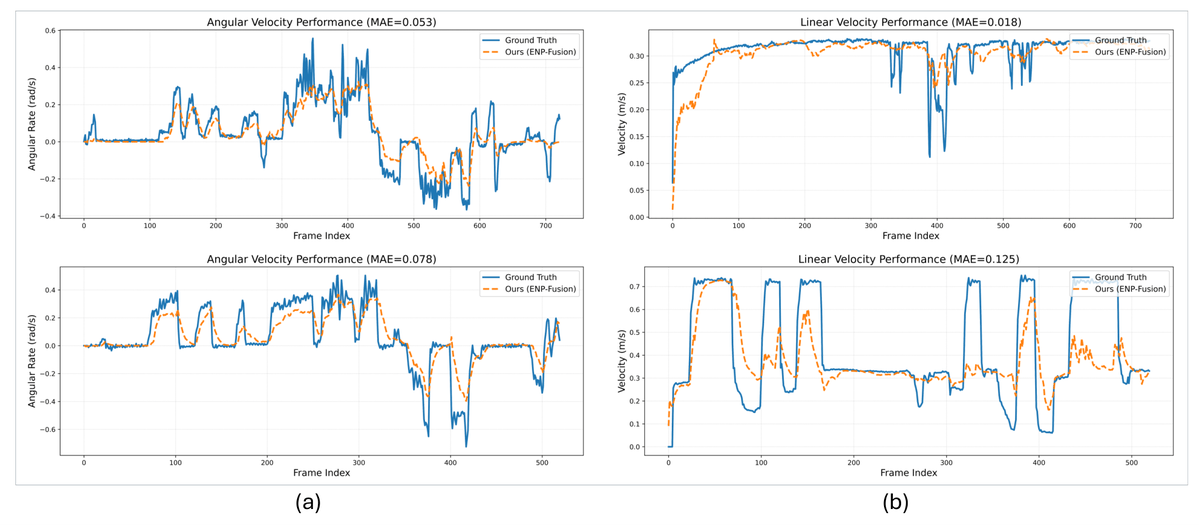
- Lower error under complexity. In the Multi-Path, Mixed-Light regime, ENP-Fusion reaches a validation MAE of 0.0370 against 0.0707 for ENP-RGB, roughly halving the action prediction error.
- Zero-shot low-light robustness. Trained only on normal-light multi-path data, ENP-RGB degrades from 0.0463 to 0.0514 MAE when tested in the dark, while ENP-Fusion degrades from 0.0335 to 0.0467, staying below the RGB baseline's normal-light number.
- RGB holds up when the task is easy. On simple single-path trajectories, ENP-RGB generalized to low light with total MAE moving only from 0.0210 to 0.0213, so events pay off mainly when the task gets harder.
Where this fits, and where it does not
The obvious fit is indoor mobile robots that need to keep operating when illumination is unreliable: service robots in warehouses at night, hospital corridors on dim shifts, security patrol platforms, or any person-following application where a human might walk from a bright hallway into a dark room. Because the pipeline learns directly from teleoperated demonstrations and odometry, it also sidesteps the need for hand-labeled trajectories or map-based planners.
The limits are worth flagging. The dataset is confined to three indoor environments, two subjects, and a single robot platform, so how well ENP transfers to outdoor scenes, crowded spaces, or different drive systems is untested. Behavioral cloning inherits the usual distribution-shift problems, and the fusion advantage largely disappears on easy single-path trajectories, so hardware cost has to be weighed against whether the deployment actually stresses the RGB camera.
What ships with the paper
The team has published the code and trained models on GitHub, and the dataset is available for download from the project page. The paper details the sensor rig, synchronization approach, and the full 12-variant ablation. For anyone building event-based control pipelines, this is one of the few public benchmarks that pairs raw event streams with expert control actions rather than just perception labels.