
ASU's EmDT Beats Every Fraud Detection Baseline by Splitting Rare Data Into Clusters
A cluster-aware diffusion model paired with a Transformer denoiser generates synthetic credit card fraud samples, pushing XGBoost F1 to 0.849.
 Pro
Takeaways
- EmDT is a diffusion model that generates synthetic credit card fraud using UMAP-clustered fraud patterns and a Transformer denoiser (paper).
- Boosts XGBoost F1 to 0.849 vs 0.834 for SMOTE and 0.816 for TabDDPM on the Kaggle credit card dataset.
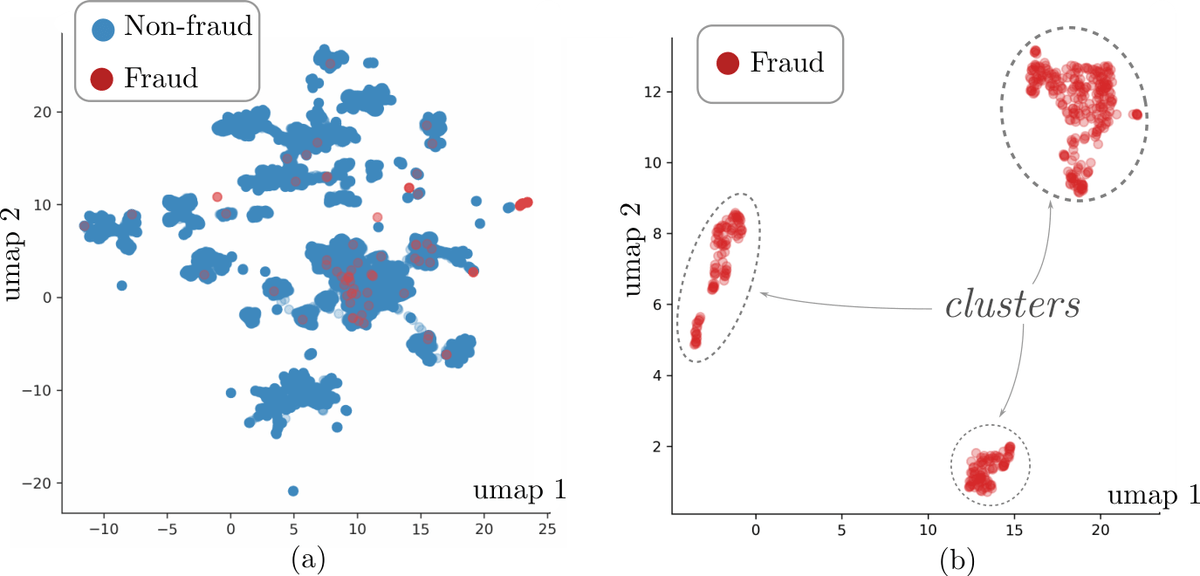
- Key trick: UMAP reveals three distinct fraud sub-clusters, and a separate DDPM is trained per cluster.
- Replaces the usual MLP noise predictor with a Transformer block using sinusoidal embeddings on every feature.
- SMOTE has a DCR of 0.686 (privacy risk), while EmDT stays near the ideal 0.5 at 0.555.
- No public code released; deep nets generate data, XGBoost still does the classifying.
Fraud detection sits on one of the ugliest problems in applied machine learning: the thing you actually want to predict is almost never in your data. A new paper from Arizona State University proposes EmDT, a diffusion model tailored for generating synthetic fraud transactions, and shows it beats SMOTE, CTGAN, TVAE, and TabDDPM on the standard credit card benchmark without materially hurting privacy.
The 0.172% problem
The credit card fraud dataset from Kaggle contains 284,807 transactions from European cardholders, with only 492 fraudulent ones, meaning the positive class comprises just 0.172% of all transactions. Classifiers trained on data like this learn a shortcut: predict "legitimate" every time and enjoy 99.83% accuracy while missing every fraud.
The usual workaround is to synthesize more minority-class samples. Traditional oversampling techniques like SMOTE address class imbalance by interpolating between existing fraud samples, but they often struggle to capture the complex and multi-modal nature of real-world fraud behavior. GAN-based approaches such as CTGAN can suffer mode collapse, and VAEs tend to produce lower-fidelity samples. Diffusion models like TabDDPM help, but most use a simple MLP as the noise predictor and can miss the feature dependencies that matter in tabular finance data.
The insight hiding in the minority class
The authors' central observation is empirical. When you project only the fraudulent transactions into 2D with UMAP, they do not form one blob. The fraudulent data further separates into three clearly defined clusters, indicating that the fraud class contains multiple distinct patterns. Averaging across those clusters with a single generator smears out the modes.
EmDT exploits this in three moves:
- Cluster first. Run UMAP on the fraud samples, then KMeans with k=3, and train a separate DDPM for each cluster.
- Embed each feature. Apply sinusoidal positional embeddings to every scalar feature and to the diffusion timestep, lifting a d-dim vector into a (d+1) x D tensor.
- Denoise with attention. Replace the usual MLP noise predictor with a Transformer block (multi-head attention plus feedforward), then linearly project back to feature space.

Notably, the deep networks only generate data. For final classification, the authors use tree-based methods like XGBoost, because such methods still tend to outperform deep neural networks on tabular data. The goal is to combine both: neural networks for synthetic data, tree-based models for classification.
How it performs
The generator doubles the size of the minority class, and an XGBoost classifier is trained on the augmented set. Averaged over 10 seeds:
| Method | F1 | Recall | Precision | DCR (privacy, ~0.5 ideal) |
|---|---|---|---|---|
| Original (no aug) | 0.800 | 0.743 | 0.868 | - |
| SMOTE | 0.834 | 0.784 | 0.891 | 0.686 |
| CTGAN | 0.805 | 0.751 | 0.873 | 0.526 |
| TVAE | 0.820 | 0.778 | 0.869 | 0.528 |
| TabDDPM | 0.816 | 0.767 | 0.873 | 0.578 |
| EmDT | 0.849 | 0.791 | 0.916 | 0.555 |
Two things stand out. First, SMOTE gets the highest DCR score, indicating its synthetic samples are closer to the training data than to the test data, which is expected because it interpolates directly between existing points rather than learning a distribution. That is a privacy red flag SMOTE users often ignore. Second, EmDT gets the best F1 and precision while keeping DCR near the 0.5 sweet spot.
The ablation confirms the clustering matters: EmDT with cluster-specific training achieves comparable privacy protection while demonstrating superior classification performance in F1, recall, precision, and balanced accuracy compared with the model trained on the full fraud set without cluster-training. Cluster training bumps F1 from 0.829 to 0.849.

Where this lands in practice
The method is a solid drop-in improvement if you are already doing tabular oversampling for a rare-event classifier. Practical caveats worth flagging:
- No public code. The paper does not release a repository, so you would need to reimplement from Algorithm 3 and the hyperparameter table. The pieces are standard: PyTorch, umap-learn, KMeans, a Transformer block, and Optuna for tuning.
- Domain scope. The generalizability of EmDT to other domains such as healthcare diagnostics, insurance fraud detection, and network intrusion detection has not yet been fully explored. The three-cluster structure was specific to this dataset, so verify your own minority class has similar geometry before committing to per-cluster training.
- Hyperparameter sensitivity. The model is robust to learning rate, batch size, and embedding dim, but the feature and time embedding scales matter and had to be tuned so both embeddings landed on comparable numeric ranges during denoising.
- Preprocessing note. The Time column is dropped and Amount is normalized. The other 28 features are already PCA components from the original Kaggle release.
The real contribution is not "another diffusion paper." It is the observation that rare-event data often has hidden sub-modes, and that a per-mode generator plus an attention-based denoiser preserves the feature correlation structure that downstream tree models rely on. If you are augmenting imbalanced tabular data, running UMAP on your minority class before you pick a generator is a cheap experiment worth doing.