
ASSR-EIC Lets One Diffusion Model Cover All Extreme Image Bitrates
A new diffusion-based codec handles any bitrate below 0.1 bpp with a single model by combining arbitrary-scale downsampling and degradation-aware reconstruction.
 Pro
Takeaways
- ASSR-EIC compresses images below 0.1 bpp using a single diffusion model that handles any bitrate via arbitrary-scale downsampling.
- The framework conditions Stable Diffusion on codec type, quality parameter, and rescaling factor for degradation-aware reconstruction.
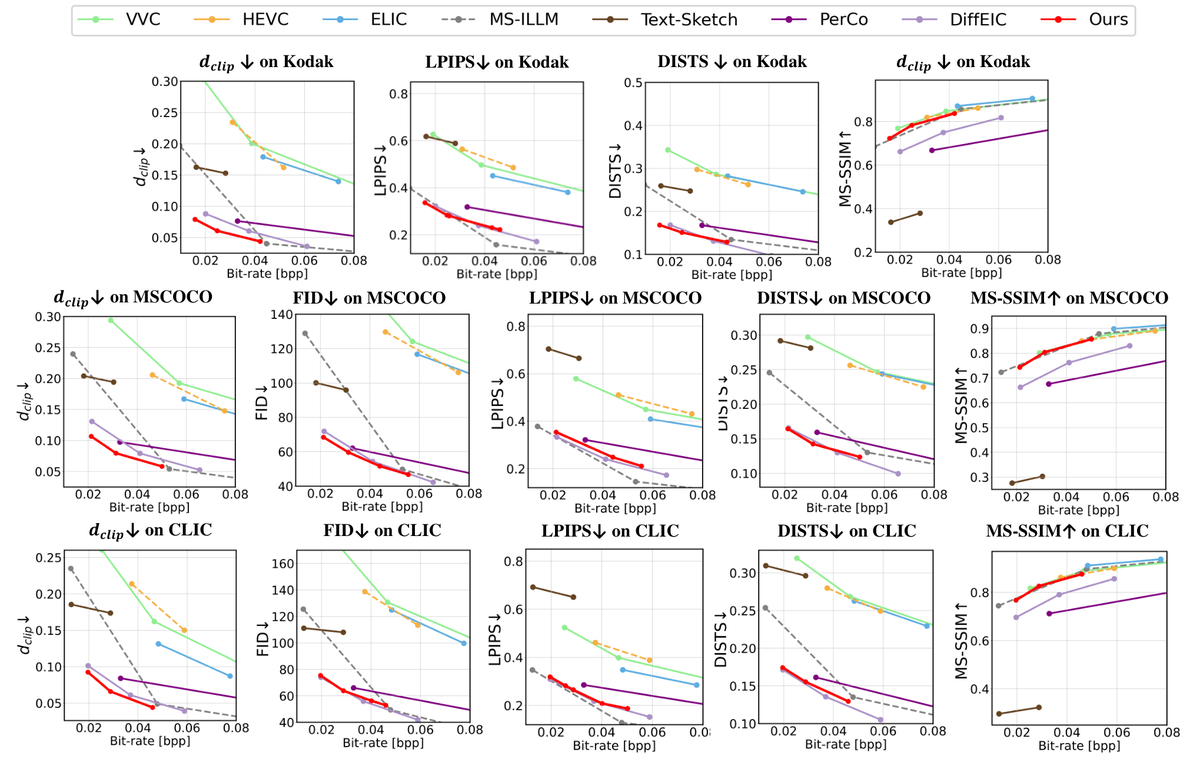
- Achieves 93% FID-BPP BD-rate reduction over VVC and 31% over MS-ILLM on MSCOCO, beating PerCo and DiffEIC.
- Generalizes zero-shot to unseen codecs including HEVC and ELIC, working as a plug-and-play decoder module.
- Trains in 100k steps on one A100 versus N separate models required by prior diffusion-based extreme codecs.
- Decoding takes 3.4 to 7 seconds per image at 20 to 50 diffusion steps; no public code released yet.
Squeezing photos below 0.1 bits per pixel while keeping them visually convincing has become one of the more surprising playgrounds for diffusion models. Every existing diffusion-based codec is essentially locked to one bitrate, so serving multiple bandwidth targets means training and shipping multiple heavy generative models. A new framework called ASSR-EIC tries to end that pattern by folding arbitrary-scale super-resolution directly into the compression pipeline, letting a single diffusion model cover an entire spectrum of ultra-low bitrates.
The paper, Joint Degradation-Aware Arbitrary-Scale Super-Resolution for Variable-Rate Extreme Image Compression, comes out of Shanghai Jiao Tong University and USTC. It targets the ultra-low bitrate regime below 0.1 bpp, which matters for bandwidth-starved settings like drones, aerospace imaging, and underwater exploration.
Why extreme compression keeps breaking
Classical codecs like JPEG, HEVC, and VVC introduce blocky artifacts at low bitrates. Learned codecs trained with pixel-wise losses tend toward blurry, over-smoothed reconstructions because they average out high-frequency detail. Generative approaches, first GANs and now diffusion, sidestep this by hallucinating plausible textures instead of averaging them.