
arXiv Paper Dismantles a Decade-Old Theory Linking Power Laws to Language Hierarchy
A new empirical study finds the widely cited link between power-law correlations and hierarchical syntax in language does not hold up in real parse trees.
 Pro
Takeaways
- Paper empirically tests the popular claim that power-law correlations in language come from hierarchical syntax, and finds it fails.
- Three key assumptions from Lin and Tegmark (2017) are all violated on real parse trees.
- Correlation inside parse trees decays as a power law, not exponentially, breaking the core theorem.
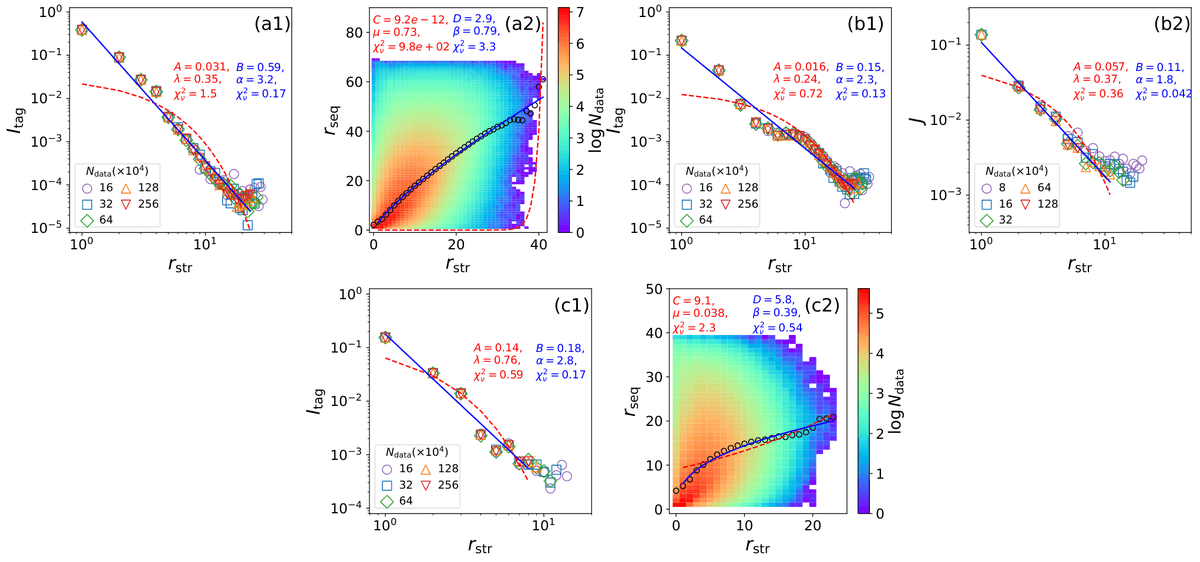
- Sequential distance grows with exponent 0.72, slower than linear, reflecting English right-branching and Japanese left-branching bias.
- Real trees show large context-free independence breaking, so PCFG-generated synthetic data misrepresents natural syntax for LLM theory work.
- Results replicate across BLLIP, WikiText-103, and the Japanese NPCMJ treebank.
For nearly a decade, one of the most cited explanations for why natural language shows long-range statistical correlations has been Henry Lin and Max Tegmark's argument that the power-law decay you see in text is a fingerprint of the hidden tree structures behind sentences. That claim has been extended to child speech, birdsong, and even chimpanzee tool-use sequences as evidence that all of these behaviors must share some kind of underlying hierarchy. A new paper on arXiv, Rethinking the Relationship between the Power Law and Hierarchical Structures, takes the argument apart by actually measuring it on real parse trees, and finds it does not survive contact with the data.
The claim under the microscope
The starting observation is uncontroversial. Previous studies have consistently found that the correlation decays according to a power-law function of the distance between elements in natural language, measured between characters, phones, or words. Power-law decay is much slower than the exponential decay you get from something like a Markov chain, which is why distant words in a text still influence each other.
Lin and Tegmark's 2017 explanation ties this to probabilistic context-free grammars (PCFGs). They proved that in PCFGs, the correlation decays exponentially in sufficiently large structures, and they assumed that the sequential distance grows exponentially with the structural distance. Combine an exponentially decaying correlation in the tree with an exponentially growing distance in the sentence, and you get a power law at the surface. Elegant, but resting on assumptions nobody had empirically checked.
Three questions, three empirical tests
The authors formalize the argument as three testable claims about syntactic trees:
- Does correlation between nodes decay exponentially with structural (in-tree) distance?
- Does sequential distance grow exponentially with structural distance, as it would in a balanced tree?
- Do real parse trees actually behave statistically like PCFGs?
To answer these, they run analyses on three treebanks: the Brown Laboratory for Linguistic Information Processing corpus (BLLIP), which contains approximately 30 million words and one million sentences, WikiText-103 parsed with the Berkeley Neural Parser, and the Japanese-language NPCMJ treebank. Japanese matters here because it is head-final and left-branching, so if a result holds across both English and Japanese it is not a quirk of one language family.
Correlation is measured with mutual information (MI) between tags, using the Grassberger estimator to control finite-sample bias, cross-checked against six other estimators. To probe the third question, they use a metric called context-free independence breaking (CFIB): the mutual information between the children of two nodes once you fix the categories of those nodes. Under a true PCFG this must be zero, since children of different nodes are conditionally independent given their parents. Any positive value means the grammar has memory a PCFG cannot capture.
All three assumptions fail
The verdicts are uniformly negative. On question one, model fitting reveals that the correlation decays according to a power law rather than an exponential form with respect to the structural distance. Reduced chi-square values favor the power-law fit by an order of magnitude. So the correlation is not exponential inside the tree either, meaning the tree is not doing the hidden work Lin and Tegmark assumed.
On question two, sequential distance does not grow exponentially with structural distance. The fitting reveals that the growth follows a power law rather than an exponential form. Notably, the exponent is 0.72, smaller than 1, indicating that the growth is slower than linear. That reflects the well-known right-branching bias of English syntax, which produces long, lopsided trees rather than the balanced ones the theory needs.
On question three, the CFIB is clearly non-zero and, unusually, itself decays as a power law with structural distance. In other words, real parse trees carry long-range dependencies between distant subtrees that a PCFG cannot express, even in principle. All three effects reproduce on WikiText and on NPCMJ, so the finding is not an artifact of one corpus, one parser, or one language typology.
Why this matters for LLM research
There is a practical consequence beyond linguistics. Several recent theory papers on large language models train transformers on synthetic PCFG-generated data to reason about how models acquire structure, including Allen-Zhu and Li's Physics of Language Models series and Cagnetta and Wyart's work on how the structure of language is acquired by deep neural networks. The authors point out that the statistical fingerprint of PCFG-generated trees differs sharply from real parse trees, most dramatically on the CFIB metric where PCFG values collapse toward zero while natural-language values stay firmly positive. If your synthetic curriculum is a PCFG, whatever your model learns about it is not the same object as natural syntax.
There is also a knock-on effect for the wider power-law-implies-hierarchy narrative. The authors show that PCFG-generated trees, at the sizes typical of single sentences, do not reach the asymptotic regime the theorem requires. That undermines the extension of the argument to child speech and animal behavior, where sequence lengths are typically comparable to those in the PCFG studied here, making it difficult to interpret the power-law decay of correlation as evidence for hierarchical structures.
What is left standing, and what to try next
The power-law correlation itself is not in doubt. What the paper removes is a specific mechanistic story for where it comes from. Two alternatives are floated:
- Discourse-level hierarchy, where the tree is not the parse of one sentence but the organization of paragraphs, sections, and chapters across a whole text. The Lin-Tegmark argument might still apply there, but existing discourse-annotated corpora are too small to test it.
- Critical phenomena from statistical physics, where power laws arise from systems tuned near a phase transition rather than from any hierarchy at all. The authors point to prior work showing that LLMs exhibit critical behavior as the sampling temperature varies.
The paper does not release a code repository, but the methodology is straightforward to reproduce: standard treebanks, the NLTK binarization pipeline, the Grassberger MI estimator from the entropy-estimation library, and the lmfit package for the power-law versus exponential comparison. If you work on structured probing, synthetic pretraining data, or theoretical analyses of transformers, the takeaway is concrete: real syntax has statistical properties that PCFGs demonstrably lack, and any story that treats them as interchangeable is missing something important.