
Arizona State's Swarm Algorithm Keeps 50 Robots Connected in One Round
A new paper proposes a leader-based topology control scheme that keeps robot swarms connected even under communication delays and unknown disturbances.
 Pro
Takeaways
- New paper by Kunal Garg and Xi Yu on hybrid topology control for multi-robot systems.
- Leader-based algorithm reconfigures the communication graph in one round of message passing.
- Decision time scales with graph diameter, not the number of robots, unlike consensus methods.
- Handles unknown dynamical disturbances and communication delays via uncertainty-aware position estimation.
- The central node deletes redundant edges while keeping graph diameter under a chosen threshold.
- Validated in simulation; no public code released with the preprint.
Keeping a swarm of robots talking to each other is harder than it sounds. Every extra communication link constrains where the robots can move, and every dropped link can break the team's ability to coordinate. A new paper from Kunal Garg (Arizona State University) and Xi Yu tackles this trade-off with a leader-based algorithm that reconfigures the communication graph in real time, even when messages arrive late and the robots themselves are being pushed around by forces they cannot measure.
The core claim is that connectivity maintenance can be done in time proportional to the graph's diameter rather than the number of robots, using just one round of information exchange across the network. That is a meaningful shift from the consensus-style methods that dominate the field.
Why swarm connectivity is a moving target
In multi-robot systems, agents need to stay within communication range to share sensor data, coordinate motion, or execute a team objective. Maintaining the connections imposes costs in terms of restricted robot mobility, resulting in suboptimal team performance. Every edge in the communication graph is a leash. Too many edges and the robots cannot spread out to do their jobs; too few and the team fractures.
The standard approach uses consensus algorithms, where each robot repeatedly gossips with its neighbors until the group agrees on a graph reconfiguration. Decision-making time scales with the number of nodes and requires multiple rounds of communication, making them ineffective under communication delays. If your messages are late, consensus stalls, and the robots make decisions based on stale positions.
A central node that thinks for the group
Garg and Yu replace the peer-to-peer gossip with a designated leader. The novel leader-based decision-making algorithm uses a central node for efficient real-time reconfiguration, reducing decision-making time to depend on the graph diameter rather than the number of nodes and requiring only one round of information transfer through the network.

Concretely, the procedure works in three phases:
- Each robot sends its estimated position to the central node in a single upstream pass.
- The leader decides which edges to delete (to free up mobility) and which new edges are permitted (to preserve reachability), aiming to keep the graph diameter below a chosen threshold.
- The decisions propagate back to the robots in one downstream pass.
Because the whole loop is bounded by the graph diameter, the algorithm scales gracefully as the team grows. A 50-robot line topology no longer requires 50 rounds of consensus.
Position estimates that admit their own uncertainty
The trickier problem is that by the time the leader receives a robot's position, that robot has already moved, and possibly been shoved off course by wind, currents, or unmodeled dynamics. The authors build a position estimator that treats each robot's true location as living inside a bounded region of uncertainty that grows with the delay and the disturbance magnitude.
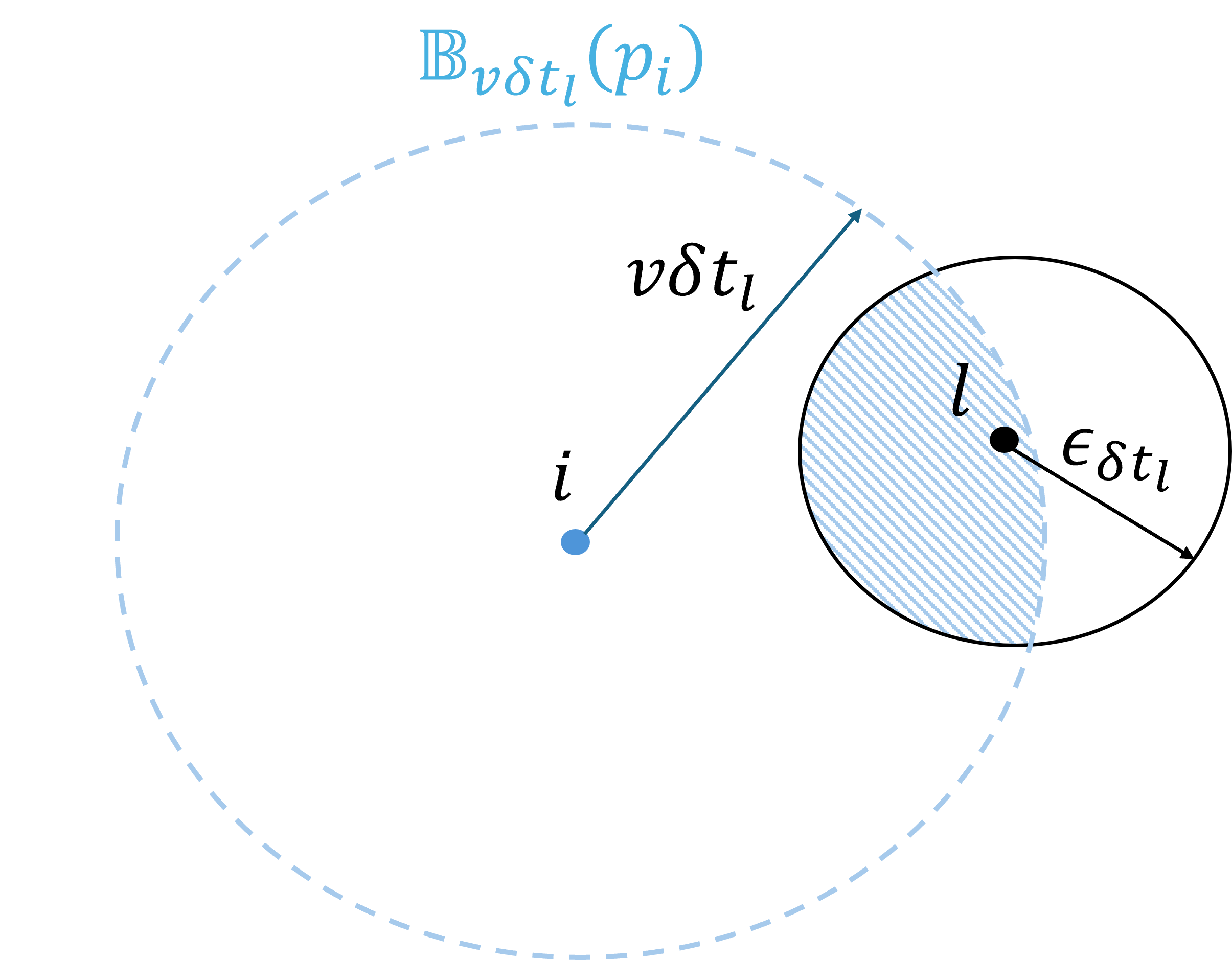
Edge decisions are then made against the worst case within those uncertainty balls: an edge is only added if it remains feasible for every possible true position, and only deleted if the resulting graph is guaranteed to stay connected. This is what makes the method robust rather than merely fast.
What the simulations show
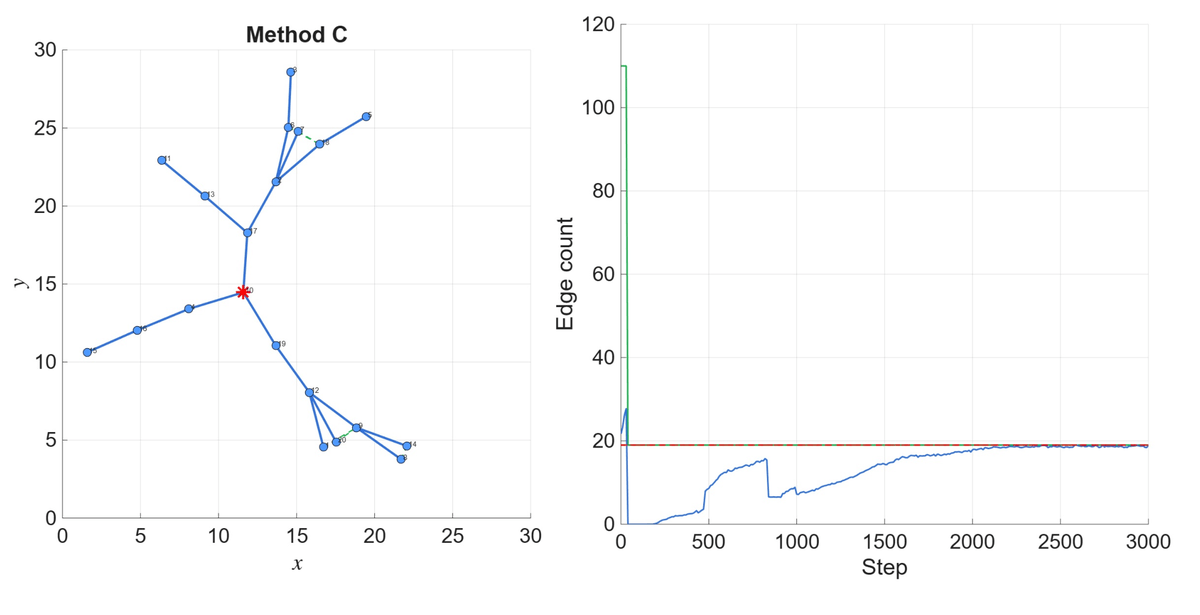
The paper reports simulation studies across several methods (labeled A through D in the figures), tracking three quantities over thousands of steps: total edges E, required edges Er, and slack edges Es. The trends show the algorithm quickly pruning redundant connections and then holding a stable, low-edge topology while the diameter constraint is respected.

Where this fits and where it does not
The approach is a good match for teams operating under realistic wireless conditions: aerial swarms with WiFi mesh links, underwater vehicles with acoustic communication (where delays are measured in seconds), or ground robots in cluttered RF environments. It is less suited to fully leaderless deployments where designating a central node is a single point of failure, or to scenarios where the graph diameter itself is huge and the one-round guarantee becomes weak.
A few practical caveats worth flagging:
- No public code or dataset is referenced in the paper, so reproduction requires reimplementation from the described algorithm.
- The method assumes bounded disturbances with known bounds. Unbounded or heavy-tailed noise breaks the worst-case guarantees.
- Leader election and failover are not the focus of this work, and would need to be layered on for a deployable system.
The broader significance is that connectivity maintenance in multi-robot systems has largely been treated as a consensus problem, inheriting all of consensus's weaknesses under delay. Reframing it as a centralized decision with distributed execution, and pairing that with an uncertainty-aware position estimator, gives a cleaner separation of concerns that other safe autonomy research in the same group has been building toward.