
Arizona State's Sim2Act Fixes the Hidden Flaw Killing Supply Chain AI
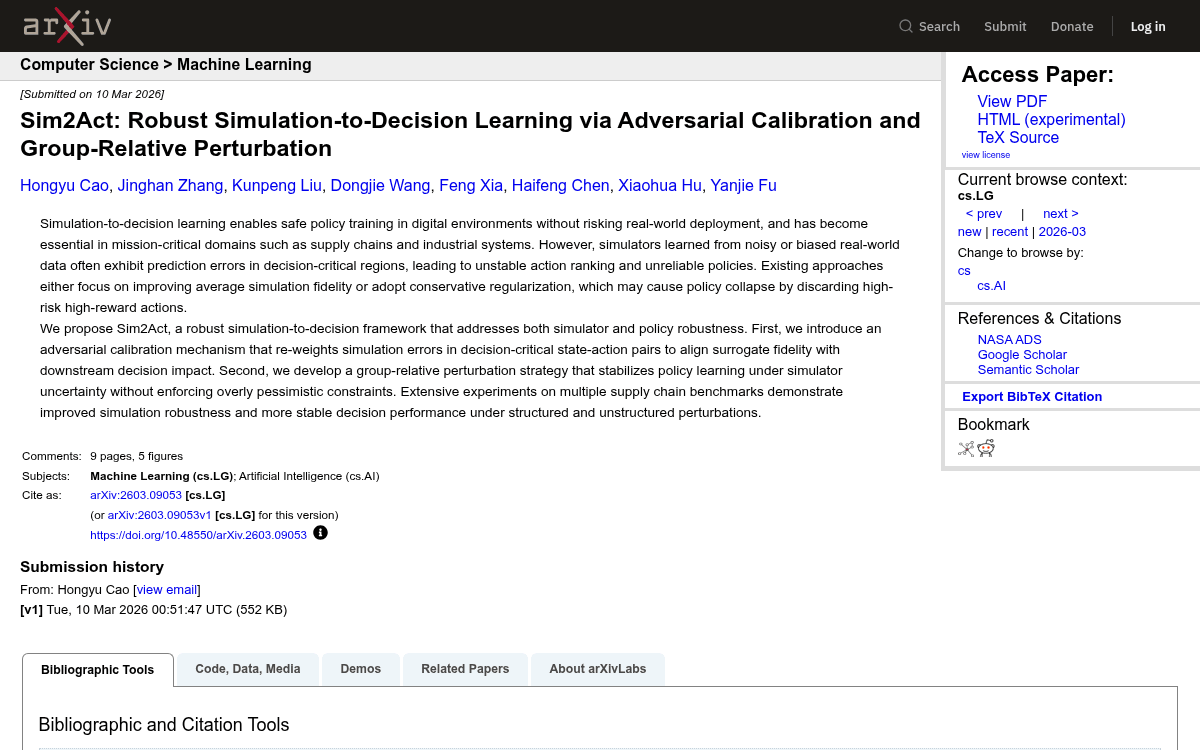
Sim2Act fixes a critical blind spot in simulation-based decision learning: simulators that look accurate on average but fail exactly when it matters most for high-stakes choices.
 Pro
Takeaways
- Core problem: Simulators trained on noisy data look accurate on average but fail in decision-critical regions, causing policies to pick wrong actions.
- Sim2Act solution: A two-stage framework combining adversarial simulator calibration and group-relative policy perturbation to fix both the simulator and the policy.
- Adversarial calibration: A minimax game between a simulator and a lightweight calibrator that re-weights training loss toward state-action pairs that most affect action rankings.
- Group-relative perturbation: Borrowed from GRPO (used in DeepSeek), it trains the policy to rank actions relative to a group of perturbed states, avoiding over-conservative "policy collapse".
- Results: On DataCo, Sim2Act degrades by only 0.001 under perturbation vs. a 0.069 drop for the prior SOTA (S2D); CVaR@5% holds at 0.61 vs. S2D's drop to 0.53.
- No code released yet; tested on three supply chain benchmarks (paper link); no physics-based or continuous-control environments evaluated.
Training a decision-making policy inside a simulator is a well-established strategy for high-stakes domains where real-world mistakes are expensive. You build a digital twin of your environment, let an agent explore freely, and only deploy the resulting policy once it has proven itself. This simulation-to-decision paradigm first develops a surrogate simulator of the environment, then learns optimized policies by interacting with the simulator. It is now a cornerstone of supply chain management, industrial control, and logistics planning.
But there is a subtle and dangerous flaw baked into how these simulators are typically trained. While a simulator might look accurate on average in terms of reward prediction, it can exhibit significant biases on rewards over actions: predicted rewards of common actions with large training data are accurate, yet predicted rewards of rare, risky actions are less accurate. The consequence is not just a small performance hit. Because policies choose actions by comparing predicted rewards of one action against another, small reward prediction errors on some actions can flip the ranking orders of all actions, leading to unstable or unsafe decisions.
The two failure modes nobody was fixing together
Researchers from Arizona State University, Clemson University, and NEC Laboratories America identified that existing methods attack this problem from only one side at a time, and both sides have critical weaknesses.
- Simulator side: Most methods minimize global prediction error (e.g., MSE across all samples). In certain state-action pairs, which the authors call decision-critical regions, small simulation errors can fully distort action ranking orders and significantly reduce policy performance. A tiny 1% error in reward prediction in one of these regions can result in far more than a 1% error in the actual decision path.
- Policy side: Existing model-based and offline reinforcement learning methods typically rely on adversarial perturbations or conservative regularization schemes to improve robustness. However, this often results in "policy collapse", where the model becomes too afraid of potential errors that it abandons not just high-risk low-reward, but also high-risk high-reward opportunities entirely.
The team's paper introduces Sim2Act, a two-stage framework that addresses both problems simultaneously without sacrificing performance for safety or vice versa.
How it works: two interlocking mechanisms

Step 1: Adversarial Simulator Calibration. The simulator is an LSTM-based encoder-decoder that maps a state-action pair to a predicted next state and reward. Alongside it sits a lightweight calibrator , a softmax-weighted function that assigns importance scores to each state-action pair. The calibrator modulates simulator training by assigning higher weights to state-action pairs whose prediction errors are more consequential for action ranking, thereby enabling action-aligned calibration in decision-critical regions.
The two components are trained as adversaries in a minimax game. In the max part, the calibrator scans the data to find where the simulator is most wrong about action outcomes, then shines a spotlight on those errors by giving them the highest weights; in the min part, the simulator then tries to minimize the errors that the calibrator has highlighted. They alternate: freeze the calibrator, update the simulator; freeze the simulator, update the calibrator , until validation error stabilizes.
Step 2: Group-Relative Perturbation. Once the simulator is calibrated, the policy is trained with a novel robustification strategy borrowed conceptually from GRPO (Group Relative Policy Optimization), the same technique used in DeepSeek's math reasoning models. Rather than reacting to a single noisy perturbed state, the policy is trained to compare actions across a local group of perturbations, which stabilizes relative action preferences, reduces overreaction, and keeps the policy robust without becoming overly conservative.
Concretely, for each state, the simulator samples M perturbed versions from a Gaussian distribution parameterized by the simulator's own learned covariance matrix. The policy acts on all M perturbed states, and each action is scored not by its absolute reward, but by its reward relative to the group mean. Actions that consistently outperform the local average get reinforced; those that fall below get suppressed. A second utility-gap term simultaneously pushes the policy toward a target reference reward, ensuring it stays ambitious and does not collapse into timidity.
Benchmarks and what the numbers say
Experiments were conducted on three open-source supply chain datasets: DataCo (43 features, 165,445 items), GlobalStore (27 features, 51,290 items), and OAS (22 features, 28,136 items), covering diverse logistics and shipping scenarios with order-level records including products, shipment modes, and delivery outcomes. Baselines included Markov-chain simulators, multi-task prediction models, DQN, PPO, GPT-3.5 zero-shot, RARL, EPOpt, and the prior state-of-the-art Sim2Dec (S2D).
The results tell a clear story on robustness:
- On DataCo, Sim2Act shows almost no degradation (1.1232 → 1.1222) under perturbation, while S2D drops notably (1.1034 → 1.0342).
- While S2D shows competitive nominal performance, it becomes brittle under perturbation, suffering a 20.9% CVaR drop on DataCo (0.67 → 0.53). In contrast, Sim2Act maintains a high CVaR of 0.61.
- Sim2Act achieves consistently higher worst-case accuracy across all datasets, e.g., 0.679 on DataCo compared to 0.225 for the Markov baseline.
- On GlobalStore, Sim2Act boosts profit from 0.9278 to 0.9460 while maintaining timeliness, and on OAS the overall decision score rises from 0.6493 to 0.6717.
The ablation study confirms both components pull their weight independently. Adding only simulator calibration (+SimCal) reduces the profit drop rate on DataCo from 6.9% to 4.8%, while adding only decision perturbation (+DecPert) reduces the timely-delivery drop on OAS from 0.37% to 0.22%. The combined setup yields the most consistent results.
The real insight: accuracy is the wrong target
The deeper contribution here is a reframing of what it means for a simulator to be "good." Correcting high-impact state-action prediction errors is more effective than minimizing average reward loss, and group-relative perturbation can robustify policies without downgrading decision reward. This matters because the entire field of digital-twin-based decision making has been optimizing the wrong metric.
Digital-twin-based supply chain management increasingly relies on simulation models integrated with optimization and predictive analytics to evaluate disruption scenarios and support real-time decision-making. As these systems get deployed in production, the gap between average simulator accuracy and decision-critical accuracy becomes a real operational liability , a miscalculated shipping mode, a wrong inventory replenishment decision, or a missed delivery window.
The group-relative perturbation mechanism also has an interesting lineage. The Group-Relative Proximal Optimization (GRPO) approach has demonstrated remarkable success in large language models and reasoning by evaluating outputs relative to a group mean rather than a fixed baseline, thus reducing variance and enhancing generalization. Sim2Act adapts this concept from LLM training to the very different problem of robust policy learning under simulator uncertainty , a creative transfer that suggests the technique may have broader applicability.
Limitations and what's next
The framework has some practical constraints worth noting. The experiments are limited to supply chain datasets with discrete action spaces, and the LSTM-based simulator architecture may not generalize directly to continuous-control or physics-based environments without re-engineering. The adversarial calibration also adds training complexity , two models must be co-trained in alternating optimization, which increases compute and tuning overhead compared to a standard simulator. No code repository is currently available with the paper.
The authors point to physics-knowledge-guided simulation as the next frontier , incorporating domain equations directly into the surrogate model to further close the gap between digital twin and reality. The framework enables more reliable digital twin deployment in real-world mission-critical domains such as transportation and supply chains without risking expensive infrastructures. For teams already running simulation-based decision pipelines, the adversarial calibration idea alone is worth examining: if your simulator looks good on held-out test sets but your deployed policy underperforms, decision-critical regions may be the culprit.