
Arizona State Reframes LLM Routing as a Math Problem With 100% Precision
A new paper reframes LLM routing as a weighted MaxSAT problem, showing natural language feedback acts as logical constraints over model attributes.
 Pro
Takeaways
- Arizona State researchers reframe LLM routing as weighted MaxSAT, with language feedback injecting hard and soft clauses.
- On a 25-endpoint OpenAI benchmark, language feedback yields 100% precision with 80-93% coverage of valid models.
- Under no-feedback, the router violates neutrality in about 50% of runs, returning a structured shortlist.
- A sparse logistic model with 6 active clauses predicts no-feedback selections at AUC 0.8839, p=0.005.
- Implicit priors favor reasoning-enabled, large max-output, long-context, and cached-input models.
- Router used is Grok 4.1 Fast; no code or model artifacts released with the preprint.
Picking the right LLM for a given query has quietly become one of the messier problems in production AI. You have dozens of endpoints with different price points, context windows, reasoning modes, and latency profiles, and users who describe what they want in vague natural language like I want a cheaper model. A new paper from Arizona State University argues that this whole mess is best understood as a classic problem from computer science: weighted maximum satisfiability.
Routing is a constraint problem in disguise
Most existing routers treat model selection as a learned policy that trades accuracy against cost. FrugalGPT learns a cascading strategy for a two-model scenario, routing strong models only when needed, Hybrid LLM utilizes the predicted difficulty of a query, and other approaches are trained from preference data. These work, but they mostly output a single endpoint and struggle with two things production systems actually need: composable natural language preferences and many candidate models.
The authors point out that real deployments face partial observability, where endpoints have latent properties such as robustness to long-context errors, instruction adherence, and reasoning reliability that are not fully specified a priori. Routing then stops being a lookup and becomes a reasoning problem where the controller has to interpret user intent under uncertainty.
The MaxSAT reframe
The core idea is elegant. Treat every natural language direction from the user as a set of logical clauses over model attributes, then pick the endpoints that satisfy as many of those clauses as possible. The paper splits them into two kinds:
- Hard clauses encode requirements the router cannot violate, coming from precise language like
cheaper cached input. - Soft clauses encode preferences with fuzzy scope, coming from vague language like
a cheaper model, each with a weight expressing how strongly the direction pushes on that preference.
Crucially, hardness is induced by language semantics such as certainty or negotiability, and weights are injected per query by the direction key. That is a departure from the usual pattern of hardcoding hard resource caps and soft cost objectives. Here, whether a constraint is negotiable depends on how the user phrased it.
Formally, the router picks decision variables x_m for each model, and maximizes a weighted sum of satisfied soft literals minus a penalty for oversized recommendation sets, subject to hard constraints. In practice the authors do not run a MaxSMT solver; they treat an LLM router as a black box and check whether its behavior is consistent with this abstraction.
What the 25-model benchmark reveals
The experimental setup uses an LLM router over OpenAI models with 25 endpoints and 34 objective attributes, with model names removed when feeding the model zoo to the agent to prevent possible external knowledge leakage. The router itself is Grok 4.1 Fast, a model with moderate capabilities in instruction following but fair long context reasoning, achieving 52.7% and 68.0% respectively on Artificial Analysis benchmarks.
Direction keys were split into three regimes:
- LF-PD (precise): things like
I want a model with cheaper cached input. - LF-GD (general): things like
I want a cheaper model. - NF (no feedback):
NONEor empty direction.
With language feedback, the router hit 100 percent precision on both precise and general directions. But it did not include every valid model. Even when asked to follow a specific direction, the agent still ignores some models, with coverage of 93.1% for LF-PD and 80.0% for LF-GD, suggesting that under uncertainty the agent tries to offer a smaller set for robustness. That is a subtle but important finding: routers voluntarily shrink shortlists when they are not sure, even when the constraint would allow more matches.
The no-feedback surprise
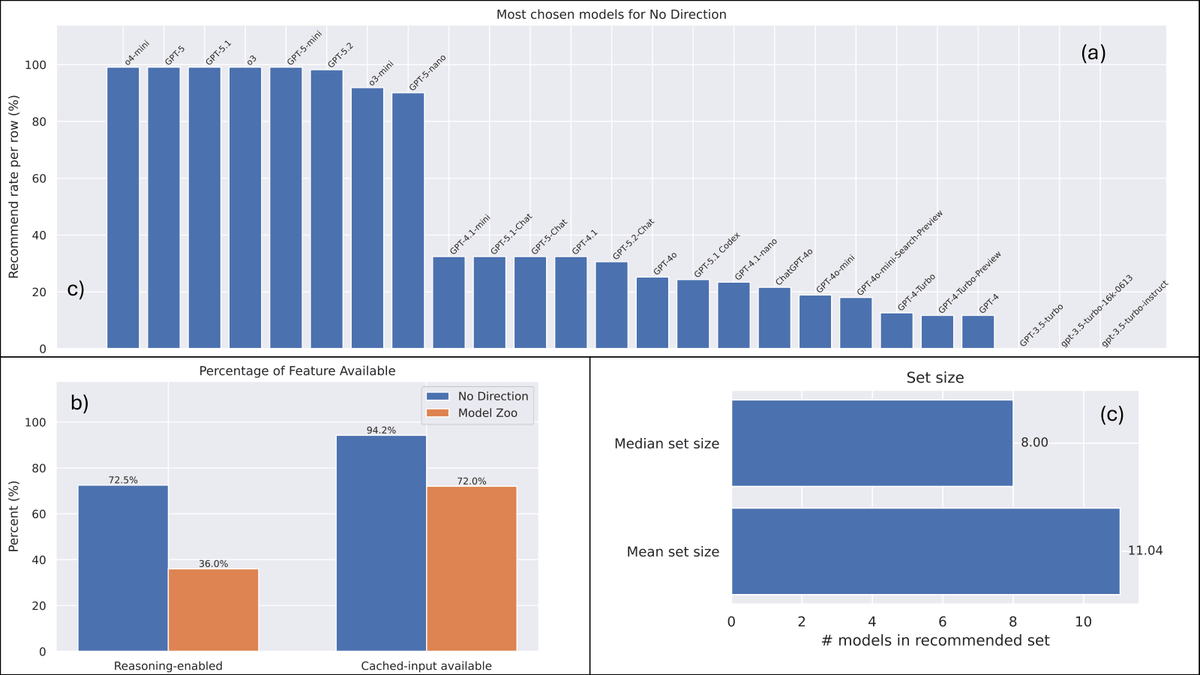
The more interesting result is what happens when the user says nothing. Under the MaxSAT view, an empty direction should produce either the empty set or the full model zoo, since there are no clauses to satisfy. Instead, in around 50% of no-feedback cases the router returns a structured subset rather than all or nothing.
And that subset is not random. Eight endpoints show clearly superior recommendation rates: o4-mini, GPT 5, GPT 5.1, o3, GPT 5 mini, GPT 5.2, o3-mini, and GPT 5 nano. This set contains the only model with the maximum intelligence score o3, the set of intelligence 4 models with lowest price, one endpoint each at intelligence 3 and 2 with the lowest cost in their tier, and all of them support cached input.
In other words, the router silently applies a default preference for robust, capable, cost-efficient models even when the user gives it no reason to.
Reverse-engineering the implicit priors
To test whether this behavior is really structured, the authors fit a sparse logistic regression on 111 no-feedback runs using 19 interpretable boolean predicates over model metadata, things like reasoning_enabled, cheap_output_global_q0.25, and ctx_ge_p75.
The results are striking. The sparse model achieves pair-level AUC of 0.8839 against a chance baseline of 0.5, Spearman correlation of 0.8810 between predicted probabilities and empirical selection rates, and top-8 recovery of 8 out of 8. A permutation test that preserves set sizes confirms significance with observed AUC of 0.8839 versus null mean of 0.5031 at p=0.005.
Only 6 out of 19 predicates get nonzero weight. The heaviest contributors are large max output, reasoning enabled, long context, and the conjunction of cached input with reasoning. That is a compact, human-readable explanation of what the router silently prefers when nobody tells it what to do.
What the breakthrough actually is
The headline is that routing can be viewed as MaxSAT. The deeper contribution is showing that a black-box LLM router carries a stable, learnable implicit weight vector even in the absence of any input, and that this bias can be recovered with a handful of interpretable predicates. This gives you a diagnostic tool: if you suspect your router is quietly favoring certain endpoints, you can now test that hypothesis with a sparse logistic fit over a predicate library, and you can name the clauses it is secretly optimizing.
For anyone building a multi-model orchestration layer, this reframing is useful in a few concrete ways:
- Auditability: you can express routing policies as clauses and check whether outputs satisfy them, rather than trusting an opaque score.
- Debugging non-neutrality: when a router produces a structured shortlist without any user preference, you now have a method to identify which implicit preferences are driving it.
- Composing natural language and hard limits: user phrasing determines whether a constraint is hard or soft, so
must be cheaper than the current modelandideally cheaperget handled differently by the same mechanism.
Caveats worth knowing
This is a small, exploratory study. The benchmark covers 25 OpenAI endpoints scored against a single router agent, and the authors do not actually run a MaxSMT solver, they interpret an LLM's outputs through the MaxSMT lens. The empirical claims about implicit priors are specific to Grok 4.1 Fast as the router; a different backbone would likely have different default clause weights. The paper itself frames this as a starting point, calling for experimenting on a larger range of agents and prompts and developing mitigation methods.
There is no code release attached to the preprint, and no fine-tuned model artifact. What you get is the abstraction, the clause library, and enough methodological detail to reproduce the implicit-prior analysis on your own routing stack.
Why this matters for production routing
If you are running any kind of model cascade or multi-endpoint gateway, the practical takeaway is that your router probably has opinions it is not telling you about. It might silently over-select the newest reasoning models, or quietly avoid endpoints without cached input pricing, even when the user has expressed no preference. The MaxSAT framing gives you a way to make those opinions explicit, weight them deliberately, and audit whether your routing decisions match your stated policy. That is a step toward routing systems that are not just cost-efficient but explainable.