
Argonne's PreLoRA Cuts Vision Transformer Training Time by 3x Without Losing Accuracy
PreLoRA starts pretraining with full parameters, then flips to LoRA once weights stabilize, cutting trainable params to 10% with no accuracy loss.
 Pro
Takeaways
- PreLoRA switches ViT pretraining from full parameters to LoRA once weight updates stabilize, preserving accuracy.
- Achieves 3x throughput, 1.5x faster epochs, 20% less GPU memory, and cuts trainable params to 10%.
- A partial convergence test uses weight-norm and loss thresholds to decide when to switch modes.
- Dynamic rank assignment gives each layer a rank between 8 and 64 based on its convergence.
- A joint warmup phase lets randomly initialized LoRA modules learn from the still-active full model.
- Code available at anonymous.4open.science/r/PreLoRA-D624; paper on arXiv.
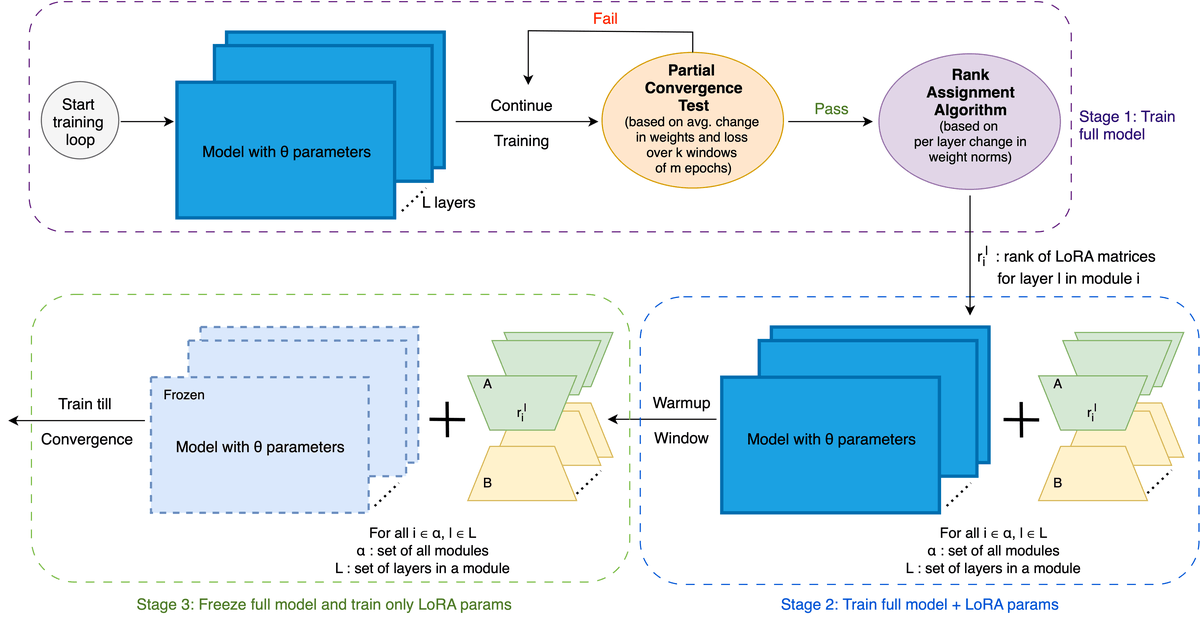
Pretraining a Vision Transformer from scratch is brutally expensive, and a new paper from Argonne National Laboratory and Washington State University argues that most of that cost is wasted on late-stage epochs where the weights barely move. Their fix, PreLoRA, watches the training loop for signs of partial convergence and then flips the model from full-parameter training to a Low-Rank Adaptation regime, keeping the accuracy while slashing compute.
The trick pushes trainable parameters down to 10% of the original, boosts throughput by 3x, cuts average epoch time by 1.5x, and reduces GPU memory usage by 20% on ViT-Large. Code is available on an anonymized repository, implemented in PyTorch with HuggingFace PEFT.
Why late-stage training is mostly refinement
During the initial training epochs, the model undergoes substantial weight updates, which gradually stabilize as training progresses. The authors plotted weight norms for a full ViT-Large pretrain on ImageNet-1k and found that after roughly epoch 150 the norms flatten out, even though the cross-entropy loss keeps dropping. That gap between big weight change and continued loss improvement is the crux: the network is still learning, but the updates it needs are small and structured, which is exactly the regime where LoRA decomposes weight updates into low-rank matrices works well.
LoRA is normally a fine-tuning tool applied on top of an already-trained model. Prior work like ReLoRA tried to bring it into pretraining, but ReLoRA applies a fixed and pre-determined uniform rank across all layers and modules throughout the whole pretraining run, ignoring the fact that different layers converge at different rates.
How the switch is decided
PreLoRA introduces a partial convergence test that runs at the module level over sliding windows of epochs. For each target module (query, key, value, dense, output projections), it tracks two things across k windows of m epochs:
- Percent change in weight norms between consecutive windows, thresholded at
τ - Percent change in training loss between consecutive windows, thresholded at
ζ
If both stay below their thresholds across every window and every module, the test passes and PreLoRA transitions to LoRA training. Tightening τ and ζ or increasing window count makes the criterion stricter, which gives users a direct knob on the accuracy versus speed trade-off.
Ranks assigned per layer, not per model
Once the switch fires, a rank assignment algorithm walks through every layer of every target module and looks at how much that specific layer's weight norm changed in the final window. Layers that have already stabilized get a low rank; layers still moving get a higher one. Concretely, the change values for a module are min-max normalized to [0, 1] and bucketed into powers of two between r_min and r_max (8 to 64 in the experiments). The intuition is simple: more parameters are assigned to layers that still need substantial learning, while avoiding unnecessary parameters for already stable layers.
Warmup keeps LoRA from drifting
Because LoRA modules are randomly initialized, dropping them into a partially trained network can throw the optimizer off track. PreLoRA runs the full model and the freshly initialized LoRA modules jointly for w warmup epochs before freezing the base weights. Ablations found w=10 to be the sweet spot; short warmup windows may insufficiently guide LoRA adaptation, whereas longer warmup periods shift most updates to the base model, limiting LoRA learning.
What the numbers look like
Experiments used ViT-Large (300M parameters) trained from scratch on ImageNet-1k across 64 NVIDIA A100 GPUs on 16 NVLink-connected nodes. Three convergence settings were tested, from relaxed to strict:
| Setting | τ / ζ | Training speedup | Final CE loss |
|---|---|---|---|
| Exp1 (relaxed) | 1.0% / 5.0% | ~40% | ~2.0 |
| Exp2 (medium) | 0.5% / 2.5% | ~34% | ~1.85 |
| Exp3 (strict) | 0.25% / 1.0% | ~28% | ~1.75 |
Interestingly, the relaxed Exp1 attained the highest top-1 validation accuracy despite the worst training loss, suggesting the low-rank constraint acts as a mild regularizer. Over a 300-epoch run, PreLoRA saved roughly 9 hours of wall time.
Stacking with ReLoRA
PreLoRA only kicks in late, so the authors experimented with layering ReLoRA on top to compress the earlier epochs too. Starting with a few full-parameter epochs, they drop rank from 1024 to 256 (300M to 114M parameters), keep periodic merge-and-reinitialize updates until partial convergence, then let PreLoRA's dynamic rank assignment pick layer-specific ranks between 8 and 64. The combined pipeline saves about 122 seconds per epoch, a 42% speed gain, with negligible accuracy impact.
Where it fits and where it does not
PreLoRA is targeted at from-scratch pretraining of large vision models where compute budget is the bottleneck. It is a good candidate when you can tolerate a small drop in training loss for a large drop in wall time, and when you have knobs available to tune convergence strictness for your task. It has only been validated on ViT-Large and ImageNet-1k, so generalization to LLMs, diffusion models, or much larger ViTs is unproven. The method also adds hyperparameters (window count, window size, two thresholds, warmup length, rank bounds) that need tuning, and the convergence test itself adds per-epoch bookkeeping overhead that becomes relatively larger on smaller models.
The real contribution here is not the LoRA trick itself but the observation that pretraining has a natural phase boundary where the intrinsic rank of the useful updates collapses, and that this boundary can be detected online with a cheap test. That reframes LoRA from a fine-tuning shortcut into a general tool for the tail end of any long training run.