
AReW Fixes the Hidden RL Trap That Makes AI Agents Stop Asking Questions
Researchers identify why RL-trained LLM agents stop asking useful questions, and propose a lightweight fix that yields up to 60-point gains.
 Pro
Takeaways
- Outcome-only RL can trap LLM agents in a low-information regime where they stop asking useful questions and ignore returned evidence.
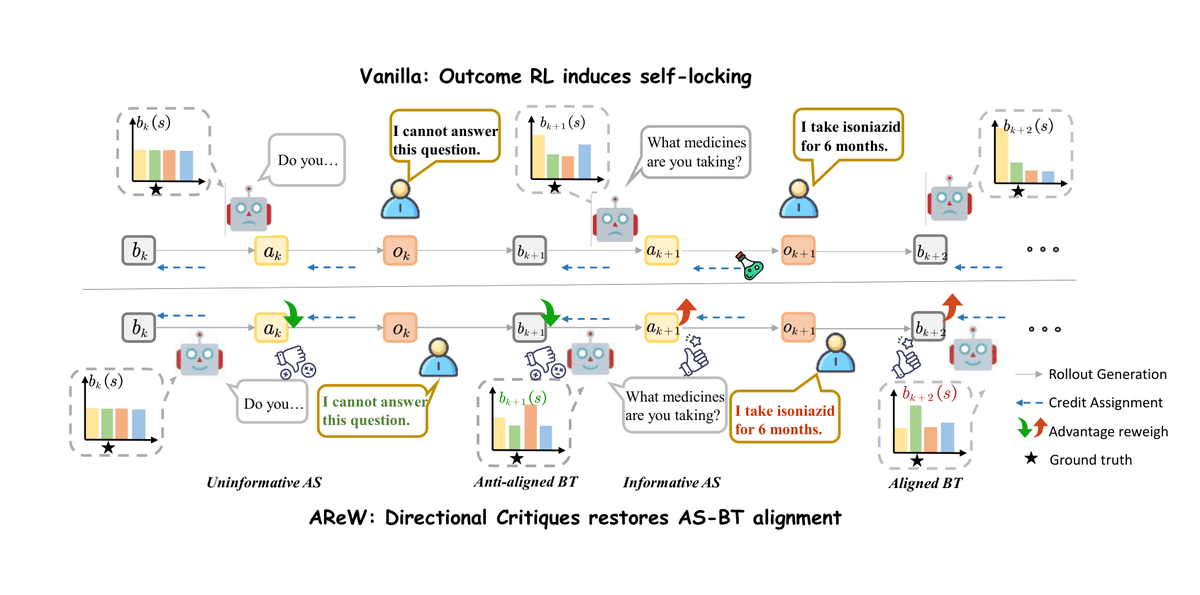
- The paper decomposes agent behavior into Action Selection and Belief Tracking, and proves both stall when weakly initialized.
- AReW reweights per-step advantages using cheap directional critiques while keeping the original sparse outcome reward untouched.
- Reported gains reach 60 points on preference estimation and a 2.5x reward increase on the tau-squared customer-service benchmark.
- AReW improves 27 of 28 settings across PPO, GRPO, and GSPO, and tolerates critique flip rates up to 0.5.
- Code and prompts are available at github.com/unimpor/T3 for Qwen2.5-7B and Llama-3.1-8B experiments.
Reinforcement learning has become the standard recipe for turning LLMs into agents that reason across long horizons. But when the task requires the agent to actively pull in missing information, something strange happens: the agent stops asking informative questions and starts ignoring the answers it gets. A new paper from researchers at CUHK, Georgia Tech, and ByteDance calls this failure mode information self-locking, and offers both a theory of why it happens and a simple fix that adds only a few lines to a standard policy-gradient update.
The work targets what the authors call agentic active reasoning: settings like deep research, customer service, or medical triage, where the model does not receive all the facts up front and must interact with an environment to make progress. Code is available on GitHub.
When outcome rewards quietly break interaction
The setup is a familiar one. An agent trained with outcome-based RL only sees a reward at the end of an episode, so it has to figure out on its own which intermediate actions actually helped. In single-turn math or coding, this works well. In multi-turn interactive tasks, the authors show it can silently collapse.
Rather than learning to acquire and use more task-relevant information, agents can drift into low-information interaction patterns: they take actions that reveal little useful evidence, and even when useful observations are returned, they do not reliably incorporate them into subsequent reasoning. Reward numbers may still creep up, but through shortcuts that bypass interaction entirely.
To make this concrete, the paper decomposes agent behavior into two coupled processes:
- Action Selection (AS): what query, tool call, or clarification the agent chooses, which determines what evidence it will see next.
- Belief Tracking (BT): how the agent updates its internal understanding of the task once new evidence arrives.
The trouble is that these two capabilities depend on each other. An informative question is only rewarded if the model actually uses the answer, and belief updates only improve if the questions supply useful evidence to update on. When both are weak at initialization, outcome rewards cannot tell them apart, and neither improves.
A theory of the trap
The authors formalize this as a two-dimensional low-AS, low-BT region of parameter space they call the self-locking regime. By decomposing the outcome policy gradient into an AS channel and a BT channel, they prove that inside this region the expected upward drift of each capability scales linearly with the current level of the other capability. In plain terms: weak belief tracking masks the credit signal for informative actions, and weak action selection starves belief tracking of anything to learn from.
Three empirical observations back this up in their testbeds:
- Reward can climb during training while per-turn information gain (AS) plateaus or degrades.
- The correlation between informative actions and reward is strong when a frontier model handles belief updates, but weak when the trained agent updates its own belief.
- After RL training on MediQ, replacing all patient feedback with the string "Unknown" causes a smaller performance drop than before training, evidence that the policy has learned to rely on early context rather than interaction.
AReW: reweighting credit instead of shaping rewards
The fix, called AReW (Advantage Reweighting), leans on a practical observation: even when calibrated intermediate rewards are hard to design, active reasoning environments often expose cheap directional signals. Whether a query elicited new evidence, or whether a confidence readout moved toward the ground truth, can usually be inferred from the trajectory itself.
AReW assigns each step a discrete critique z_t in {-1, 0, +1} for both the AS and BT channels, then folds it into training through an intra-trajectory likelihood-margin objective. The resulting update looks almost identical to a standard actor loss, with one change: the per-step advantage A_t is shifted by a small coefficient u_t derived from the critique.
if z_t == +1:  u_t = +1 / |positives_in_trajectory|
elif z_t == -1: u_t = -1 / |negatives_in_trajectory|
else:           u_t = 0
A_hat_t = A_t + lambda * u_t   # keep original outcome reward
Because the coefficients sum to zero across a trajectory, the auxiliary term reallocates gradient mass from negatively critiqued steps to positively critiqued ones without inflating the total return. The critic target and outcome reward stay untouched, which the authors argue makes the method more robust to noisy critiques than injecting them as intermediate rewards.
A supporting proposition makes the robustness claim precise: AReW improves AS informativeness beyond the vanilla update whenever the weighted accuracy of the critiques exceeds 0.5. In other words, the critiques only need to be better than random, not calibrated.
How well it works
The authors evaluate on nine tasks across four domains: preference estimation (PE-G, PE-F variants), medical diagnosis (MediQ), flowchart-grounded troubleshooting (FloDial), and the tau-squared bench customer-service benchmark. Base models are Qwen2.5-7B-Instruct and Llama-3.1-8B-Instruct.
Highlights from the reported numbers:
- AReW beats vanilla PPO in 27 of 28 evaluated settings, with the AS+BT variant outperforming the AS-only variant in 11 of 14 head-to-head cases.
- On PE-G with three focused dimensions and Qwen2.5-7B, vanilla PPO gets 18.3 on the test set. AReW-AS+BT reaches 80.3, a 62-point gain.
- On the standard dual-control setting of tau-squared bench Telecom with Qwen2.5-14B, AReW raises average reward from 0.20 to 0.50, a 2.5x improvement, while cutting reliance on user-side repair actions.
- The method plugs into PPO, GRPO, and GSPO without algorithmic changes.
Robustness analyses matter here because the critiques are meant to be cheap and imperfect. When the authors randomly flip the sign of each critique with probability up to 0.5, AReW still stays at or above the vanilla baseline. Under structured perturbations, using only AS critiques or only BT critiques still outperforms vanilla, though combining them works best, echoing the theoretical claim that both channels are coupled.
What is actually new
The headline number is the 60-point jump, but the more interesting contribution is the framing. The paper argues that a common class of RL failures on agentic tasks are not exploration bugs or reward hacking, but a structural credit-assignment problem between two entangled capabilities. That reframing suggests why prior workarounds like stronger process reward models or dense reward shaping have been finicky in long-horizon settings.
AReW itself is a minimal intervention: no new critic, no learned discriminator, no calibrated intermediate rewards. The critiques come from signals the environment already exposes, such as whether the user revealed new information or whether a self-reported confidence moved in the right direction. For anyone training an interactive agent and watching reward curves that look fine while the model quietly stops asking useful questions, the diagnosis and the recipe are both worth a look.