
ARC-VLA Beats Simulation Champions With a 3.6B Robot That Learns From Failure
A gearbox assembly contest exposed a brutal sim-to-real gap and revealed why failure-recovery data beats bigger models for industrial manipulation.
 Pro
Takeaways
- RoCo Challenge at AAAI 2026 benchmarked robotic gearbox assembly with 60+ teams from 10+ countries.
- End-to-end VLA models beat modular perception-action pipelines in real-world deployment despite losing in simulation.
- Winning ARC-VLA replaced L2 with L1 loss to eliminate the lazy robot problem near targets.
- Failure-recovery curriculum data proved more decisive than model scale for industrial reliability.
- Runner-up RoboCola used a Specialist plus Generalist dual-model fusion with delta action spaces.
- Full datasets, CAD files, code, and baselines released at rocochallenge.github.io.
A high-precision robotic assembly competition just delivered one of the clearest reality checks the embodied AI field has seen this year. The RoCo Challenge at AAAI 2026 asked teams to build systems that could assemble a planetary gearbox from scratch, and the leaderboard flipped almost completely between simulation and the physical robot. The teams dominating in Isaac Sim collapsed onsite, while Vision-Language-Action (VLA) models that looked mediocre in simulation ended up winning the real-world round.
The task nobody could fake
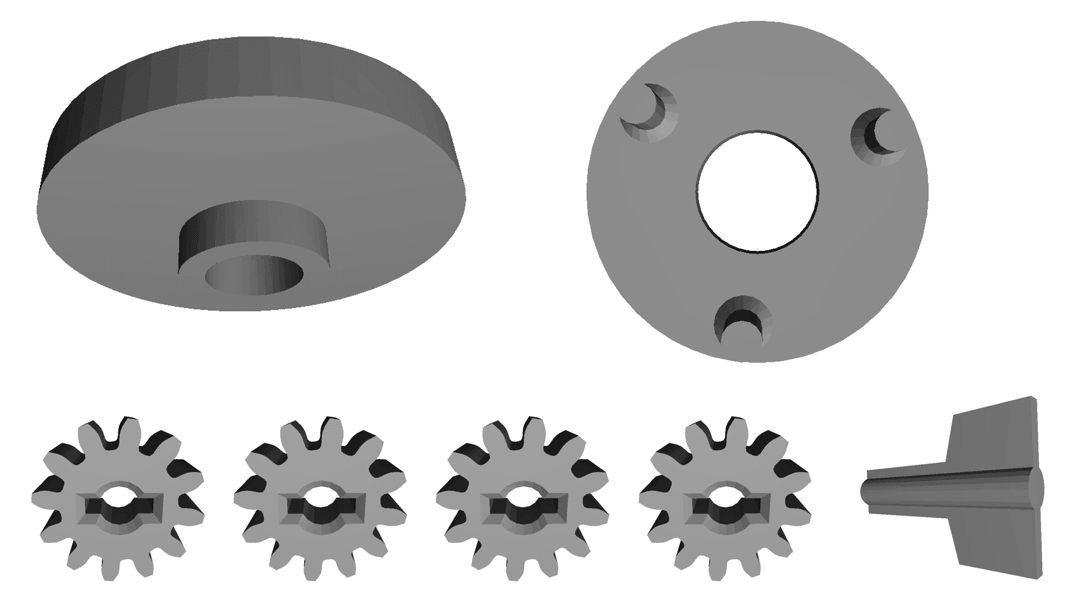
The core task required assembling an epicyclic gearbox: mounting three planet gears, a sun gear, and a ring gear onto a planet carrier. This is a textbook long-horizon manipulation problem where one early failure cascades through the rest of the sequence, and it demands sub-millimeter precision because misaligned gears simply refuse to mesh.
The organizers split the competition into two tracks. The Simulation Track ran on a self-developed environment built on NVIDIA Isaac Sim with a digital twin of the Galaxea R1 robot. The Onsite Track deployed models on a Galaxea R1 Lite dual-arm platform at the Advanced Remanufacturing and Technology Centre in Singapore. Three scenarios stressed different capabilities:
- Task 1 (Assembly from scratch): Start with an empty carrier and place every gear in sequence.
- Task 2 (Resume from partial state): Continue an assembly a virtual human left half-finished.
- Task 3 (Error detection and recovery): Detect a wrongly placed part, remove it, and get back on track.
Over 60 teams and 170+ participants from more than 10 countries entered the challenge. A single model had to handle all three scenarios, and the final evaluation happened on a private workstation with randomized lighting, textures, and gearbox colors to prevent overfitting.

The sim-to-real cliff
The leaderboard tells the story. Modular pipeline teams like HD-Robo and K-Lee-gends dominated the simulation round but their solutions proved brittle onsite, failing to generalize to the physical robot's latency and mechanical tolerances. HD-Robo scored 0.256 in simulation and 0.000 onsite. K-Lee-gends scored 0.184 in sim and 0.000 in the real world.
Meanwhile, the top three overall winners (IIGroup, RoboCola, and Show Me Robot) all used end-to-end VLA architectures that showed superior robustness to the domain shift between simulation and reality, especially in Task 3 error recovery where semantic reasoning mattered most. The winning team IIGroup posted a mediocre 0.126 in simulation but a 0.344 real-world score, enough to take first place overall.
ARC-VLA: fixing the lazy robot problem
IIGroup's winning system, ARC-VLA, is a 3.6-billion-parameter model built on the π_0.5 backbone. The team's key insight had nothing to do with scaling the model. They noticed that standard L2 loss leads to vanishing gradients as the robot approaches a target, causing it to stop correcting when it is close enough but not yet aligned for insertion.
Switching to L1 loss keeps the gradient constant all the way to zero error, forcing the policy to eliminate sub-millimeter offsets instead of settling for good enough. The other decisive choice was training data engineering. Instead of only training on perfect trajectories, IIGroup built a two-stage pipeline of 600 simulation episodes and 400 real-world episodes teaching two failure modes: small offset corrections during placement, and full retract-recalibrate-retry sequences after failed grasps.
They also skipped calibrated global depth entirely, betting on wrist-mounted cameras for near-field geometry. And they shortened their action chunk size from 50 to 20 steps to keep the robot in tighter closed-loop control rather than blindly executing long trajectories predicted from stale frames.
RoboCola: two brains are better than one
Runner-up RoboCola built a Specialist + Generalist dual-model framework, fusing outputs from a semantic planner (OpenPi) and a kinematic controller (GalaxeaVLA). The generalist handles task logic and error correction. The specialist, pre-trained on the Galaxea R1 Lite's specific kinematics, ensures physically valid motions. The final action is a weighted blend that prioritizes kinematic precision.
Three other design decisions mattered:
- Delta action space: Predict relative movements instead of absolute coordinates, so the model stays sensitive during the final millimeters of insertion.
- Rejection sampling fine-tuning: Let the model run in Isaac Sim, keep only successful trajectories, and add them back to the training set as a self-correction loop.
- Inference sweet spot: Onsite, they found 7 execution steps per inference cycle balanced visual lag against computational stutter on their RTX 6000 Ada hardware.
What the results actually mean
The paper draws a hard conclusion about where industrial robotics is heading. Modular pipelines that chain perception, pose estimation, and motion planning are elegant and interpretable, but every stage compounds calibration error and latency jitter. HD-Robo, for example, used a clever twist-left-twist-right primitive to let gears settle into meshed positions, but their reliance on Franka-style impedance control, which the Galaxea R1 Lite doesn't natively support, killed the deployment.
VLA models internalize calibration offsets as part of the visual distribution. They also carry semantic priors from their language-model backbones, which is why they were the only systems to reliably handle Task 3, where the robot has to recognize that a gear is wrong and correct it.
Data, code, and datasets
Everything from the challenge is public. The dataset, CAD files, code, and evaluation results are available on the challenge site, along with over 300 automatically generated Isaac Sim demonstrations and 300+ teleoperated real-world demonstrations on the Galaxea R1 Lite. The simulation dataset and real-world dataset are both hosted on Hugging Face. Baselines for π_0.5 and ACT are included as reference implementations.
For anyone building manipulation policies for structured industrial tasks, the takeaways are concrete: use L1 loss for precision-critical insertion, budget your data collection toward failure and recovery trajectories rather than perfect demos, prefer wrist-mounted cameras over global depth, and consider hybrid architectures where a generalist handles logic and a specialist handles motion.