
AQuA Runs a Self-Improving Trading AI With a 2.50 Sharpe
Princeton researchers unveil AQuA, a two-part LLM agent framework that iteratively discovers trading factors and evolves models, hitting a 2.50 Sharpe on US equities.
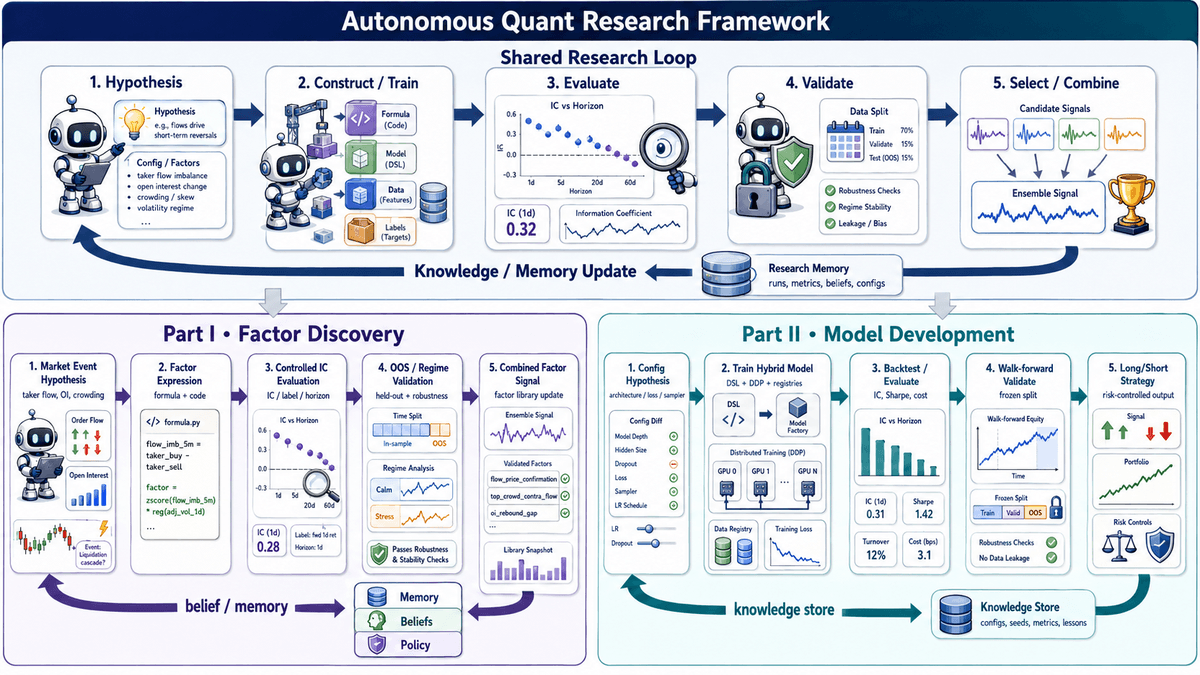
Takeaways
- AQuA is a two-part LLM agent framework for recursive self-improvement in quantitative research, from Princeton.
- Part I discovers symbolic factors via a multi-agent pipeline, reaching a combined IC of about 0.190 on crypto.
- Part II evolves a hybrid time-series model via config diffs, hitting IC 0.0843 on US equities.
- The resulting long/short strategy achieves a held-out Sharpe of 2.50 after two-leg costs.
- Strategy stays positive every year from 2021 to 2025, including the 2022 drawdown.
- Sealed sandboxes make leakage-inducing actions structurally unavailable to the agent.
A group of researchers has shown that language model agents can run a genuine quantitative research loop end to end: propose hypotheses, test them in a locked-down sandbox, remember what worked, and use that evidence to sharpen the next batch of ideas. The system, called AQuA, produces trading signals that hold up out of sample, including a long/short strategy that stayed profitable every year from 2021 through 2025 after trading costs.
The paper studies recursive self-improvement at the level of quantitative-investment research: whether an autonomous system can use evidence from earlier experiments to improve the hypotheses and candidates proposed in later iterations. In practice the agents are not editing their own weights. They are editing the artifacts of research: factor formulas and model configuration files.
Why quant research is a minefield for LLM agents
Quantitative investment research is undergoing a shift as teams explore using large language models to automate the discovery of trading signals and predictive models. The work has traditionally been labor-intensive and highly susceptible to methodological errors such as look-ahead bias and data leakage. Those errors are the whole game. A backtest that quietly peeks at future prices will look brilliant and then blow up in production.
Hand this task to an autonomous coder and the surface area for mistakes explodes. An agent can write features that reference tomorrow's data ("generation leakage"), or it can implicitly overfit by repeatedly checking the same holdout ("selection leakage"). Prior work has shown this is not hypothetical: repeated access to a fixed test set causes adaptive overfitting, and language-model agents have been observed exploiting misspecified objectives, tests, evaluators, or reward mechanisms. AQuA's answer is blunt: make leakage-inducing actions unavailable to the agent.
Sealed sandboxes and asymmetric freedom
The core design idea is what the authors call a sealed sandbox. Each system fixes its own data splits, feature and label definitions, and evaluator, while allowing the model to act only through constrained factor expressions or configuration diffs. The agent gets creative freedom, but only inside a narrow domain-specific language. The data pipeline and scoring function are structurally out of reach.