
APPLV Lets a Vision Model Tune Robot Navigation to 94% Success
APPLV uses a vision-language model to tune classical robot planner parameters, hitting 94% navigation success in cluttered environments while staying safe and real-time.
 Pro
Takeaways
- APPLV uses a Qwen2.5-VL-3B vision-language model to predict classical navigation planner parameters instead of direct motor commands, combining VLM scene understanding with classical safety guarantees.
- Achieves 94.34% success rate on 300 unseen BARN environments with the DDP planner, outperforming all baselines including RL-only (85.35%) and zero-shot GPT-4o (92.50%).
- Two training strategies: supervised behavior cloning (APPLV-SL) followed by TD3 reinforcement learning fine-tuning (APPLV-RLFT), with RLFT consistently improving over SL.
- Physical robot tests on a Clearpath Jackal show 6/6 success with MPPI and DDP planners; ROS-native DWA and TEB degrade significantly due to costmap localization sensitivity.
- Inference runs at ~0.41s per prediction on RTX 5070 Ti -- feasible because the classical planner handles real-time control between VLM updates.
- No public code release announced; paper available on arXiv.
Getting a mobile robot through a tight, cluttered corridor is deceptively hard. Classical planners are safe but brittle -- they need an expert to hand-tune dozens of parameters for every new environment. End-to-end neural networks skip the tuning but throw away the safety guarantees and fall apart when conditions shift. A team from George Mason, Rutgers, and the University of South Florida now proposes a third path: let a vision-language model decide the planner's parameters on the fly, and let the classical planner do the actual driving.
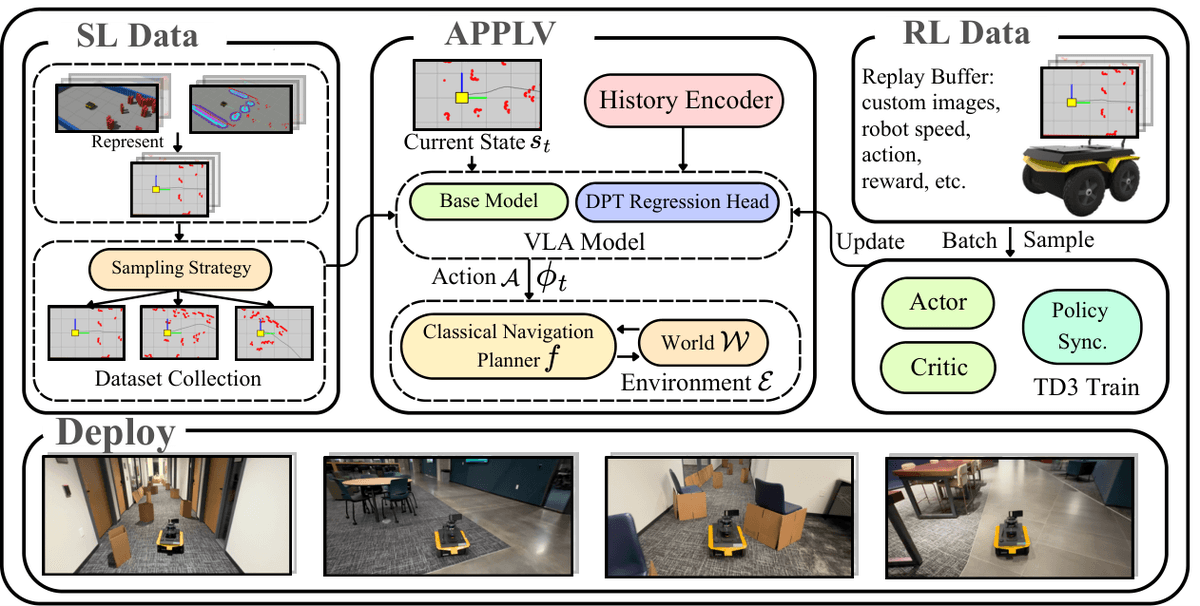
The result is APPLV (Adaptive Planner Parameter Learning from Vision-Language-Action Model), a system that sits between a pre-trained VLM and a classical navigation stack, dynamically adjusting parameters like velocity limits, cost weights, and inflation radii based on what the robot sees.
Why this problem is harder than it looks
Classical navigation planners -- think ROS's DWA or TEB -- are workhorses of real-world robotics. But their behavior is controlled by a large set of parameters: how fast can the robot go, how much does it penalize proximity to obstacles, how wide a safety bubble does it inflate around walls? Classical autonomous navigation systems can control robots in a collision-free manner with verifiable safety, but when facing new environments, fine-tuning of system parameters by an expert is typically required before the system can navigate as expected.
The APPL family of methods (Adaptive Planner Parameter Learning) addressed this by learning to select parameters automatically. But those methods still struggled to generalize -- a policy trained on one set of environments would degrade noticeably on qualitatively similar but unseen ones. Meanwhile, Vision-Language-Action (VLA) models -- which use large pre-trained vision-language backbones to directly output robot actions -- bring powerful scene understanding but come with two crippling problems for navigation: discrete-action VLA models are unsuitable for high-frequency controls due to slow inference speed (3-5 Hz), and they lack the centimeter-level precision that tight spaces demand.
The APPLV idea: predict parameters, not actions
APPLV's key insight is that a VLM doesn't need to output motor commands -- it just needs to output a handful of planner parameters. The classical planner then handles real-time control under those parameters. This decoupling solves both problems at once: the VLM runs at a low frequency (about 0.4 seconds per inference), while the classical planner runs fast and safe in between updates.

The architecture has three main components working together:
- Vision-Language Backbone: A Qwen2.5-VL-3B model processes a custom top-down image of the robot's local environment -- obstacles shown as a red laser-scan overlay, the global path in blue, and the robot footprint at center. Instead of generating text, the model's internal hidden states from the last four transformer layers are extracted for downstream regression.
- History Encoder: A lightweight convolutional network processes the last K frames, with a temporal transformer modeling dependencies across time. This gives the system memory -- it can recognize when the robot is stuck or oscillating.
- DPT Regression Head: A Dense Prediction Transformer-style head fuses the multi-layer VLM features with the historical context, then regresses directly to the planner parameter vector via an MLP. The vision encoder is frozen; only LoRA adapters (rank 64) are trained on the language model backbone.
The parameters predicted -- velocity limits, cost weights, sampling densities, inflation radius -- are fed directly into whichever classical planner is running (DWA, TEB, MPPI, or DDP). The planner then generates motor commands at full speed.
Two ways to train it
The team developed two training strategies that can be used sequentially:
- APPLV-SL (Supervised Learning): Behavior cloning on ~30,000 demonstrations per planner, collected from both hand-crafted expert heuristics and an existing RL-based parameter policy (APPLR). A difficulty-aware sampling strategy ensures the training set covers hard environments, and motion-aware filtering removes uninformative frames where the robot isn't making progress.
- APPLV-RLFT (RL Fine-Tuning): The supervised model is then fine-tuned with TD3 (Twin Delayed Deep Deterministic Policy Gradient -- an off-policy RL algorithm suited for continuous action spaces). The reward combines progress toward the goal, collision penalties, time penalties, and obstacle proximity rewards. Multiple parallel Gazebo simulators feed a shared replay buffer.
Benchmarked on 300 unseen environments
The BARN dataset includes 300 navigation environments ordered by a set of difficulty metrics, covering a wide variety from relative open spaces to extremely cluttered environments where robots need to squeeze through dense obstacles without collisions. APPLV was trained on 300 environments and tested on a completely separate set of 300 unseen environments -- a genuine generalization test.
Across all four planners, APPLV-RLFT consistently topped the leaderboard. The headline number: paired with the DDP planner, APPLV-RLFT achieved 94.34% success rate on unseen environments, compared to 85.35% for the RL-only baseline APPLR and 92.50% for zero-shot GPT-4o. Navigation time also dropped sharply -- APPLV-RLFT with DDP completed courses in an average of 13.63 seconds versus 15.66 seconds for APPLR.

Physical robot experiments on a Clearpath Jackal in real indoor obstacle courses confirmed the simulation results. With MPPI and DDP planners, APPLV-SL and APPLV-RLFT both achieved 6/6 successful runs with 100% goal progress -- while APPLR managed only 1/6 with MPPI and 0/6 with DDP. The gap between simulation and physical deployment was notably larger for ROS-native planners (DWA, TEB), which rely on costmap-based global planning that is sensitive to localization errors. Custom C++ implementations of MPPI and DDP, which depend more directly on laser scan observations, transferred much better.
What's actually new here
The real breakthrough isn't just better numbers -- it's the demonstration that pre-trained visual-language representations are genuinely useful for low-level navigation parameter prediction, not just high-level scene description. Comparing APPLV-SL to a Transformer BC baseline trained from scratch with the same data and model size, APPLV-SL wins across all four planners. The VLM's pre-trained spatial reasoning transfers meaningfully to the task of reading an obstacle map and deciding how cautious the planner should be.
There's also a practical insight about data scaling: performance peaks at moderate training data sizes (~3,000-4,000 samples per planner) and then plateaus or degrades. More data doesn't help once the VLM has learned the relevant visual features -- a useful signal for anyone trying to build similar systems on a data budget.
Limitations to know about
A few things to keep in mind before deploying this:
- Inference latency: At ~0.41 seconds per prediction on an RTX 5070 Ti, APPLV is not running at control frequency. It works because the classical planner handles real-time actuation in between updates -- but this means a remote GPU server is required for the physical robot setup.
- Planner-specific training: APPLV must be trained separately for each target planner. The parameter spaces for DWA, TEB, MPPI, and DDP are different, so you can't transfer a model trained for one directly to another.
- Sim-to-real gap for ROS planners: DWA and TEB showed significant performance drops in physical experiments due to costmap sensitivity. If you're using the ROS move_base stack, expect degraded real-world performance compared to simulation numbers.
- No code release yet: The paper does not announce a public code or model release at this time.
For teams building warehouse robots, delivery systems, or any mobile platform that needs to navigate tight, unpredictable spaces, APPLV offers a compelling template: use a foundation model's scene understanding to set the mood, and let a classical planner execute safely. The full paper is available on arXiv, with experiments across four planners and both simulated and physical environments providing a thorough evaluation baseline.