
Apple's VSSFlow Generates Full Video Audio With One Unified Model
VSSFlow unifies video-to-sound and visual text-to-speech into one flow-matching model, beating specialized baselines without complex multi-stage training
 Pro
Takeaways
- VSSFlow is the first unified flow-matching model that handles Video-to-Sound, Visual TTS, and joint sound+speech generation from a single architecture.
- A disentangled attention routing mechanism sends semantic video features through cross-attention and temporally dense signals (lip sync, phonemes) through self-attention concatenation.
- Joint training of sound and speech tasks causes no performance degradation, overturning a widely held belief in the field.
- VSSFlow-M (443M params) beats LoVA (1057M params) on V2S benchmarks with an FAD of 1.11 vs 2.02, using no extra training data.
- Joint generation is enabled via feature-space data synthesis -- mixing feature vectors instead of raw audio -- requiring only 10k fine-tuning steps.
- Code and demos are forthcoming at the project page; paper available on arXiv.
Making a silent video sound right is harder than it looks. You need two fundamentally different things at once: realistic ambient sound that matches what's happening on screen, and intelligible speech that syncs with the speaker's lips. Until now, the field has treated these as entirely separate problems, with dedicated models for each. VSSFlow, from researchers at Renmin University of China and Apple, challenges that assumption head-on -- and the results are striking.
Two tasks, one stubborn wall
The two core tasks in video-conditioned audio generation are Video-to-Sound (V2S) -- generating environmental or ambient audio from a silent video -- and Visual Text-to-Speech (VisualTTS) -- generating lip-synced speech from a talking-head video plus a transcript. These tasks share a lot of structure: both need temporal alignment with video, both operate on audio latents, and both benefit from visual context. Yet the community has kept them siloed.
The reason is a widely held belief: joint training of V2S and VisualTTS causes the two tasks to interfere with each other, degrading performance on both. Prior unified attempts like DualDub and DeepAudio worked around this with carefully staged, multi-phase training pipelines -- first learn sound, then learn speech, then combine. That complexity is a real barrier to practical use.
There is also a data problem. High-quality videos that contain both synchronized speech and environmental sound simultaneously are scarce. Most datasets cover one or the other, not both at once.
One model, three modes
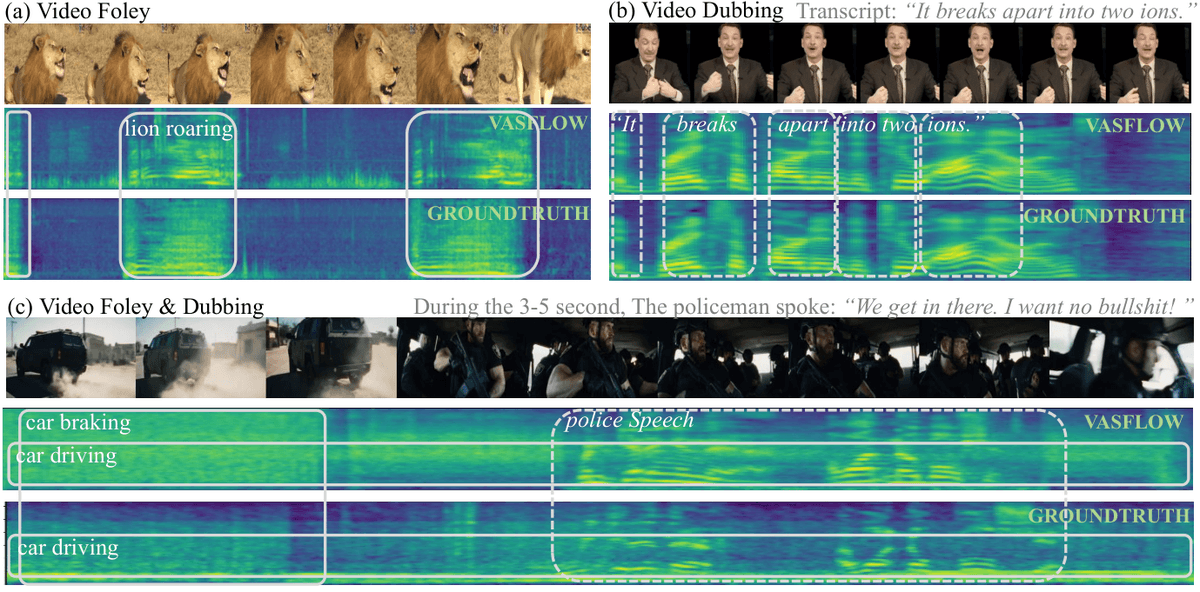
VSSFlow handles all three generation scenarios from a single model:
- V2S: Given a silent video, generate matching environmental sound.
- VisualTTS: Given a silent talking-head video plus a text transcript, generate lip-synced speech.
- Joint generation: Given a video and transcript, generate both speech and background sound simultaneously.
The architecture is built on a Diffusion Transformer (DiT) -- a transformer that operates on latent audio representations and is guided by a flow-matching objective. Flow matching is a generative framework that learns to smoothly transform Gaussian noise into a target audio distribution by predicting a velocity field, rather than the noisier score-matching approach used in classic diffusion. It tends to train more stably and sample faster.

The key insight: not all conditions are equal
The real architectural contribution is how VSSFlow handles four very different input signals at once. Each signal has a different relationship with time, and the team found that forcing them all through the same attention mechanism hurts performance.
Their solution is a disentangled condition aggregation mechanism that routes each signal through the attention type best suited to its structure:
- Cross-attention handles video semantic features (CLIP embeddings). These are high-level, globally relevant context -- what kind of scene is this? Who is speaking? Cross-attention lets the model freely attend to any part of this context without positional constraints.
- Self-attention via channel concatenation handles temporally dense signals: sound synchronization features (from Synchformer), speech transcript phonemes, and lip movement features (from AV-HuBERT). These are concatenated with the audio latent along the channel dimension, so the model processes them frame-by-frame through self-attention. Self-attention has a natural diagonal bias -- it attends strongly to neighboring positions -- which turns out to be exactly what you want for tight temporal alignment.
The team validated this split through five ablation variants (V1-V5), systematically swapping which signals go through which attention type. The final configuration (V5) consistently wins across both speech and sound metrics.

Joint training actually helps
Here is the result that overturns the field's conventional wisdom: when VSSFlow trains jointly on sound and speech data, it matches the performance of models trained on each task separately. There is no degradation. The learning curves for sound metrics (FAD, DeSync) and speech metrics (WER, UTMOS) are essentially identical whether the model sees mixed data or single-task data.
The authors attribute this to two architectural properties working together. First, the decoupled attention routing keeps sound and speech conditioning pathways largely separate in feature space, reducing interference. Second, flow matching provides a smoother optimization landscape than autoregressive or standard diffusion objectives, making it easier for the model to handle two different data distributions simultaneously.
Solving the joint data problem with feature-space synthesis
For the joint generation mode, real paired data (video + simultaneous speech + environmental sound) is extremely rare. VSSFlow sidesteps this with a clever feature-level synthesis strategy. Instead of mixing raw audio or video files -- which is computationally expensive -- the team mixes the extracted feature vectors directly during data loading. Two synthesis modes are used:
- Additive synthesis: Speech features are superimposed on sound features at a random signal-to-noise ratio, simulating overlapping audio.
- In-place substitution: Sound features within a speech interval are replaced by speech features, simulating a clean transition between the two.
This happens entirely in feature space, so it adds negligible storage or compute overhead. Fine-tuning on this synthetic data for just 10,000 steps (on top of 250,000 steps of pretraining) is enough to unlock joint generation. The model even generalizes zero-shot to out-of-domain videos, including Veo3-generated content.
Benchmark results
VSSFlow was evaluated in three settings. On the VGGSound V2S benchmark, VSSFlow-M (443M parameters, no extra training data) achieves an FAD of 1.11 -- better than LoVA (2.02, 1057M params) and Frieren (1.49, 421M params), both trained on the same data. Even VSSFlow-S at 245M parameters beats models more than four times its size.
On VisualTTS (Chem and GRID benchmarks), VSSFlow-M achieves a Word Error Rate of 9.4 on Chem, beating all VisualTTS-specific baselines and approaching the pure TTS baseline E2-TTS (8.7 WER). It also sets new state-of-the-art on lip sync metrics (LSE-C, LSE-D) and acoustic quality (MCD scores) across both benchmarks.
On the V2C-Animation joint generation benchmark, VSSFlow outperforms pipeline-based baselines (which independently run a VisualTTS model and a V2S model then merge outputs) on most speech and sound metrics, despite being fine-tuned for only 10k steps on synthetic out-of-domain data.
Three model sizes, one framework
The team trained three variants to demonstrate scalability:
- VSSFlow-S: 245M parameters, 5 DiT blocks
- VSSFlow-M: 463M parameters, 10 DiT blocks
- VSSFlow-L: 618M parameters, 15 DiT blocks
Performance scales consistently from S to L, validating that the architecture is not just a one-size trick. All variants use the AudioLDM 2 VAE for audio encoding, HiFi-GAN as the vocoder, and were trained on 4 NVIDIA H100 GPUs with a total of 350k training samples across V2S and VisualTTS datasets.
What it cannot do yet
VSSFlow has real limitations worth noting. It relies on frozen pretrained feature extractors (CLIP, Synchformer, AV-HuBERT), which means it cannot learn fine-grained audio-visual nuances that those extractors do not already capture. The joint generation quality is also bounded by the distributional gap between synthetic training data and real-world videos. The authors flag both as open problems for future work.
Code and demos are promised on the project page, with release described as "coming soon." The paper is available on arXiv. For practitioners building video post-production pipelines, dubbing tools, or immersive media applications, VSSFlow represents a meaningful step toward a single model that handles the full audio track -- not just half of it.