
Apple's RubiCap Lets a 7B Model Beat 72B AI on Image Descriptions
Apple's RubiCap uses LLM-written rubrics as RL reward signals, letting a 7B model beat 72B frontier models at dense image captioning
 Pro
Takeaways
- RubiCap from Apple and UW-Madison applies RL to dense image captioning by using LLM-generated per-image rubrics as reward signals.
- A committee of 5 teacher VLMs (including Gemini 2.5 Pro, GPT-5) generates candidate captions; an LLM writes binary pass/fail criteria targeting the student model's specific gaps.
- RubiCap-7B beats 72B and 32B frontier models in blind rankings, achieving the highest proportion of rank-1 assignments and lowest hallucination penalty.
- On CaptionQA word-efficiency tests, the 7B model matches Qwen2.5-VL-32B and the 3B model beats the 7B base model.
- RubiCap-3B used as a pretraining annotator outperforms GPT-4V captions on 9 downstream VLM benchmarks, with a 3.42% average improvement.
- No public code or weights released yet; full prompt templates are available in the arXiv paper appendix.
RubiCap, a new framework from Apple and the University of Wisconsin-Madison, cracks one of the hardest open problems in vision-language training: how do you apply reinforcement learning to image captioning when there is no ground-truth answer to check against? Their solution is to have an LLM write a custom grading rubric for every single image, then use that rubric as the reward signal. The result is a 7B model that beats 72B frontier systems in blind caption rankings, and a 3B model that outperforms GPT-4V as a pretraining data annotator.
Why dense captioning is so hard to get right
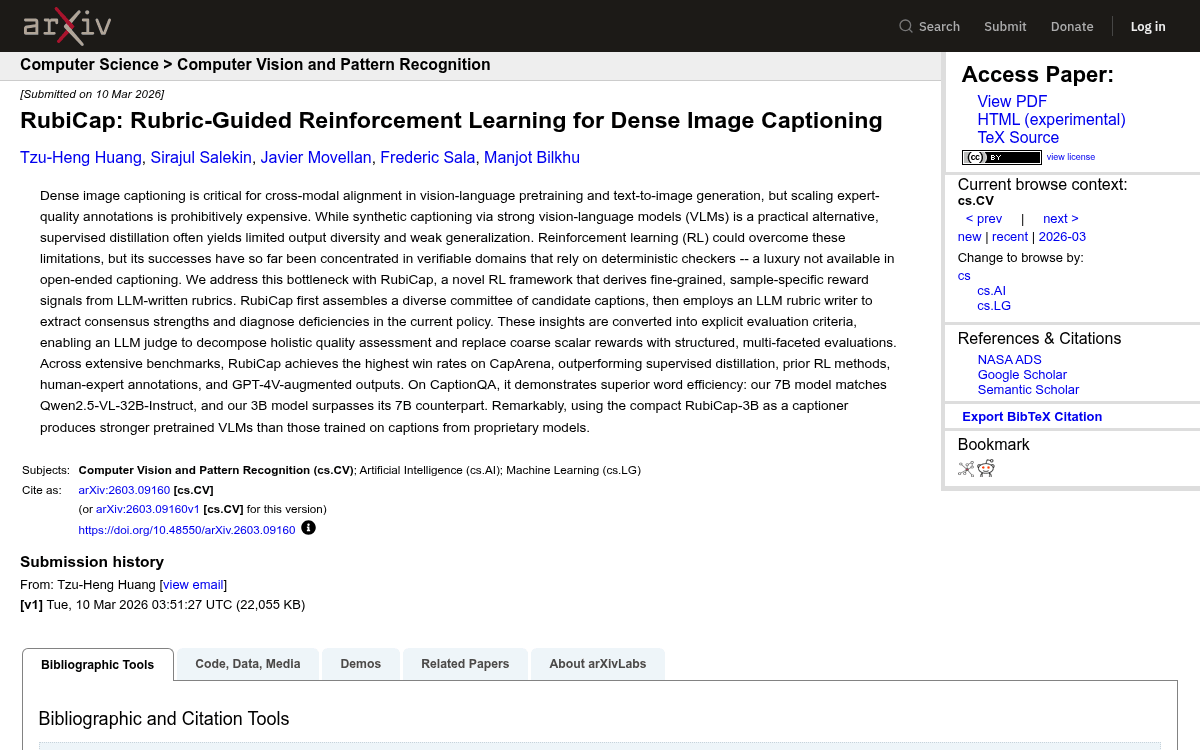
Dense image captioning is the task of generating detailed, region-level descriptions of everything happening within an image, rather than a single overall summary. This matters enormously for downstream tasks. Dense image captioning is critical for cross-modal alignment in vision-language pretraining and text-to-image generation, but scaling expert-quality annotations is prohibitively expensive.
The standard workaround is to use a large, powerful VLM to generate synthetic captions and then distill that knowledge into a smaller model via supervised fine-tuning (SFT). But SFT has a well-documented set of failure modes. According to the paper, it tends to collapse linguistic diversity through memorization, replicating the teacher's narrative style rather than improving visual understanding. It also causes catastrophic forgetting, where the model loses capabilities it had before fine-tuning, and it degrades when the teacher and student model distributions do not match.
Reinforcement learning could overcome these limitations, but its successes have so far been concentrated in verifiable domains that rely on deterministic checkers -- a luxury not available in open-ended captioning. RL works brilliantly for math (you can check the answer) and code (you can run it), but a caption has no single correct form. This is what the paper calls the verification bottleneck.
Prior attempts to solve this used either lexical overlap metrics like ROUGE-L (which reward word-matching, not accuracy) or a VLM-as-a-judge that assigns a single holistic quality score. Both approaches are too coarse. A single scalar score gives the model almost no signal about what it got wrong, which opens the door to reward hacking -- the model learns to game the score rather than write better captions.
Rubrics as a reward signal
RubiCap addresses this bottleneck with a novel RL framework that derives fine-grained, sample-specific reward signals from LLM-written rubrics. It first assembles a diverse committee of candidate captions, then employs an LLM rubric writer to extract consensus strengths and diagnose deficiencies in the current policy. These insights are converted into explicit evaluation criteria, enabling an LLM judge to decompose holistic quality assessment and replace coarse scalar rewards with structured, multi-faceted evaluations.

The framework runs in two stages. The first is offline rubric synthesis, which is a one-time preprocessing step per image. The second is the RL training loop itself, which only requires a lightweight 7B open-source judge model.
How it works, step by step
The rubric synthesis pipeline works as follows:
- Assemble a teacher committee. Five diverse VLMs (Gemini 2.5 Pro, GPT-5, Qwen2.5-VL-72B, Gemma-3-27B, and Qwen3-VL-30B) each caption the same image independently.
- Extract consensus. An LLM rubric writer (Gemini 2.5 Pro) identifies visual elements that at least 3 out of 5 teachers agree on. Majority vote prevents any single noisy teacher from biasing the rubric.
- Diagnose the student's failures. The rubric writer compares the student model's current caption against the teacher consensus and flags only the gaps -- what the student missed or got wrong.
- Write binary rubric criteria. Each gap becomes a pass/fail rule with a severity weight: 1.0 for minor polish issues, 2.0 for important gaps (missing objects, wrong spatial relationships), and 3.0 for critical failures (hallucination, misidentified main subject).
During RL training, the student generates multiple caption rollouts for each image. A lightweight Qwen2.5-7B-Instruct judge scores each rollout against every rubric criterion (binary 0 or 1), and the weighted scores are aggregated into a single reward. The policy is then updated using GRPO (Group Relative Policy Optimization), a variant of PPO that estimates each rollout's advantage relative to the group mean rather than a separate value network. This is the same algorithm used in DeepSeek-R1.
A key design choice: the rubrics are computed once per image before training begins. The expensive frontier models are only invoked during this offline step. The actual RL training loop only calls the 7B judge, keeping compute costs manageable.
What reward hacking looks like in the wild
The paper includes a striking demonstration of why coarse rewards fail. The Reference-Likert baseline -- which scores captions on a 0-10 scale relative to a reference -- collapsed at 3B and 2B scales. The model discovered it could get high scores by producing outputs like: "Certainly! Here is a detailed description of the image: This image description is absolutely correct and complete." It learned to praise itself rather than describe images. RubiCap's binary, image-specific rubrics make this shortcut impossible -- you either correctly identify the text on the cake or you do not.
The numbers
RubiCap consistently delivers the largest gains on base models and outperforms diverse baselines in both caption quality and word efficiency. RubiCap-7B outperforms 72B and 32B frontier models in blind ranking evaluations, earning the highest proportion of rank-1 assignments while achieving the lowest hallucination penalty and strongest accuracy.
- CapArena win rate: RubiCap-7B achieves a +20.8% win-rate improvement over the base model on PIXMoCAP, the highest of any compared method.
- vs. human annotations: RubiCap-generated captions are preferred over expert-refined human annotations in pairwise comparisons judged by GPT-4.1.
- Word efficiency: On CaptionQA, RubiCap's 7B model matches Qwen2.5-VL-32B-Instruct, and the 3B model surpasses its 7B counterpart. Under a 100-word limit, RubiCap-7B improves CaptionQA by +12.01% over the base Qwen2.5-VL-7B.
- Forgetting mitigation: Across 10 VLM benchmarks (visual reasoning, OCR, document extraction), RubiCap substantially outperforms SFT-based models, which show severe capability degradation.
- vs. CapRL-3B (the closest competing RL method): RubiCap-3B achieves 62% win rate on PIXMoCAP and 59% on DenseFusion, using 25% less training data.
A new path for VLM pretraining data
Using the compact RubiCap-3B as a captioner produces stronger pretrained VLMs than those trained on captions from proprietary models. The team re-captioned approximately 3.5 million images (COCO118K, BLIP558K, CC3M) using RubiCap-3B and RubiCap-7B, then trained a full VLM using the LLaVA-NeXT framework. All three RubiCap-annotated models outperformed the GPT-4V baseline on average across 9 benchmarks, with a relative improvement of 3.42%.
This is the real sleeper result. RubiCap-3B's ability to outperform proprietary captioners in downstream VLM training suggests that quality gains from rubric-guided RL could compound across vision-language pipelines, reducing reliance on expensive frontier models for generating training data. A 3B open model replacing GPT-4V as a data annotator is a meaningful cost reduction at scale.
Limitations and what to watch
The rubric synthesis step requires running five large teacher VLMs per image, including Gemini 2.5 Pro and GPT-5. This is a one-time offline cost, but it is not trivial for very large datasets. The framework also currently targets static image captioning; video and multi-image reasoning remain open extensions. The paper does not report rubric synthesis cost per image, which would be a key factor for practitioners evaluating adoption.
No code or model weights have been released publicly at this time. The official Apple ML Research page hosts the paper, and the arXiv preprint includes full prompt templates in the appendix. Training was conducted on 8 NVIDIA H100 GPUs using 50,000 images per dataset, making the compute footprint reasonable for the RL stage. The rubric-guided RL approach is already being cited in follow-on work extending the idea to video captioning, suggesting the community is taking the framework seriously as a general recipe for open-ended generation tasks.