
Apple's PersonaTrace Beats Real Email Datasets by Generating Entire Fake Lives
Apple researchers built a three-agent pipeline that fabricates emails, texts, and calendar entries for fictional users, and it beat every prior synthetic dataset on out-of-distribution tasks.
 Pro
Takeaways
- Apple and Harvard released PersonaTrace, a three-agent LLM pipeline for synthesizing multi-modal digital footprints.
- Persona, Event, and Artifact agents on Gemini-1.5-Pro produce coherent emails, texts, calendars, reminders, and wallet passes.
- Demographic priors come from the 2022 American Community Survey, seeded by PersonaHub events.
- Fine-tuning Mistral-7B on PersonaTrace beats all synthetic baselines on categorization, drafting, QA, and next-message prediction.
- Deployed in an internal retrieval product, delivering a 7% absolute Recall@10 gain.
- End-to-end cost is roughly 0.57 USD per artifact; dataset available on request under restricted license.
Training a personal assistant that understands your inbox, your calendar, and your group chats requires exactly the kind of data no company can legally share. Apple's research team, working with a Harvard collaborator, just proposed a workaround: instead of scrubbing real user traces, generate a full life from scratch using cooperating LLM agents. The system is called PersonaTrace, and the resulting synthetic corpus outperforms every existing baseline when used to fine-tune models for real-world tasks.
Why real digital footprints are basically off-limits
Digital footprints are the persistent records that individuals leave behind when they interact with digital systems, including email threads, chat logs, calendar appointments, purchase histories, and sensor traces. They power personalization, behavioral research, and any assistant that claims to understand context. The catch is that almost no useful corpus of this data exists in the open.
The Enron email corpus captures a single company from the early 2000s, and most public datasets focus on a single modality such as emails, chat dialogs, or transaction logs, failing to reflect the breadth of modern digital life. Proprietary data is locked down by GDPR and internal policy, and anonymization alone is insufficient because rich textual artifacts can be deanonymized with modern LLMs. Existing synthetic-data recipes do not solve this either, since current synthesis methods presume access to large seed datasets to bootstrap diversity, an assumption that breaks for digital-footprint data.
Three agents, one fake life
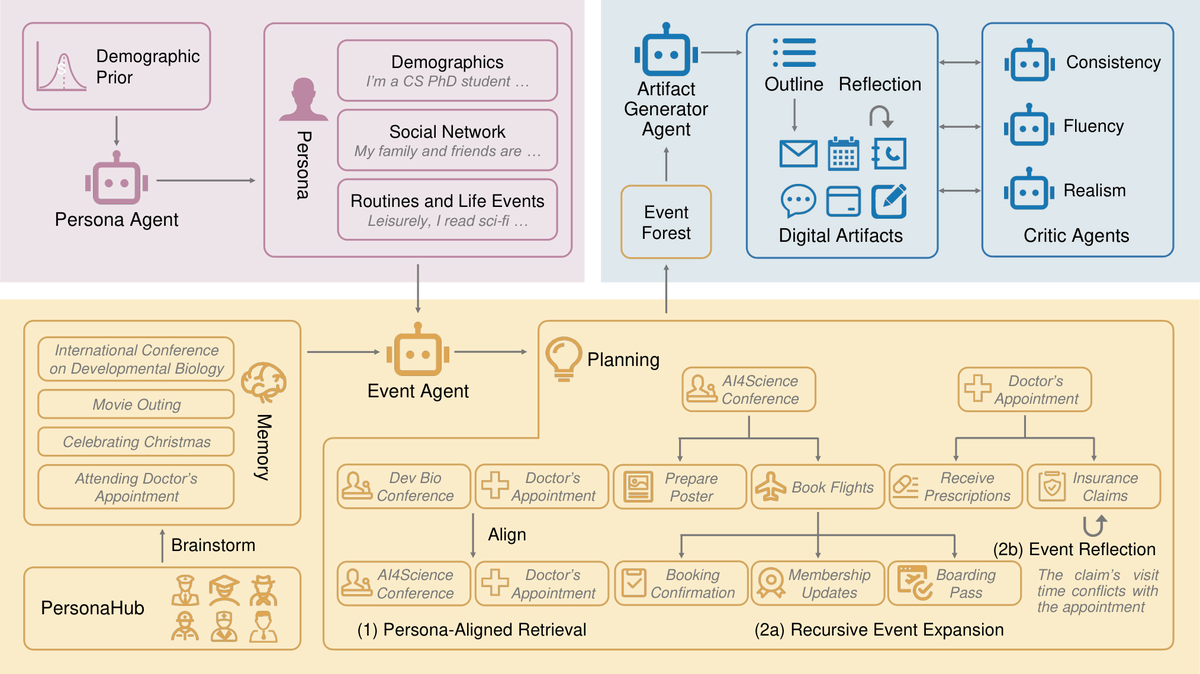
PersonaTrace uses a pipeline of specialized LLM agents that all share the same backbone. All agents share the same underlying LLM (Gemini-1.5-Pro with a temperature of 0.9) but are prompted with role-specific instructions and constraints. The workflow goes:
- Persona Agent. Basic demographic attributes such as age, gender, and locale are sampled from a predefined prior distribution, then estimated from the 2022 American Community Survey to ensure plausible macro-level distributions. From there the agent fills in a social network, weekday and weekend routines, and life events.
- Event Agent. It maintains an event memory seeded from PersonaHub, retrieves relevant activities, and expands each one into a tree of sub-events.
- Artifact Generator + Critic Agents. A generator drafts the actual email, SMS, calendar invite, reminder, or wallet pass, and three critics iteratively push back until the output is consistent with both the persona and the event.
The event expansion is where things get interesting. Each seed event serves as a root node in an event tree, and the Event Agent autonomously decides whether and how to branch that event into finer-grained sub-events. Some events may remain atomic, while others unfold into a sequence of related sub-events. A travel-related root event like attending an academic conference on AI for science might be expanded into sub-events such as prepare poster and book flights. Then, book flights can be further expanded into receive booking confirmation, get membership updates and receive boarding pass. The agent iterates breadth-first until no new branches appear or the forest hits 300 nodes.
The numbers
The team evaluated PersonaTrace two ways: intrinsic quality of the corpus, and downstream utility after fine-tuning. On diversity metrics like pairwise correlation, remote-clique, and entropy, PersonaTrace shows the greatest diversity among synthetic datasets, surpassing even some real ones such as Enron across all diversity metrics and W3C-Emails in entropy. It also has the longest average email length, reflecting closer resemblance to real data, and attains the highest LLM-as-Judge scores across both synthetic and real datasets.
For the downstream test, the team fine-tuned Mistral-7B with LoRA on each synthetic corpus and evaluated on four tasks: email categorization, email drafting, question answering, and next-message prediction. Across all evaluated tasks, PersonaTrace proves to be the most effective synthetic dataset for out-of-distribution generalization, with models fine-tuned on it consistently achieving top performance across metrics such as accuracy, F1, ROUGE-L, and BERTScore. The most striking gap is on question answering against the Enron test set, where PersonaTrace pushes ROUGE-L to 0.44 versus 0.32 for FinePersonas-Email.
An ablation replaces the Event Agent with a fixed list of event types and the artifact loop with templates. The results are brutal for the ablated version: email-categorization accuracy on Enron collapses from 0.27 to 0.006, and question-answering ROUGE-L drops from 0.25 to 0.04. The agent loop, not just the persona seeding, is doing the work.
What is actually new here
The real contribution is the multi-bundle coherence. Prior synthetic datasets generate one kind of artifact at a time, so an email dataset never knows about the calendar invite that preceded it. PersonaTrace ties everything back to a shared persona and a shared event forest, which is why a booking confirmation email, a boarding-pass wallet entry, and a text to a friend can all reference the same conference trip without contradicting each other.
The team also reports a production signal that most academic papers do not have: they train their model on the dataset and deploy it in an online retrieval product, achieving a 7% absolute improvement in Recall@10.
Cost, limits, and access
Generation is not free. Each generation of about 1,500 input plus 1,500 output tokens costs roughly 0.019 USD, and with 2 generations per round and up to 5 rounds, the upper bound of the end-to-end cost is about 0.57 USD per artifact. For a corpus of tens of thousands of items, that adds up quickly.
The main functional limitation is controllability. The current implementation relies heavily on the Event Agent, which constructs event trees based on the LLM's prior knowledge, making it difficult to constrain or guide the generation toward specific topics. If you need a corpus that is, say, 80 percent travel-related, you cannot easily force that today.
Access is also gated. The authors say data and code will be made available on request due to privacy and legal concerns, and the release will come with licenses that forbid surveillance or protected-attribute inference use cases. For anyone building on-device assistants, inbox summarizers, or personalization systems where real data is off-limits, this is the closest thing yet to a defensible substitute.