
Apple's MixAtlas Cuts Multimodal Training Steps in Half With Smarter Data Mixing
Apple researchers built a two-axis search that finds better multimodal training mixes using tiny 0.5B proxies, then transfers them to 7B models.
 Pro
Takeaways
- MixAtlas from Apple + UW + Virginia Tech optimizes multimodal midtraining data along two axes: image concepts and task supervision.
- Uses Qwen2-0.5B proxy models with a Gaussian process surrogate and GP-UCB acquisition instead of regression-based baselines.
- Improves Qwen2-7B average by 8.5-17.6% across 10 benchmarks; DocVQA jumps from 15.8 to 46.9 on the concept axis.
- Reaches baseline-equivalent training loss in up to 2x fewer steps on both Qwen2-7B and Qwen2.5-7B.
- Recipes discovered on 0.5B proxies transfer to 7B without redoing the search, making mixture optimization affordable.
- Trade-off: document-focused recipes can hurt broader benchmarks like MMBench-EN and MathVista.
Choosing the right mix of training data is one of the least glamorous, most consequential decisions in building a multimodal model. Get the ratio of captions to OCR to grounding data wrong and you burn compute chasing benchmarks that never converge. A new framework from Apple, University of Washington, and Virginia Tech called MixAtlas attacks this problem directly, and the numbers are notable: on Qwen2-7B, optimized mixtures improve average performance by 8.5%-17.6% over the strongest baseline; on Qwen2.5-7B, gains are 1.0%-3.3%.
The reason this matters is that they found those mixtures using 0.5B parameter proxy models and then transferred the recipe up to 7B without redoing the search.
The trial-and-error tax on multimodal training
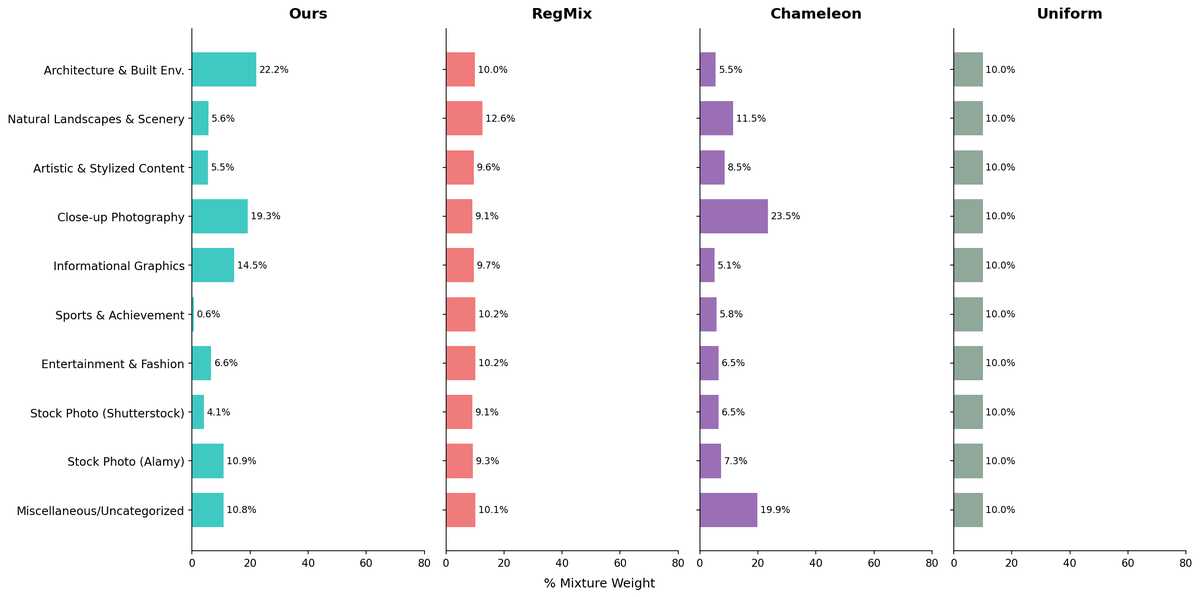
Data mixture optimization is well studied for text-only pretraining, with methods like DoReMi, RegMix, and Chameleon showing that reweighting domains beats uniform sampling. Multimodal midtraining, the phase after initial pretraining where a model picks up capabilities from high-resolution images and curated annotations, has been stuck with cruder heuristics. Principled domain reweighting can substantially improve sample efficiency and downstream generalization, yet mixture optimization for multimodal pretraining remains underexplored. Current recipes tune weights from only a single perspective such as data format or task type.
Consider MM1's fixed 5:5:1 caption/interleaved/text ratio, or PaliGemma-style task-type weighting. These recipes optimize one knob at a time and give you no insight into which visual content or which supervision signal is actually moving the needle on your benchmark.
Two knobs instead of one
MixAtlas decomposes the training corpus along two orthogonal axes and searches each independently:
- Task supervision (5 types):