
Apple's AMES Beats Visual Document Search Records Without Replacing Your Existing Stack
Apple researchers show that fine-grained multi-vector document retrieval can run inside a stock Apache Solr cluster without redesigning enterprise search infrastructure.
 Pro
Takeaways
- Apple researchers published AMES, a multimodal late-interaction retrieval architecture that runs on Apache Solr.
- Two-stage pipeline: parallel token-level ANN with Top-M MaxSim approximation, then accelerator-optimized Exact MaxSim re-ranking in PyTorch.
- Uses parent/child indexing so text tokens, image patches and video frames live in one shared embedding space.
- On the ViDoRe V3 English Industrial subset, beats prior nDCG@10 across ColQwen3.0, ColQwen2.5 and ColQwen2.5-Omni backbones.
- Supports GPU (CUDA) and Apple Silicon (Metal Performance Shaders) with fp16 re-ranking; no specialized vector database required.
- No open-source release; evaluation limited to English Industrial subset with no reported latency, throughput or memory numbers.
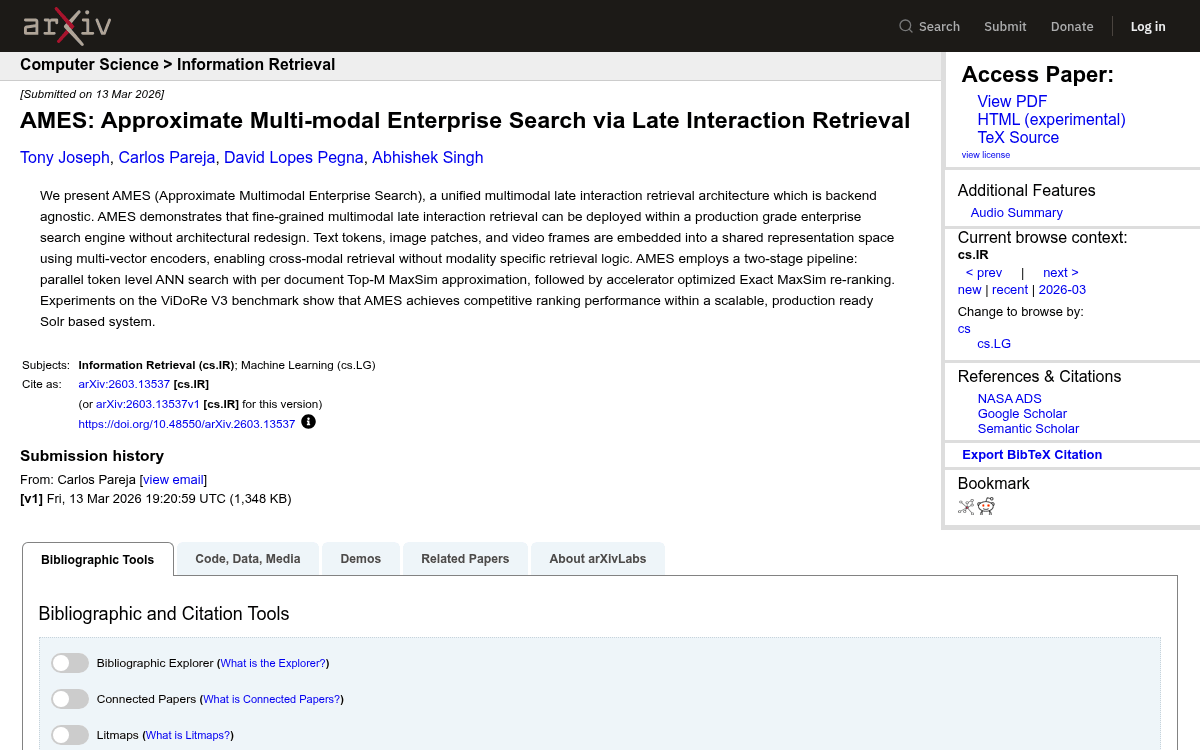
A team at Apple has published a paper describing AMES, short for Approximate Multimodal Enterprise Search, a retrieval architecture that fits modern late-interaction multi-vector models into the kind of Lucene-based search stack that enterprises already run in production. AMES is a unified multimodal late interaction retrieval architecture which is backend agnostic, and it demonstrates that fine-grained multimodal late interaction retrieval can be deployed within a production grade enterprise search engine without architectural redesign. The reference implementation runs on Apache Solr.
The gap between research retrievers and enterprise search
Most enterprise corpora are messy and multimodal. Engineering manuals, financial filings and product docs mix paragraphs with tables, diagrams, screenshots and increasingly video. Classic keyword search misses visual evidence entirely, and single-vector dense encoders tend to squash a whole page into one embedding, losing the localized match between a query and a specific chart or paragraph.
Late-interaction retrieval, popularized by ColBERT and extended to documents by ColPali and ColQwen, fixes that by representing each query and document as a set of token or patch embeddings and scoring them with a MaxSim aggregation. It works well on benchmarks, but the paper argues the deployment story has been rough: existing late-interaction systems typically require specialized ANN infrastructure or custom retrieval engines, which is exactly what enterprise IT teams do not want to add next to their existing Solr or Elasticsearch cluster.
What late interaction actually means
If you have not touched this literature, the mental model is simple. A bi-encoder gives you one vector per query and one per document, then compares them with a dot product. A late-interaction model gives you many vectors per query (one per token) and many per document (one per token, image patch, or video frame). The score is the MaxSim: for each query token, find its best-matching document vector, then sum those maxima. It preserves fine-grained alignment at the cost of more compute and much larger indexes.
How AMES bolts this onto Solr
The core trick is a parent/child indexing schema plus a two-stage pipeline. Text tokens, image patches, and video frames are embedded into a shared representation space using multi-vector encoders, enabling cross-modal retrieval without modality specific retrieval logic. Each retrievable unit (a page, image, or video segment) is a parent document, and each embedding underneath it becomes a child document with a single dense vector field and a modality tag.

At query time, AMES runs a two-step retrieval flow: parallel token level ANN search with per document Top-M MaxSim approximation, followed by accelerator optimized Exact MaxSim re-ranking. Concretely:
- Stage 1 (approximate): For each query token, fire an ANN search against the child index. Runs asynchronously in parallel with bounded concurrency to keep tail latency down.
- Per-document Top-M aggregation: For each parent, keep only the M highest token-level maxima and sum them. This suppresses noise from weakly grounded query tokens.
- Modality fusion: When text tokens and image patches are both indexed, ANN is run separately per modality, scores are normalized with median and median absolute deviation, then combined with a weighted sum (equal weights by default).
- Stage 2 (exact): The top N parents get a full MaxSim recomputation in PyTorch using batched matrix multiplication, with fp16 execution on CUDA or Apple Silicon via Metal Performance Shaders.

Because Solr does not natively understand MaxSim, the token-level maxima and parent-level aggregation are computed client-side after the KNN request returns. Structured filters (project scope, ACLs, document type, modality) are pushed down into the ANN query as regular Solr filter queries, so metadata-aware retrieval and access control keep working the way ops teams expect.
Results on ViDoRe V3
Evaluation uses ViDoRe V3, a recent benchmark from Illuin Technology and NVIDIA. It is engineered for multi-modal enterprise document retrieval evaluation, targeting complex visually-rich documents, prioritizing enterprise relevance and rigorous data quality, and draws from 10 challenging real-world datasets spanning diverse industrial domains. The Apple team evaluates on the English Industrial subset with hyperparameters fixed at top-K=10 per token, candidate pool N=80, Top-M=12, and numCandidates=250.
Across three ColQwen backbones, AMES beats the previously reported English-only nDCG@10 numbers on that subset while running entirely inside Solr:
| Backbone | Previous SOTA nDCG@10 | AMES nDCG@10 |
|---|---|---|
| ColQwen3.0 | 54.1 | 58.1 |
| ColQwen2.5 | 49.4 | 52.4 |
| ColQwen2.5-Omni | 49.4 | 52.2 |
The authors are careful to note that the embedding models themselves are unchanged. The gains come from the retrieval strategy, specifically the Top-M aggregation, modality fusion, and exact re-ranking on top of the approximate candidate set.
What is not in the paper
A few caveats matter if you are considering this for a real system:
- There is no released code or model. AMES is described as a reference architecture with a Solr implementation, but the paper does not link a repo.
- Evaluation is limited to the English Industrial subset of ViDoRe V3. Multilingual and non-industrial domains are not measured.
- No systems-level numbers are reported. Latency, throughput, and memory footprint under production load are called out explicitly as future work.
- Indexing cardinality explodes. Every token and every patch becomes its own Solr child document, so index size scales with embedding count, not page count.
Why it matters
The interesting result is not another point on a leaderboard. It is that a team can now take a ColQwen-family multi-vector encoder and drop it into an existing Lucene-based search stack without swapping in a specialized vector database or a custom ColBERT server. Parent/child indexing plus client-side MaxSim aggregation, plus a GPU (or Metal) re-ranking step, is enough. For anyone maintaining an enterprise search product with existing shard topology, ACL pipelines and hybrid lexical-plus-vector workflows, that is a much shorter path to shipping a visual-document RAG system than replatforming onto a bespoke retriever.