
Apple Researcher Fixes a Hidden Flaw in Every Transformer With XSA
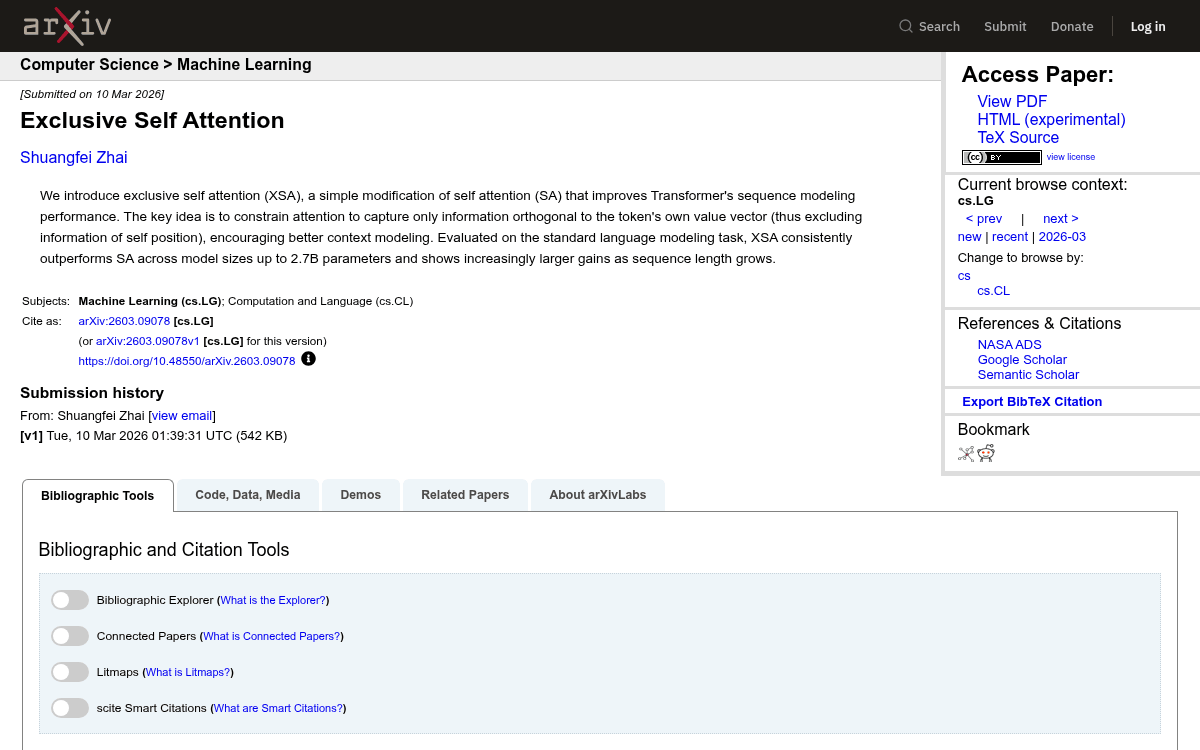
A two-line fix to standard self-attention forces Transformers to focus on context, consistently beating baselines up to 2.7B parameters with near-zero compute cost.
 Pro
Takeaways
- What happened: Apple researcher Shuangfei Zhai introduced Exclusive Self Attention (XSA), a two-line modification to standard Transformer self-attention.
- The problem: Standard attention wastes capacity echoing each token's own value vector back to itself, competing with the FFN layer's job.
- The fix: XSA removes the component of the attention output that points along the token's own value vector, forcing attention to focus purely on context.
- Results: XSA outperforms standard attention at 0.7B, 1.4B, and 2.7B scales on 8 benchmarks, with gains growing from +0.26 to +1.36 average accuracy points.
- Long-context bonus: Gains widen as sequence length increases (tested up to 16,384 tokens), making XSA especially relevant for long-context applications.
- Cost: Near-zero compute and memory overhead; no new parameters; drop-in replacement requiring no hyperparameter retuning.
Every Transformer ever trained has a quiet inefficiency baked into its attention mechanism. A researcher at Apple just found it, named it, and fixed it in two lines of code. The result is Exclusive Self Attention (XSA), a minimal modification to standard self-attention that consistently improves language model performance across every model size tested, and gets more effective the longer your sequences get.
The Hidden Redundancy in Every Attention Layer
To understand the problem, recall how self-attention works: each token computes a weighted sum of value vectors from all previous tokens (including itself). The output at position i is y_i = sum(a_{i,j} * v_j), where the weights a_{i,j} are the attention scores. Nothing stops the model from heavily weighting its own position, a_{i,i}, and pulling in its own value vector v_i.
The paper calls this the attention similarity bias: the output of attention tends to be highly similar (in cosine similarity terms) to the token's own value vector. Across a trained 1.3B-parameter model, this bias grows layer by layer, meaning later layers are increasingly just echoing each token back to itself.

Why is this a problem? Transformers already have a dedicated component for per-token feature transformation: the Feed-Forward Network (FFN). When attention wastes capacity doing the same thing, it creates a direct competition between modeling context (attention's actual job) and modeling the token itself (FFN's job). The two components step on each other.
The Fix: Two Lines of Math
XSA adds a single projection-removal step after standard attention runs. Once you have the normal attention output y_i, you subtract the component of y_i that lies along the direction of the token's own value vector v_i:
# After standard multi-head attention produces Y:
Vn = torch.nn.functional.normalize(V, dim=-1)
Z  = Y - (Y * Vn).sum(dim=-1, keepdim=True) * Vn
This is a vector projection (Gram-Schmidt style): you are removing whatever part of the attention output points in the same direction as the token's own value. The result Z is guaranteed to be orthogonal to v_i, meaning the attention output can no longer contain the token's self-information. The full PyTorch implementation, as shown in the paper, is a drop-in replacement for any standard multi-head attention block.
No new parameters are introduced. No architectural changes are required. The attention scores, queries, keys, and values are all computed identically to standard attention. XSA only modifies what happens to the output after the weighted sum.
What the Numbers Say
The paper tests XSA against standard Transformers at three scales -- 0.7B, 1.4B, and 2.7B parameters -- all trained for 100B tokens on the FineWeb-100BT dataset using the NanoGPT codebase with RoPE position embeddings.
Key results across 8 downstream benchmarks (ARC-Easy, BoolQ, HellaSwag, LAMBADA, OpenBookQA, PIQA, SocialIQA, WinoGrande):
- 0.7B: XSA average accuracy 53.48% vs. baseline 53.22% (+0.26 pp)
- 1.4B: XSA average accuracy 57.19% vs. baseline 56.16% (+1.03 pp)
- 2.7B: XSA average accuracy 59.42% vs. baseline 58.06% (+1.36 pp)
The gains compound with scale. The paper notes that XSA claims larger gains as sequence length increases, suspecting this is due to the increasing tension on context modeling for longer sequences, which makes the benefit of XSA more pronounced. Tested at sequence lengths from 512 to 16,384 tokens, the advantage of XSA widens monotonically.

XSA introduces minimal overhead in terms of both speed and memory , benchmarked on a B200 GPU across varied sequence lengths and model sizes. The two extra lines of computation are negligible compared to the attention operation itself.
Robustness Checks
The paper runs several ablations that practitioners will care about:
- Learning rate sensitivity: XSA maintains a near-constant margin over the baseline across four different learning rates on the 1.3B model. You do not need to re-tune your optimizer.
- Attention sinks: Attention sinks are a technique where a few learned "sink" tokens absorb excess attention scores to stabilize long-context generation. XSA maintains its advantage even when sinks are added to both models, confirming the two ideas are complementary.
- Training stability: XSA tracks the baseline loss curve shape throughout training, just shifted downward. There are no instability spikes or divergence patterns.
The Bigger Picture
The core hypothesis is that, in the presence of residual connections and the FFN block, XSA maintains the expressiveness of standard SA and promotes modeling efficiency by allowing the attention layer to exclusively focus on contextual information. In other words, XSA does not remove information from the model -- the token's own value vector still flows through the residual connection directly to the FFN. It just stops attention from redundantly re-encoding it.
The connection to long-context scaling is the most commercially relevant finding. As context windows push toward 128K and beyond, the tension between self-referential attention and genuine context modeling only grows. The paper suggests that XSA is a promising technique for long context modeling, one of the critical problems of scaling Transformers.
Open questions the paper flags for future work include behavior at larger scales (beyond 2.7B), compatibility with alternative optimizers like Muon, and whether the gains transfer to non-language modalities like vision or audio. Interest in applying XSA to diffusion models has already emerged , where the same self-referential redundancy appears in patch-based attention. No code repository has been released alongside the paper, but the full PyTorch pseudocode is included in the paper and the implementation is straightforward enough to reproduce in minutes.