
Apple Releases mAceReason-Math to Fix AI's Multilingual Math Blind Spot
Apple releases 140k translated math problems across 14 languages, filling a critical gap in multilingual reinforcement learning training data.
 Pro
Takeaways
- Apple released mAceReason-Math, ~140k challenging math problems translated into 14 languages for RLVR training.
- Source is NVIDIA's AceReason-Math, cleaned to remove ~4% corrupted and ~11% salvageable samples.
- Translations done with Claude Sonnet 4 using an iterative grade-and-refine loop plus native-speaker validation.
- 7,620 fully parallel training samples per language and a 190-sample human-validated parallel test set.
- Qwen3-14B leads at 88.6% average accuracy; distilled models collapse on low-resource languages like Swahili.
- Swahili, Telugu, and Bengali translations lack native-speaker validation, so quality may vary there.
Most of the recent leaps in math reasoning inside large language models trace back to a single training technique: Reinforcement Learning with Verifiable Rewards, where a model gets rewarded only when its final answer can be checked against a known solution. The technique works spectacularly, but there is a catch. Almost every high-quality problem corpus curated for it is in English, and the multilingual math datasets that do exist are too easy to teach anything to a modern reasoning model.
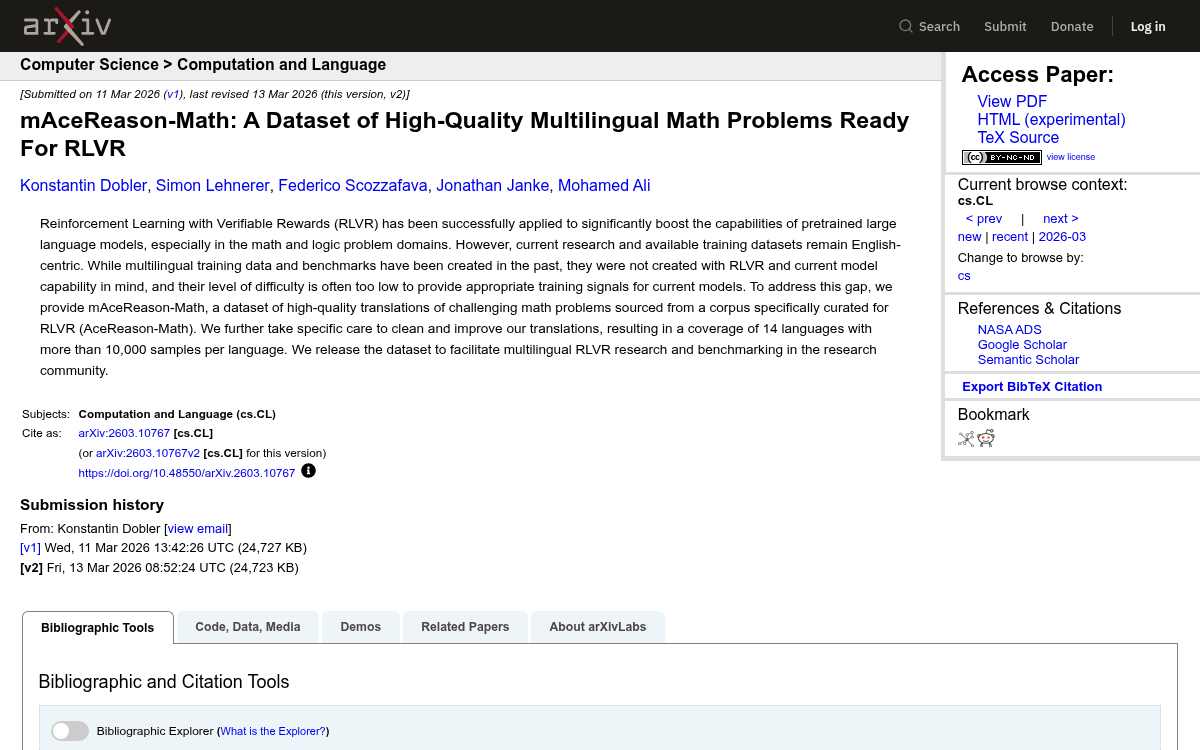
A team from Apple and the Hasso Plattner Institute is trying to close that gap with mAceReason-Math, a new dataset of roughly 140,000 challenging math problems translated into 14 languages, released alongside a paper and an open repository.
Why English-only RL data is a real bottleneck
The dataset contains translations of mathematical reasoning problems from AceReason-Math, a mathematical reasoning dataset curated for RLVR training, covering 14 languages and containing a total of about 140k translated reasoning problems and answers, released to facilitate multilingual RLVR research.
The source, AceReason-Math, was built by NVIDIA to train its AceReason-Nemotron reasoning models and sits at the difficulty level modern RL pipelines need. Existing multilingual math benchmarks like MGSM are closer to grade-school word problems, which state-of-the-art models already solve near perfectly. As the authors point out, hitting a difficulty "goldilocks zone" that matches the current policy's capability is critical for RL training signals to be useful, and easier datasets simply do not provide it. Prior challenging multilingual sets exist but cap out below 600 samples per language, which is enough for evaluation but not for training runs.
Building a clean corpus from a messy one
Rather than translating naively, the authors first ran a filtering pass on the English source. Manual inspection turned up several failure modes, which they split into two buckets:
- Critical issues (~4% of samples, discarded): problems that leak the solution in the question, open-ended prompts with numeric-only answers, references to missing diagrams or figures, samples in Croatian or Romanian instead of English, and questions requiring undefined external context.
- Salvageable issues (~11% of samples, cleaned in place): leftover task numbering like "Task 5.4:" or "[21st Math Olympiad]", broken LaTeX extraction such as
$x 2 + 5$instead of$x^2 + 5$, and stray LLM instructions from the original dataset construction.
Cleaning was done with Claude Sonnet 4 using a structured prompt that asks the model to tag corruption categories and only rewrite when confidence is high. Problems containing [asy] geometry diagram code are kept but pushed to a separate split, since solving them requires a specialized skill.
Translation with a refinement loop
Translation itself is also Claude Sonnet 4, but wrapped in a grader-refiner loop. Each problem is translated once, then graded against criteria that check mathematical accuracy, LaTeX preservation, natural fluency, and locale-specific number formatting (for example, German writes 12.345,67 where English writes 12,345.67). If the grader flags issues, a refinement prompt rewrites the translation, up to five iterations. The majority of samples do not need to enter this improvement loop and are accepted immediately.
Native-speaker annotators reviewed 100 initial translations across 10 languages, with 97% rated "acceptable" or "excellent". A final 190-item test set was human-validated with MathJax rendering so annotators could see actual formulas rather than raw LaTeX. Swahili, Telugu, and Bengali are included but were not human-verified due to a lack of available annotators.
What ships in the release
The dataset is split three ways per language:
- Parallel train split: 7,620 samples per language, where every problem exists in all 14 languages so cross-lingual experiments are directly comparable.
- Full train split: 10,270 to 12,245 samples per language, non-parallel but larger.
- Human-validated test set: 190 parallel samples across all languages.
Languages covered: English, Chinese, German, French, Spanish, Italian, Portuguese, Russian, Japanese, Korean, Thai, Bengali, Telugu, and Swahili.
How current models perform on it
The paper evaluates a spread of open and closed models on the 190-sample test set. Closed models are scored pass@1, open-weight models with avg@8 to reduce variance from sampling. Some notable numbers:
| Model | English | Average (14 langs) | Worst language |
|---|---|---|---|
| Qwen3-14B | 88.8 | 88.6 | Swahili 69.7 |
| Gemini 2.5 Flash | 78.9 | 81.4 | Swahili 76.3 |
| Claude Sonnet 4.5 | 76.8 | 75.7 | Swahili 72.6 |
| gpt-oss-20b | 79.2 | 76.3 | Swahili 64.8 |
| DeepSeek-R1-Distill-7B | 83.3 | 64.3 | Swahili 24.2 |
Two things jump out. First, distilled open models fall off a cliff on low-resource languages: DeepSeek-R1-Distill-7B drops from 83% English accuracy to 24% Swahili. Second, Qwen3 reasoning models perform suspiciously well and evenly across languages, which the authors flag as a possible sign that similar data was in Qwen3's RLVR training mix.
Where this is useful, and where it is not
The obvious use case is training or fine-tuning reasoning models with GRPO or related RLVR methods in non-English settings, something that was previously blocked by data availability. It is also a fair evaluation harness because the test set is parallel and human-checked. Limitations worth knowing: Swahili, Telugu, and Bengali did not get native-speaker validation, so quality there is likely more variable, and the automated answer verifier (Math-Verify) can misjudge complex expressions with non-US number formatting, occasionally producing false negatives during evaluation.
The dataset and full translation pipeline prompts are available under Apple's ML research organization on GitHub for anyone who wants to reproduce or extend the pipeline to more languages.