
Apple and MIT's REPO Beats GPT-4.1 by Stopping AI Reasoning From Collapsing
Apple researchers show that RL post-training silently kills the diversity of language models, and offer both numerical fixes and new algorithms to keep exploration alive.
 Pro
Takeaways
- Apple and MIT paper argues entropy must be actively monitored and controlled throughout RL post-training of language models.
- GRPO can shed nearly 90% of policy entropy during training; DAPO and GSPO implicitly protect it via asymmetric clipping.
- Default bf16 casting in HuggingFace Accelerate and FSDP2 creates an upward bias in importance ratios that silently collapses entropy.
- New algorithm REPO modifies the advantage function; ADAPO adaptively tunes DAPO's asymmetric clip based on measured entropy.
- With FP16 training and the numerical fix, plain RLOO hits 79% / 71% on AppWorld Test Normal / Test Challenge with Qwen-3-32B.
- Entropy-preserving methods retain trainability for sequential learning; GRPO checkpoints struggle when fine-tuned on a new task.
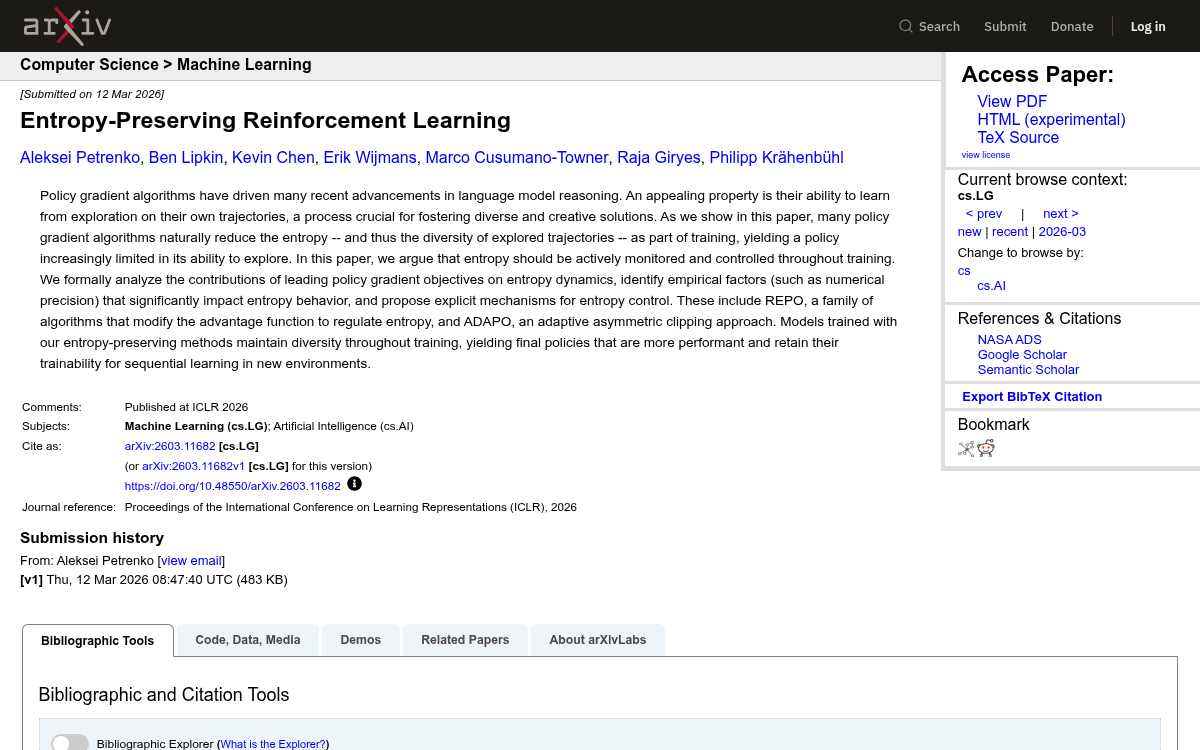
Reinforcement learning has become the default recipe for teaching language models to reason, but it has an ugly habit: the longer you train, the narrower the model gets. A new paper from Apple and MIT, Entropy-Preserving Reinforcement Learning, argues that policy entropy should be treated as a first-class signal during training, not an afterthought, and delivers a mix of theory, low-level numerical fixes, and two new algorithms that push the state of the art on the AppWorld agent benchmark.
The quiet death of exploration
Policy gradient algorithms like GRPO, LOOP, DAPO, and GSPO drive most recent language-model reasoning gains by sampling trajectories from the current policy and using them to estimate a gradient that maximizes expected reward. The problem is that this loop tends to eat its own tail. In an issue known as entropy collapse, training excessively narrows the distribution around already high-probability solutions from the base model, ignoring other correct but less likely options, which often leads to premature convergence and improves pass@1 at the expense of pass@k.
The authors reframe the diagnosis in a memorable way: a lower-entropy trajectory throughout training yields lower final performance, while runs that only diverge in entropy near the very end perform similarly. In short, the whole training curve of entropy matters, not just the final value.
Where the entropy actually leaks out
Section 3 of the paper works out the math of how each popular objective moves entropy per update. The short version:
- PPO's multiple off-policy updates amplify entropy collapse, but its clipping bounds how much entropy can change per step.
- DAPO's asymmetric clipping and GSPO's sequence-level clipping provide implicit entropy preservation by allowing larger entropy increases than decreases.
- Even strictly on-policy RLOO is subject to the same dynamic: if the base policy is already well-calibrated, advantages and log-probabilities are positively correlated and entropy falls.
Formally, they prove that PPO-style clipping bounds the new policy's entropy in a symmetric window [(1-eps_low) H_old, (1+eps_high) H_old], which means asymmetric bounds (like DAPO's 0.2/0.28) let entropy drift upward on average.
The bfloat16 trap
The most surprising contribution is empirical, not theoretical. Common training stacks such as HuggingFace Accelerate with FSDP2 cast model outputs to the training dtype before computing the importance ratio, so the ratio is effectively evaluated as an exponential of two bf16-rounded log-probabilities. The authors prove this rounding produces a systematic upward bias in the observed probability ratio, and the bias grows with the ratio itself.
The practical effect is a hidden asymmetric clip pointed the wrong way. Advantageous tokens hit the upper clip earlier so their probability can't grow, while disadvantageous tokens are pulled toward 1 and escape the lower clip, which is equivalent to asymmetric clipping with eps_low greater than eps_high, the opposite of DAPO's entropy-preserving asymmetry. Combining a full-precision fix with FP16 training (which recent work already flagged as more stable than BF16) qualitatively changes the picture: DAPO's entropy collapse in one Qwen-3-8B AppWorld setting flips into a rapid entropy increase once both fixes are applied.
REPO and ADAPO: turning entropy into a control signal
On top of the numerical fixes, the paper proposes two explicit controllers. Both use a simple bidirectional loop that measures policy entropy against its value in the first iteration and adjusts a coefficient up or down by a factor of two each iteration.
REPO (Regulated Entropy Policy Optimization) modifies the advantage itself. It replaces A(s,a) with A(s,a) minus a scaled, mean-centered log-probability term, so the advantage is no longer constant across a trajectory but varies per token. Two variants are studied:
- REPO-D (Decorrelate): chooses the coefficient to directly cancel the entropy-changing term predicted by the theory.
- REPO-R (Rescale): a cheap approximation that rescales advantages by
1 +/- zeta * log_pi, upweighting rare correct actions and softening penalties for rare incorrect ones.
A nice side effect: REPO-D is formally equivalent to adding an explicit entropy bonus, but estimated via REINFORCE using paired samples, so it incurs zero additional memory and acts as a control variate that reduces gradient variance when advantages and log-probabilities are positively correlated. That matters at scale, because an exact entropy bonus requires materializing the full logit tensor over the vocabulary.
ADAPO (Adaptive DAPO) takes a lighter touch. It keeps eps_low fixed at 0.2 and varies eps_high in [0.2, 0.32] based on measured entropy, shrinking or expanding the asymmetric clip to keep entropy near its initial value.
What the numbers look like
Experiments run on Qwen-3-8B and Qwen-3-32B, using the interactive AppWorld agent benchmark and AIME 2024/2025 math problems with a punishing 4K token budget. The story is consistent:
- GRPO reduces entropy by nearly 90% over training, while RLOO loses considerably less; LOOP behaves similarly to GRPO.
- On Qwen-3-32B AppWorld, ADAPO reaches 0.78 average Test Normal and 0.58 Test Challenge, beating vanilla DAPO (0.73 / 0.52) and GRPO (0.67 / 0.46).
- After switching to FP16 training, purely on-policy RLOO with Qwen-3-32B set a new AppWorld score of 79% Test Normal and 71% Test Challenge, exceeding the prior best from an agentic GPT-4.1 system on the leaderboard.
Why sequential training benefits most
The clearest practical payoff shows up when you take a model trained with RL on one task and continue training it on another. Policies trained with GRPO perform poorly in the second stage because entropy collapse has destroyed their ability to explore, while DAPO and especially REPO retain exploration ability across the switch. If you plan a curriculum, or expect to fine-tune the same base repeatedly, entropy preservation is not optional.
Practical takeaways
For anyone running RL post-training on Qwen3-class models or building on top of DAPO-style pipelines, three things are worth doing right now:
- Audit your framework for silent bf16 casts on logits and importance ratios. FSDP2 with default HuggingFace Accelerate settings is the specific culprit called out in the paper, and the fix is to override the
output_dtypeon theMixedPrecisionPolicy. - Consider FP16 training with proper loss scaling. It narrowed the inference/training probability gap in the authors' vLLM-based setup and stabilized entropy dynamics.
- Log per-token entropy every iteration and compare its trajectory across seeds. A run that flatlines entropy in the first few hundred steps is very likely stuck at a local optimum, regardless of how good pass@1 looks.
The paper does not release code as of submission, and the authors are careful to note that some of their algorithmic ideas (adaptive asymmetric clipping) were proposed concurrently by others such as BAPO. The core message is broader than any single algorithm: entropy is the variable to watch, and the difference between a state-of-the-art run and a collapsed one can come down to a floating-point cast you never noticed.