
APEX-MEM Beats Human-Level Memory Accuracy by Storing Chats as Living Graphs
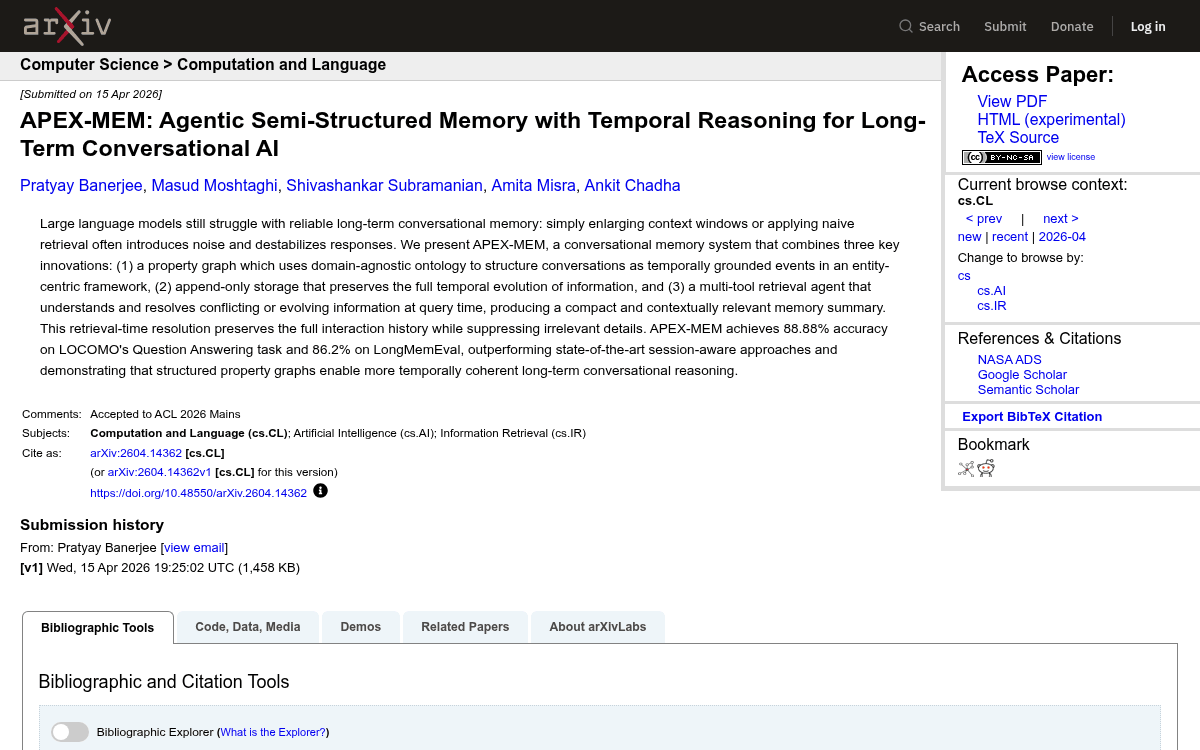
A new research paper proposes APEX-MEM, a property-graph memory system that gives chat assistants durable, temporally aware recall across long conversations.
Takeaways
- New arXiv paper introduces APEX-MEM, a property-graph memory system for long-term conversational AI.
- Combines domain-agnostic ontology, append-only storage, and a multi-tool retrieval agent for temporal reasoning.
- Reports 88.88% on LOCOMO QA and 86.2% on LongMemEval, beating session-aware baselines.
- Retrieval agent uses SchemaViewer, EntityLookUp, GraphSQL, and Search tools over a SQLite-backed graph.
- Conflicts between old and new facts are resolved at query time rather than by overwriting memory.
- No open-source release announced in the abstract; authors are independent researchers.
Long-running chat assistants have a memory problem. Stuffing everything into a giant context window is expensive and noisy, and naive vector retrieval tends to surface stale or contradictory snippets. A new arXiv paper introduces APEX-MEM, a conversational memory system built around a property graph, append-only storage, and an agent that decides how to query the graph at retrieval time.
The authors, Pratyay Banerjee, Masud Moshtaghi, Shivashankar Subramanian, Amita Misra, and Ankit Chadha, report 88.88% accuracy on LoCoMo's question answering task and 86.2% on LongMemEval, two benchmarks that stress long-horizon memory across many sessions, and claim to beat prior session-aware approaches on both.
Why long-term chat memory is still unsolved
Two benchmarks have become the standard for probing this problem. LoCoMo comprises long-term multi-session dialogues built via a human-machine pipeline grounded in personas and event graphs, with each conversation averaging around 600 turns and 16K tokens across up to 32 sessions. LongMemEval targets interactive memory in user-assistant settings and evaluates five core abilities: information extraction, multi-session reasoning, temporal reasoning, knowledge updates, and abstention when evidence is insufficient, across 500 curated questions embedded in length-configurable chat histories.