
AOMGen Turns One Robot Demo Into 88.7% Success on Unseen Objects
AOMGen turns one real robot demonstration into a diverse photoreal training set, pushing VLA success rates from 0% to 88.7% on articulated objects.
 Pro
Takeaways
- AOMGen synthesizes photoreal, physics-consistent robot demonstrations from a single scan and one real execution.
- Fine-tuning π0.5 and OpenVLA on generated data lifted success from 0% to 88.7% on articulated tasks.
- Uses 3D Gaussian Splatting plus SAM2 segmentation to reconstruct and edit the manipulation scene.
- AOMotion module recovers joint axes and motion without any recorded joint values from the object.
- Mixed-object training pushed unseen-object success from 15% to 65% within the same category.
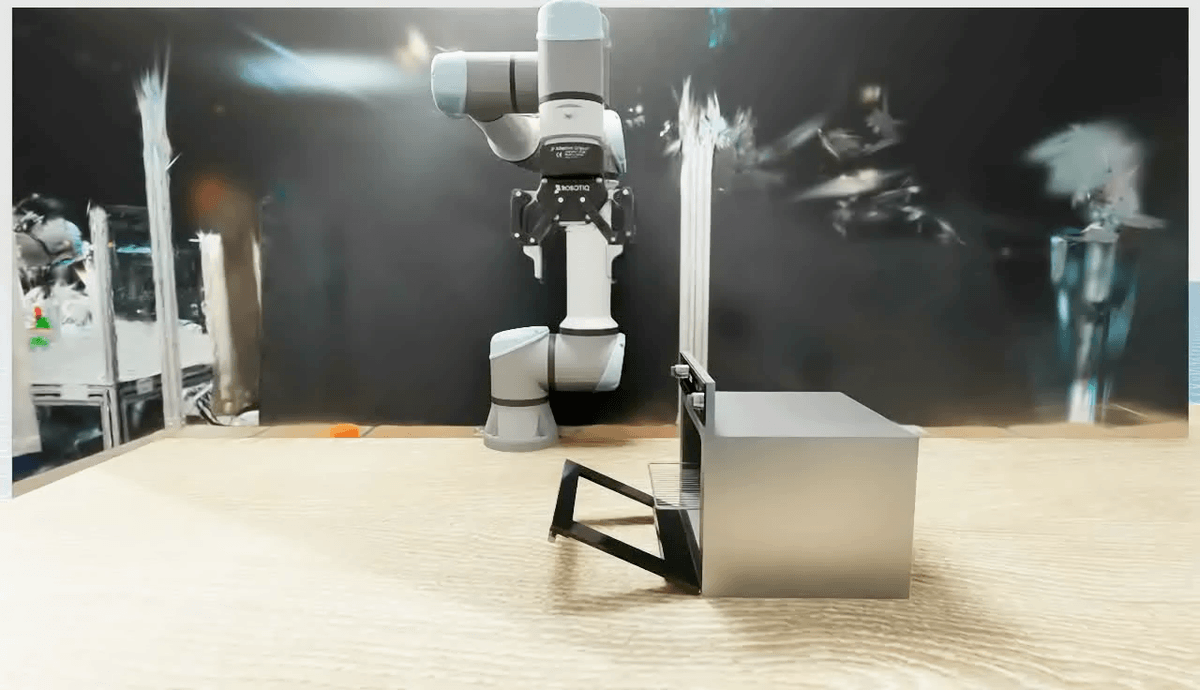
- Tested on microwaves, tool boxes, computers, drawers, and cabinets using a UR5e with 2F85 gripper. Paper
Teaching a robot to open a microwave, pull a drawer, or flip open a tool box sounds simple until you realize how many demonstrations it takes to make a Vision-Language-Action (VLA) model reliable. A new framework called AOMGen proposes a way out: start from a single real scan and one demonstration, then synthesize a photorealistic, physics-consistent training corpus that covers new objects, new poses, and new viewpoints.
The headline number is striking. Fine-tuning VLA policies on AOMGen data increases the success rate from 0% to 88.7%, and the policies are tested on unseen objects and layouts. That jump comes from expanding one execution into a diverse dataset without touching a physics simulator or collecting more real trajectories.
Why articulated objects break the usual playbook
VLA models like OpenVLA and Physical Intelligence's π0.5 have shown strong generalization, but they lean heavily on huge collections of real demonstrations. Articulated objects, meaning things with hinges, drawers, and other joint constraints, are especially hungry for data because their kinematics create richer failure modes than pick-and-place.
Two mainstream workarounds each have a well-known flaw. Physics simulators generate cheap state-action pairs but still exhibit significant gaps in visual realism compared to real-world scenes, posing substantial challenges for Sim-to-Real transfer. Video world models learn from real footage and look great, but they often provide insufficient supervision over physical realism and action executability, leading to physically inconsistent interactions. Prior demonstration-synthesis approaches like DemoGen and R2RGen sidestep both, but were limited to simple grasping, fixed object appearances, and single-view inputs.
The trick: reconstruct once, generalize many times
AOMGen sits between simulation and video generation. It uses 3D Gaussian Splatting (3DGS), an explicit radiance-field representation that renders photorealistic novel views in real time, to reconstruct the manipulation scene. Then it edits that Gaussian scene to swap in new articulated objects from the same category while preserving the physics of the original demonstration.
The pipeline has two big pieces:
- Scene Reconstruction and Motion Recovery. Segment the Gaussian points into parts using SAM2 masks, align the 3DGS coordinate frame to the real robot via ICP against the URDF, and recover articulated motion from the real arm trajectory.
- Articulated Object Replacement with Pose Generalization. Map the original object to a new digital asset of the same category, adapt contact points, transfer lighting, and inpaint the Gaussian holes left behind.
The motion recovery module, called AOMotion, is where a lot of the cleverness lives. It never records the object's joint angle directly. Instead it infers when motion starts and stops by tracking how the movable part's mask changes across frames, subtracting the robot's own mask so the gripper doesn't pollute the signal. A smoothed Motion Score with a dynamic threshold marks the start and end frames.

From there, the system finds contact points between the end-effector and the movable part, then determines the joint axis and center by scoring pairs of bounding-box edges on parallelism and distance. A rotational joint gets one sign in the scoring criterion, a prismatic (sliding) joint gets the other. The final motion angle or displacement at each timestep is fit by minimizing the distance between the robot's contact-point trajectory and the swept surface of the movable part.
Swapping in a new microwave without breaking physics
Object replacement is where the generalization comes in. Given a new asset in USD format, AOMGen normalizes both the old and new movable parts into a unit cube using a NOCS-style mapping, projects the contact point across, and denormalizes to find where the new object should be touched. A two-stage optimization then solves for scale, initial pose, and XY offset so the recorded arm trajectory actually makes contact with the new object's surface, accounting for non-uniform motion and gripper slippage.
Visual realism gets its own pass. The team uses DiffusionLight to extract lighting from the real environment, then bakes the ambient lighting onto the object's material in Blender. Gaussian Inpainting is applied to handle the Gaussian holes caused by object replacement. Pose generalization goes one step further by transforming the target object's pose, keeping the mid-trajectory relative to the object, and using linear plus spherical interpolation on the approach and retreat segments before running inverse kinematics.
What the numbers say
The team tested on a UR5e with a 2F85 gripper across five object categories drawn from ArtVIP: microwave oven, tool box, and computer (rotational joints) plus drawer and cabinet (prismatic joints). Fine-tuning used LoRA on both π0.5 and OpenVLA.
Simulator replay of generated trajectories hit an average success rate of 98% across all five objects, confirming that the synthesized interactions obey the basic physics. On downstream policy performance, both models improved sharply as the number of AOMGen demonstrations grew from 0 to 50 to 150, with π0.5 topping out at 88.66% and OpenVLA at 81.34% on average.

Robustness experiments push further. Scaling a microwave or drawer between 0.6x and 0.9x of its original size, π0.5 still hit 65 to 90% success without any additional training. And when mixing data from multiple objects in the same category, a completely unseen object jumped from 15% success (single-object training) to 65% (mixed training).
Where it helps, where it doesn't
AOMGen fits a specific niche well. If you have a real robot, one high-quality static scan, one clean demonstration, and a library of digital assets of the same category, you can bootstrap a training set that would otherwise require dozens of teleoperated sessions. It is particularly attractive for fine-grained articulated tasks where sim-to-real gap has been a persistent problem.
The limits are also clear. Category is defined narrowly: objects that have similar relative joint positions within the overall object (e.g., all joints are positioned below of the object) and exhibit the same joint motion patterns. Cross-category transfer is out of scope. The framework also assumes you can produce a clean 3DGS reconstruction and that the interaction is a single articulated motion. Complex multi-step tasks, deformable objects, or scenes with heavy occlusion during the scan would need more work.
The paper does not appear to release code or model weights alongside the arXiv preprint, so reproducing the full pipeline currently means reimplementing the segmentation, motion recovery, and replacement stages from the description. Still, the individual building blocks, SAM2, COLMAP, 3DGS, DiffusionLight, and ArtVIP assets, are all publicly available, which lowers the barrier for anyone wanting to try a similar recipe.