
Anyreach AI's DualTurn Beats 3.1B Models at Predicting When Humans Stop Talking
DualTurn uses generative speech pretraining to teach a 0.5B model human-like turn-taking, beating models 6x its size and anticipating turn endings 220ms earlier
 Pro
Takeaways
- DualTurn is a 0.5B turn-taking model for voice pipelines that anticipates conversation turn-ends instead of waiting for silence timeouts.
- It uses two-stage training: generative pretraining on dual-channel audio (no labels), then fine-tuning six classification heads for turn signals.
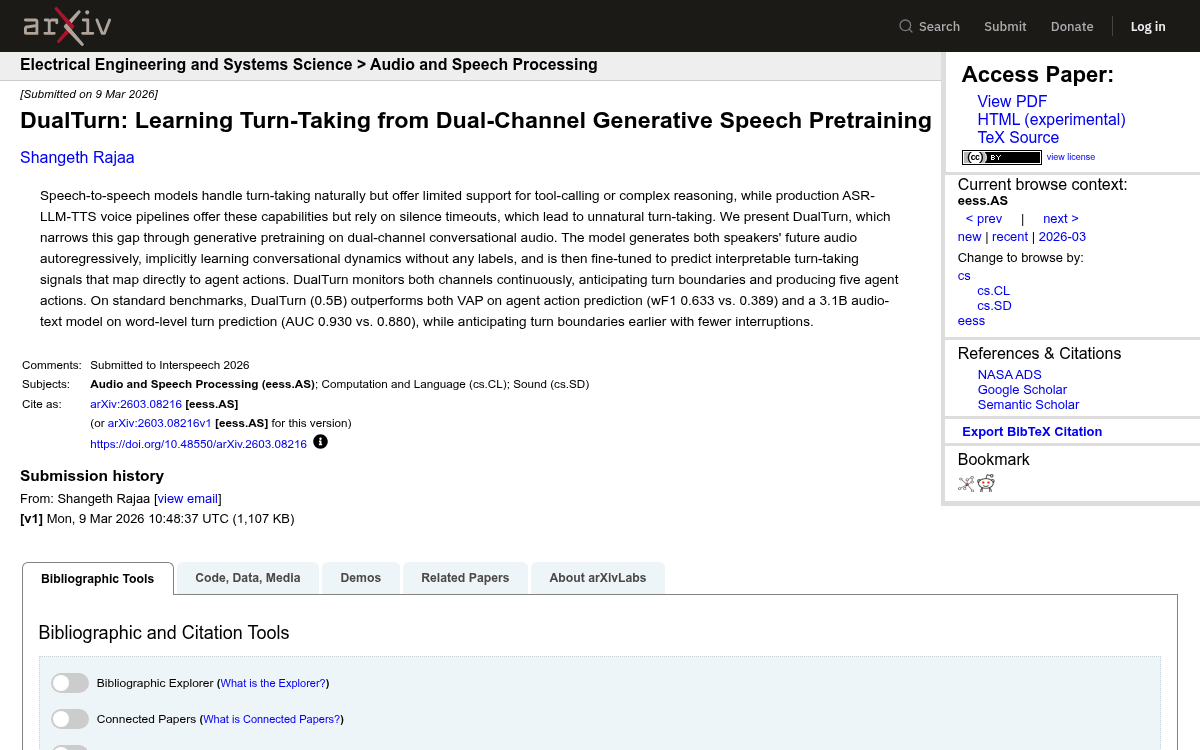
- Outperforms VAP on agent action prediction (wF1 0.633 vs. 0.389) and beats a 3.1B audio-text model on word-level turn prediction (AUC 0.930 vs. 0.880).
- Anticipates turn boundaries 220ms earlier than VAP and reduces false interruptions by 5 percentage points.
- Backchannel prediction (knowing when to say "uh-huh") jumps from near-zero to BC F1 0.349 -- only possible with generative pretraining.
- Code, model checkpoint, and dataset are open on Hugging Face and GitHub; currently English-only, two-party conversations only.
Every voice AI pipeline today faces the same awkward problem: it waits for silence before it speaks. Whether you're building with LiveKit, Twilio, or a custom stack, the standard approach is to run a Voice Activity Detector (VAD) -- a model that flags when audio is present -- and fire off a response once silence has lasted long enough. Turn detection is the hardest product problem: too sensitive causes interruptions; too conservative creates awkward silence. It's a blunt instrument, and every user who has ever been cut off mid-sentence by a voice bot has felt the consequences.
A new paper from Anyreach AI introduces DualTurn, a 0.5B-parameter model that replaces silence-based endpointing with something much closer to how humans actually listen: continuously monitoring both sides of a conversation and anticipating when a speaker is about to finish, rather than reacting after they already have.
The two-way trap voice AI is stuck in
The voice AI field has split into two camps, and both have real problems. Speech-to-speech models handle turn-taking naturally but offer limited support for tool-calling or complex reasoning, while production ASR-LLM-TTS voice pipelines offer these capabilities but rely on silence timeouts, which lead to unnatural turn-taking. In other words: the models that sound natural can't reason, and the ones that can reason sound robotic.
The modular pipeline -- Audio In → VAD → ASR → LLM → TTS → Audio Out -- is the production standard because it's controllable, debuggable, and lets you plug in the best model at each stage. Human conversation typically features very short gaps between turns, often on the order of a couple hundred milliseconds, and timing is considered a core constraint on language processing in dialogue. A silence timeout of 500ms or more already violates that expectation before the LLM has even started generating.
The closest prior art is Voice Activity Projection (VAP), a self-supervised model that predicts future conversational patterns directly from raw acoustic inputs, unlike traditional turn-taking approaches that rely on reactive silence thresholds or specific event labels. But VAP collapses everything into binary voice-activity probabilities and has a critical blind spot: it cannot distinguish a backchannel (a quick "uh-huh") from an actual turn-end. Its 5.8M-parameter encoder also lacks the capacity for semantic understanding.
Teach a model to predict speech, and turn-taking comes for free
DualTurn's core insight is that the best way to learn conversational dynamics is not to label them -- it's to predict them. The model is trained in two stages:
- Stage 1 -- Generative Pretraining: The model learns to autoregressively predict both speakers' next audio tokens simultaneously, given the full dual-channel conversation so far. No labels, no annotations. The model just has to predict what either person will say next. This forces it to internalize prosody, semantics, and the rhythm of conversation.
- Stage 2 -- Signal Fine-tuning: The generative head is discarded. Six lightweight classification heads are attached to the frozen backbone and trained to predict six interpretable per-channel signals: End-of-Turn (EOT), Hold (mid-turn pause), Beginning-of-Turn (BOT), Backchannel (BC), Voice Activity (VAD), and Future Voice Activity (FVAD). All labels are derived automatically from voice activity alignment -- no human annotation required.

The architecture uses the Mimi neural codec (from Moshi) to encode 24kHz audio into 512-dimensional continuous embeddings at 12.5 frames per second. These feed into a Qwen2.5-0.5B LLM backbone. The model can monitor both speakers' channels continuously, running on a single CPU. Inference latency is around 78ms on CPU and 27ms on a GPU.
The six signals then combine into five concrete agent actions that map directly to pipeline decisions:
- Start-Talking (ST): User finished, agent should respond
- Continue-Listening (CL): User paused mid-thought, agent should wait
- Start-Listening (SL): User started talking over the agent (long overlap)
- Continue-Talking (CT): Brief overlap, agent keeps going
- Backchannel (BC): Agent should produce a short acknowledgment like "mm-hmm"
This mapping can be done with a zero-parameter heuristic (simple thresholds on the signals) or a logistic regression probe trained on validation data. Either way, the neural model does the heavy lifting.
Pretraining is the teacher; the LLM is just the vessel
The ablation results are the most revealing part of the paper. The authors tested seven variants, swapping out the backbone, removing pretraining, and changing the input format. The conclusion is stark: over 99% of gains in total BC F1 come from pretraining, not from architecture. An 8M-parameter LSTM pretrained the same way performs nearly identically to the 500M-parameter Qwen backbone without pretraining.
Backchannel prediction is where this becomes most dramatic. Every model without Stage-1 pretraining achieves a BC F1 of around 0.079 -- barely above chance. The two pretrained models hit 0.337--0.349, a relative gain of +340% in recall. The improvement in BC is substantial rather than incremental, with recall increasing from 0.045 to 0.458. VAP, for comparison, scores BC F1 = 0.000 because it has no dedicated backchannel signal at all.
An attention analysis explains why. After pretraining, the transformer develops a natural hierarchy: six layers handle short-range acoustic detail (under 1 second), while three layers maintain long-range conversational context reaching back 12--15 seconds. Without pretraining, this structure doesn't emerge. The model also develops action-specific attention patterns without any explicit supervision -- for example, the user channel gets 3.77x more attention weight when predicting the Continue-Listening action.
A codebook ablation also confirmed that semantics and prosody drive turn-taking far more than fine acoustic detail: 56% of the turn-end discrimination signal comes from CB0 (semantics), CB1 contributes 26%, and the remaining 18% from CB2-7 together.
Beating models 6x its size
On the standard Switchboard benchmark (138-session test split used across all prior work), DualTurn's results are clear:
| Model | wF1 (5 classes) | BC F1 | Ant@-240 (AUC) |
|---|---|---|---|
| VAP (LR-6) | 0.389 | 0.000 | 0.780 |
| DualTurn LoRA (0.5B) | 0.633 | 0.349 | 0.874 |
| DualTurn Full FT (0.5B) | 0.626 | 0.337 | 0.879 |
DualTurn (0.5B) outperforms both VAP on agent action prediction (wF1 0.633 vs. 0.389) and a 3.1B audio-text model on word-level turn prediction (AUC 0.930 vs. 0.880), while anticipating turn boundaries earlier with fewer interruptions. On word-level prediction, even the single EOT signal alone (zero aggregation parameters) outperforms the 3.1B model.
The anticipation gap is practically significant. DualTurn picks up on turn boundaries about 220ms before VAP does, reacting at a median of -360ms vs. -140ms relative to turn end. It's also less trigger-happy: false start-talking events drop from 27.4% to 22.4% of cases.
What it's trained on, and where to get it
Training used approximately 453 hours of dual-channel conversational audio: the otoSpeech dataset and Switchboard, with training code available at github.com/anyreachai/dualturn and a model checkpoint at anyreach-ai/dualturn-qwen2.5-mimi-0.5B. The preprocessed Switchboard dataset with per-frame labels is also available on Hugging Face.
There are real limitations to keep in mind. The model was trained entirely on English two-party speech. Backchannel prediction, while dramatically improved, still has precision of only 0.282 -- the authors recommend using it as a soft signal rather than a hard trigger. The model also currently handles only dyadic (two-person) conversations, and scaling to multilingual or multi-party settings is listed as future work.
The broader takeaway is a design principle that will likely influence how voice AI pipelines are built going forward: you don't need to label conversational dynamics to learn them. Train a model to predict what people will say next, and it will figure out when they're done speaking on its own. That's a much cheaper and more scalable path than annotation -- and apparently, a more accurate one too.