
Ant Group's CRAFT-GUI Beats UI-TARS-72B on Android Tasks With Smarter RL Training
Ant Group's CRAFT-GUI trains mobile agents like humans learn apps, stacking curriculum learning on GRPO to lift success rates 10.3% over baselines.
 Pro
Takeaways
- CRAFT-GUI from Ant Group and Zhejiang University pairs GRPO with a three-stage curriculum for GUI agents.
- Training data is stratified by trajectory length: 3 steps or fewer, 4 to 8 steps, and more than 8 steps or visual understanding.
- Hybrid reward splits tool selection, argument accuracy, format compliance, and length penalty rather than one scalar.
- Beats UI-TARS-72B by 5.1 points on AndroidWorld (51.7% vs 46.6%) using a smaller 32B base.
- Ablations show curriculum adds 3.8% over vanilla GRPO, and length penalty prevents catastrophic reasoning loops.
- No weights or code released, and insurance-app tasks remain unsolved at 60.4% success.
Training a model to tap through a food delivery app is not the same as teaching it to file an insurance claim across eight screens. Yet most reinforcement learning pipelines for GUI agents treat every trajectory as equal weight training data, and squeeze the whole thing into one coarse reward. A team from Ant Group and Zhejiang University argues that is why RL-trained GUI agents keep plateauing, and their CRAFT-GUI paper proposes a fix that reads like the ML equivalent of a school syllabus.
The system pairs Group Relative Policy Optimization (GRPO) with a three-stage curriculum, feeds it a reward function that mixes hard rules with model-judged semantic scores, and reports meaningful gains on both public and private benchmarks. Experiments show 7.1% improvement on AndroidWorld and 10.3% on a private benchmark over prior state-of-the-art approaches.
Why uniform training breaks GUI agents
Recent GUI agents like UI-TARS, OS-Atlas, and Aguvis have shown that reinforcement learning with verifiable rewards can push mobile automation past what supervised fine-tuning delivers. But existing implementations exhibit three fundamental limitations: data distribution bias where no method systematically addresses the impact of imbalanced difficulty; task scope restriction with excessive focus on operation tasks and inadequate support for understanding tasks; and reward granularity issues from overly simplistic reward formulations lacking multi-dimensional feedback.
The authors compare it to expecting a child to master elementary and university curricula at the same time. A single-step tap on a login button and an eight-step medical booking flow generate wildly different reward signals, and jamming them into one policy update produces unstable gradients and stunted capability growth.
Three difficulty tiers, one policy
CRAFT-GUI stratifies training data by trajectory length, which turns out to be a decent proxy for difficulty. Stage 1 covers basic level tasks requiring 3 or fewer interaction steps. Stage 2 handles intermediate level tasks involving 4 to 8 steps, representing typical multi-step operational workflows. Stage 3 targets advanced level tasks requiring more than 8 steps or involving visual understanding components such as VQA, information extraction, and element localization.
Visual understanding tasks get bundled into the hard tier because they demand fine-grained semantic reasoning rather than just motor accuracy. Training progresses stage by stage: the policy model finishes Stage 1, becomes the new reference model for KL regularization, then advances to Stage 2, and so on.

Reward that actually tells the agent what went wrong
The reward design is where the paper does its most useful engineering. Instead of a single scalar for task success, mobile operations are broken into weighted components:
- Tool selection reward: did the agent pick
clickwhen it should have pickedswipe? Binary 0 or 1. - Argument accuracy reward: for click, the predicted coordinate must land inside the same widget as the ground truth. For swipe, a prediction is considered valid if the angle between the predicted swipe vector and the ground-truth vector is within 30 degrees. Text inputs use semantic similarity plus character matching.
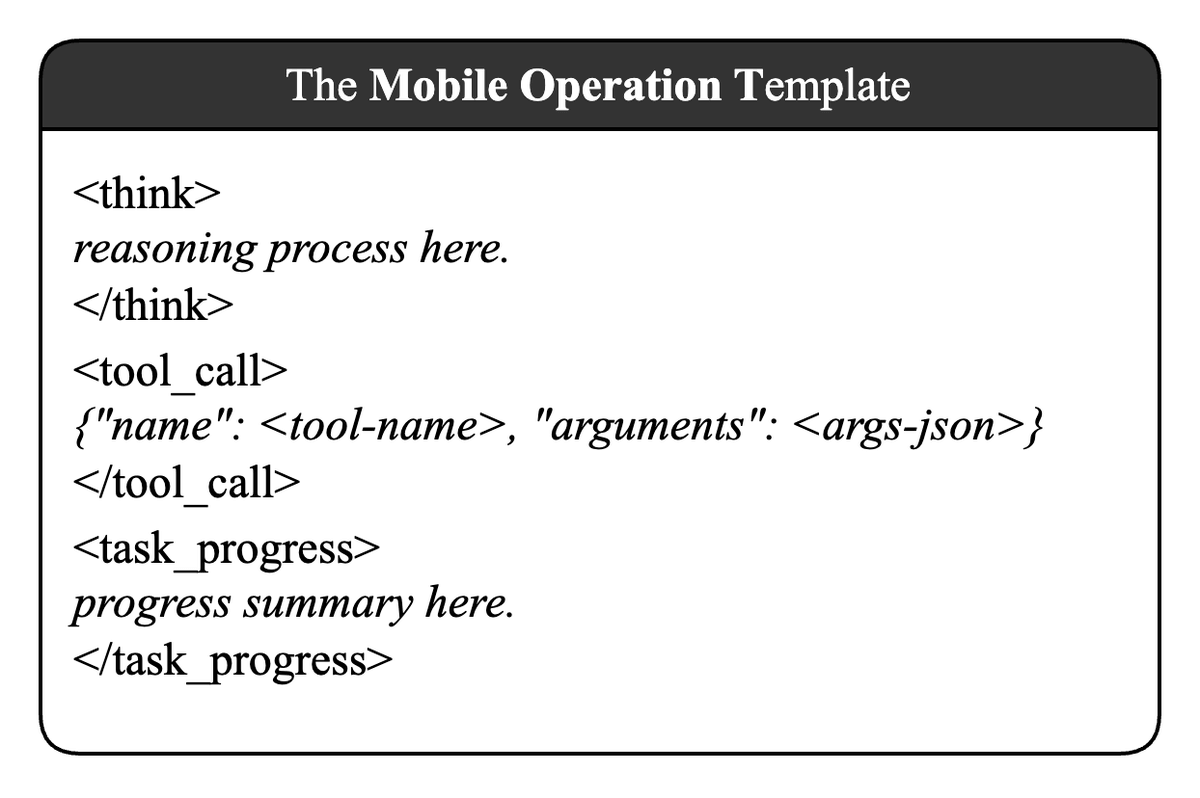
- Format reward: outputs must use HTML-style tags with
<think>,<tool_call>, and<task_progress>sections. - Length penalty: a graduated penalty on responses exceeding a soft threshold, borrowed from DAPO's optimization principles.
That length penalty is not cosmetic. Without length penalty regulation, the model progressively generates excessive nonsensical phrases and enters infinite reasoning loops until exceeding the maximum sequence length threshold, ultimately leading to catastrophic performance collapse. The ablation showed a 12.2% drop in average success rate when the penalty was removed.
For visual understanding tasks (VQA, info extraction, element localization), the team leans on a model-as-judge signal. They remotely deploy a small language reward model for semantic evaluation, which implements a comprehensive multi-dimensional assessment framework considering entity consistency, content alignment, contextual emphasis, and paraphrase robustness. Scores are discretized to {0, 0.2, 0.4, ..., 1} rather than a raw continuous similarity.
How the numbers land
The team trained Qwen2.5-VL at 7B and 32B parameters on roughly 96 A100 GPUs. On the public AndroidWorld benchmark, CRAFT-GUI-32B hit 51.7% success rate after all three curriculum stages, versus 46.6% for UI-TARS-72B and 35.0% for the vanilla Qwen2.5-VL-72B baseline. On Android Control-High, it reached 80.3% SR compared to UI-TARS-72B's 74.7%.
The stage-by-stage progression is the most convincing part of the results:
| Stage | CRAFT-GUI-7B | CRAFT-GUI-32B |
|---|---|---|
| Stage 1 (basic) | 43.9% | 62.6% |
| Stage 2 (intermediate) | 52.4% | 69.9% |
| Stage 3 (advanced) | 64.1% | 75.7% |
The ablation isolates the curriculum contribution cleanly. Vanilla GRPO beats SFT by 11.1%, and adding curriculum ordering on top adds another 3.8%. Mixing operation and understanding data in Stage 3 pushes operational success up 2.5% versus operation-only training, suggesting the two skills reinforce each other.
The internal benchmark is where it gets interesting
Beyond public datasets, the team built an online evaluation environment across six real-world mobile app categories. The benchmark's tasks are statistically derived from real-human interaction logs, preserving authentic operational frequency across application domains, with each category containing 120-200 unique test cases with configurable difficulty levels.

Against strong baselines, CRAFT-GUI-32B's 75.7% average beat Claude-3.7-Sonnet (35.9%), GPT-4.1 (27.7%), UI-TARS-72B (65.4%), and Qwen2.5-VL-72B (64.8%). The gap against Claude and GPT is enormous because those models were used without task-specific fine-tuning, but the 10-point lead over UI-TARS-72B is on comparable footing.
What it is good for and what it is not
CRAFT-GUI targets Chinese mobile ecosystems with heavy screen density, dynamic pop-ups, and multi-step transactional flows. The category mix (food delivery, dine-in, medical, finance, insurance, gaming) suggests it was built for consumer-facing app automation rather than developer tooling or web browsing.
Weak spots worth flagging:
- No code or weights released. The paper and appendix describe the training recipe in detail but no repository or checkpoint has been published. Reproducing it requires substantial GPU budget and a proprietary 80K-sample dataset.
- Gaming apps are essentially solved by every model, hovering above 92% across all baselines, which suggests that category inflates the averages.
- Insurance stays hard. Even the strongest CRAFT-GUI variant only reaches 60.4% on insurance apps, hinting that regulatory-heavy flows with complex conditional logic remain unsolved.
- Trajectory length as difficulty is a rough proxy. A short task with obscure UI elements may be harder than a long one with obvious buttons, and the curriculum does not account for this.
The real takeaway
The headline is a curriculum + GRPO combo, but the more useful contribution is the reward decomposition. Splitting tool selection from argument accuracy, adding a widget-level tolerance for click coordinates, and using an angular threshold for swipes turns success into a dense signal that credit-assigns properly. That is transferable to any GUI agent training pipeline, curriculum or not.
The team plans to extend CRAFT-GUI to desktop computer tasks and introduce trial-and-error with rollback, which is where GUI agents historically fall apart. If they release weights, this could become a solid starting point for anyone training vertical mobile agents rather than chasing a general-purpose one.