
AMD Research's qs Inequality Reveals Why MoE Models Are 5x Slower to Serve
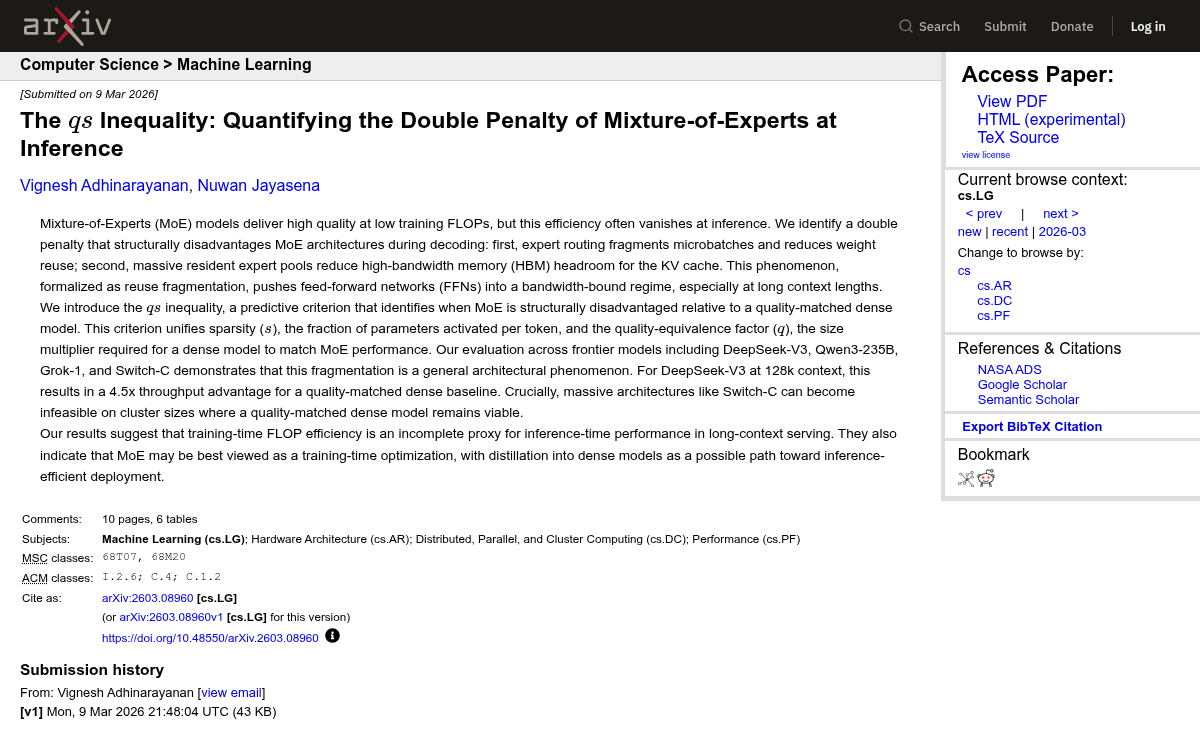
A new paper from AMD Research formalizes why MoE models, despite their training efficiency, are structurally slower than dense models at long-context inference — and by how much.
 Pro
Takeaways
- Core finding: MoE models are structurally slower than quality-matched dense models at inference, especially at long context, due to a "double penalty" on weight reuse.
- The qs inequality: A new formula combining sparsity (s = k/E) and quality-equivalence factor (q ≈ 4–6x) predicts when MoE is bandwidth-disadvantaged; all tested frontier MoEs satisfy qs < 1.
- Benchmark results: A quality-matched dense model achieves up to 5.3x higher throughput than DeepSeek-V3 at 16k context, and 4.5x at 128k context on 64 GPUs.
- Root cause: Expert routing fragments batches (each expert sees only Bk/E tokens on average), and the full expert pool crowds out KV cache memory, compounding the reuse loss.
- Extreme case: Switch-C-2048 becomes completely infeasible at 128k context on 64 GPUs — the expert weights alone exceed available HBM.
- Recommendation: Use MoE for training efficiency, then distill into dense models for inference-efficient deployment, particularly for long-context serving.
Mixture-of-Experts (MoE) models deliver high quality at low training FLOPs, but this efficiency often vanishes at inference. That is the uncomfortable finding at the center of a new paper from AMD Research, which puts a precise mathematical framework around something practitioners have quietly suspected: the same sparsity that makes MoE cheap to train makes it expensive to serve, especially as context windows grow. The paper introduces the qs inequality, a compact formula that predicts exactly when an MoE model is structurally slower than a quality-matched dense alternative.
The MoE gold rush and its hidden cost
Nearly every major open-weight LLM released in 2025-2026 uses a Mixture of Experts architecture , Llama 4, DeepSeek V4, Qwen 3.6, Kimi K2.6, gpt-oss, Cohere Command A+, and more. The appeal is obvious: MoE separates active parameters (used per token) from total parameters (loaded in memory). A "400B model" may only run 17B per token. This shifts the inference cost equation: compute per token goes down, but memory footprint stays high.
What the industry has been slower to internalize is that this trade-off has a breaking point. The active-to-total ratio keeps dropping , roughly 25% in Mixtral, ~4% in Llama 4 Maverick and Qwen 3.5, ~3% in DeepSeek V4 Pro. Sparser models train more efficiently but require more memory per useful FLOP delivered. The AMD paper formalizes exactly where this breaks down.
The double penalty, explained
The paper identifies two compounding problems that disadvantage MoE at inference time. To understand them, it helps to know how autoregressive decoding works: the model generates one token at a time, and at each step it must read its weight matrices from GPU memory (HBM). The more tokens you can process in a single batch, the more you amortize that memory read across tokens , this is called weight reuse.
The reuse principle holds that inference efficiency scales with the number of tokens that reuse each weight read, rather than with the number of FLOPs avoided. Dense feed-forward networks naturally satisfy this principle by amortizing weight fetches across an entire microbatch. MoE layers do not do so under realistic inference constraints. Here is why:
- Routing fragmentation: Expert routing partitions the microbatch across experts, reducing per-expert reuse and increasing weight traffic per token. If you have 256 experts and activate 8 per token (like DeepSeek-V3), each expert only sees 1/32nd of your batch on average.
- KV cache crowding: Because the full expert pool must remain resident across the serving cluster, MoE consumes high-bandwidth memory (HBM) capacity that would otherwise be available for KV cache. Less KV headroom means smaller feasible batch sizes, which further shrinks per-expert batches , a compounding loop.
The paper calls this combined effect reuse fragmentation. For a batch of B tokens routed through E experts with top-k selection, the average expert-local batch size is just B * k / E. When E is large and B is constrained by KV memory, this collapses toward 1 , meaning each expert reads its entire weight matrix to process a single token.
The qs inequality
The central contribution is a single inequality that tells you whether an MoE model is structurally disadvantaged at inference relative to a quality-matched dense model. It combines two quantities:
- s (sparsity): the fraction of parameters activated per token, equal to
k/E - q (quality-equivalence factor): how much larger a dense model needs to be to match the MoE's output quality , empirically around 4–6x based on scaling law analysis
Taking the ratio of per-token FFN weight traffic yields MoE/dense = 1/(qs). This yields the qs inequality: when qs < 1, MoE moves more FFN weight bytes per token than a dense model of equal quality and is therefore FFN-bandwidth-disadvantaged at inference.
For DeepSeek-V3 with 256 experts and top-8 routing, s = 8/256 = 0.031. With q = 5, that gives qs = 0.156 , well below 1. All representative MoE models evaluated, including DeepSpeed-MoE, GLaM, GShard, Switch-C, and ST-MoE, satisfy qs < 1.
How the analysis was done
The authors built a decode-stage cost model that explicitly tracks HBM traffic, compute time, and communication overhead for both dense and MoE configurations. Rather than running live benchmarks, they model per-token latency as:
T_token = max(T_compute, T_hbm) + T_comm_exposedWeight reuse is modeled explicitly: dense FFNs amortize over the full batch, whereas MoE reuse scales as Bk/E. This reuse factor governs whether FFN execution is compute- or bandwidth-dominated. KV cache memory is also modeled precisely, since it directly determines the maximum feasible batch size under a fixed HBM budget.
They evaluated across five frontier architectures: LLaMA (as the dense baseline), Grok-1, Qwen3-235B, DeepSeek-V3, and Switch-C, sweeping context lengths from 1K to 16M tokens and parallelism configurations across tensor, expert, pipeline, and KV-parallel strategies.
The numbers are stark
For DeepSeek-V3 on 64 GPUs at 128k context, a quality-matched dense model achieves a 4.5x throughput advantage. The gap peaks at 5.3x at 16k tokens, where the difference in batch-level FFN weight reuse between the two models is at its most pronounced.
The breakdown of why the dense model is faster is revealing:
- At short context (1k tokens): MoE actually has a 10x arithmetic advantage, but it is entirely wiped out by All-to-All communication overhead from dispatching tokens to experts. The communication cost alone is 17x the actual MoE compute cost, while the dense model incurs zero exposed communication.
- At long context (128k tokens): MoE execution becomes decisively HBM-bound: normalized HBM access costs 433 units per token versus just 72 units for the dense baseline. This massive HBM gap explains nearly the entire throughput difference.
The results generalize beyond DeepSeek-V3. For fine-grained MoEs such as Qwen3-235B, the quality-matched dense configuration achieves a 4.4x throughput advantage despite nearly identical micro-batch sizes, since the MoE batch fragments per expert. At the extreme end, Switch-C-2048 cannot admit even a single sequence at 128k context on 64 GPUs, demonstrating that sufficiently fine expert partitioning can exceed memory capacity regardless of routing efficiency.
| Model | Context | MoE Throughput | Dense-5 Throughput | Speedup |
|---|---|---|---|---|
| DeepSeek-V3 | 1k | 100% | 214% | 2.1x |
| DeepSeek-V3 | 16k | 31% | 163% | 5.3x |
| DeepSeek-V3 | 128k | 5% | 23% | 4.5x |
| Qwen3-235B | 128k | 100% | 436% | 4.4x |
| Switch-C-2048 | 128k | infeasible | -- | -- |
When does MoE actually win?
The paper is careful to note that MoE is not universally worse. MoE can be competitive when per-expert subbatches are large and execution remains compute-bound. There is also a theoretical regime at the opposite extreme: when context is so long (tens of millions of tokens) that batch sizes collapse toward 1 for both architectures, MoE's smaller active weight footprint means it moves fewer bytes per token and can pull ahead. But this regime is far beyond typical deployment settings.
Coarser-grained MoEs like Grok-1 (8 experts, top-2) show smaller gaps , around 1.6x to 2.3x depending on the assumed quality-equivalence factor , because their routing fragmentation is less severe. But even here, the dense model wins.
The real implication: MoE as a training artifact
The most provocative conclusion is architectural. The results suggest that training-time FLOP efficiency is an incomplete proxy for inference-time performance in long-context serving, and indicate that MoE may be best viewed as a training-time optimization, with distillation into dense models as a possible path toward inference-efficient deployment.
This is already a direction the field is moving toward. MoE has become the dominant architecture for the most capable models, as it enables scaling the total number of parameters while remaining practical to train and serve. However, MoE models require loading all expert parameters into memory despite activating only a fraction per token, making them less preferable for memory-constrained scenarios such as on-device deployment or single-GPU serving. A recent paper on MoE-to-dense distillation found that using the MoE as a teacher provides a stronger starting point than a dense teacher of matched parameter count , suggesting the pipeline of train-sparse, serve-dense is technically viable.
No code or simulator is released alongside this paper, but the analytical framework is fully specified and reproducible from the equations in the paper. The qs inequality itself is simple enough to apply to any MoE architecture with known E, k, and an estimated quality-equivalence factor.
What this means in practice
If you are choosing between serving a frontier MoE or a quality-matched dense model for long-context workloads, this paper gives you a concrete decision rule. Compute qs for your model. If it is well below 1 , and for most modern fine-grained MoEs it will be , expect the dense alternative to win on throughput, especially past 16k context.
- Long-context RAG and agents: Dense models will be significantly cheaper to serve at 32k+ context lengths.
- Short-context, high-concurrency workloads: MoE communication overhead dominates; dense models still win unless you can fully hide All-to-All latency.
- Cluster sizing: Extreme MoEs like Switch-C can become physically infeasible on cluster sizes where a quality-matched dense model runs fine , a hard constraint, not just a performance one.
- Training pipelines: MoE remains the right choice for training efficiency. The paper's recommendation is to distill into dense for deployment.
The qs inequality will not end the MoE era , the training economics are too compelling to ignore. But it draws a clear line between where sparsity helps and where it quietly becomes a liability, and gives teams a principled way to make that call before committing to a serving infrastructure.