
Amazon's P²GNN Fixes Two Major Graph AI Failures Beating All Baselines
Amazon researchers introduce P²GNN, a plug-and-play prototype wrapper that fixes two core GNN failure modes and beats production e-commerce models
 Pro
Takeaways
- Two-prototype wrapper: P²GNN adds two learnable prototype sets to any message-passing GNN, fixing global context blindness and noisy neighborhood problems.
- Production-validated: Beats live Amazon e-commerce GCN models by 4% on one dataset and 1.5% on another (Hits@1, MRR@10 metrics).
- Top benchmark rank: Achieves average rank #1.5 across 8 node classification datasets and #1.2 across 6 large-scale datasets, beating 15+ baselines.
- Plug-and-play design: Compatible with GCN, GAT, GraphSAGE, ACM-GCN and other MP-GNNs; no pretraining required; trains end-to-end.
- Scales linearly: O(K×|V|) complexity vs O(|V|²) for edge-augmentation approaches; tested on graphs up to 3.5M nodes and 400M edges.
- No code release yet: Paper available at arxiv.org/abs/2603.09195; implemented in DGL + PyTorch and reproducible from the paper's algorithm.
Graph Neural Networks power some of the most valuable ML systems in industry today -- product recommendations, fraud detection, social feed ranking. But they have two stubborn failure modes that practitioners have been quietly working around for years. A team from Amazon India just published a clean fix for both, wrapped in a technique that bolts onto any existing GNN without requiring a rewrite.
The two problems every GNN practitioner knows
Message-passing GNNs face two major hurdles: heavy reliance on local context, often lacking information about global context or graph-level features, and an assumption of strong homophily among connected nodes, which causes them to struggle with noisy local neighborhoods.
- No global view. Standard GNNs only aggregate from direct neighbors. A node in a 3.5M-node product graph has no way to "know" what the broader graph looks like. This is a problem when you need to distinguish a niche product from a mainstream one.
- Noisy neighborhoods break everything. GNNs assume that connected nodes are similar (homophily). In fraud detection, a fraudster is deliberately connected to many legitimate users -- so the neighborhood looks clean, and the model misses the signal. On the Film dataset, GAT actually performs 2.6% worse than a plain MLP baseline because of this exact issue.
These aren't edge cases. They are the dominant failure mode in heterophilous graphs -- graphs where connected nodes are often from different classes -- which describes most real-world industry graphs.
The fix: two sets of learnable prototypes
The team introduces P²GNN, a plug-and-play technique leveraging prototypes to optimize message passing, enhancing the performance of the base GNN model. A prototype here is a learnable embedding vector that acts like a synthetic node -- it doesn't correspond to any real entity in the graph, but it learns to summarize patterns across the whole graph during training.
The key insight is using two distinct sets of prototypes, each targeting one of the two failure modes:
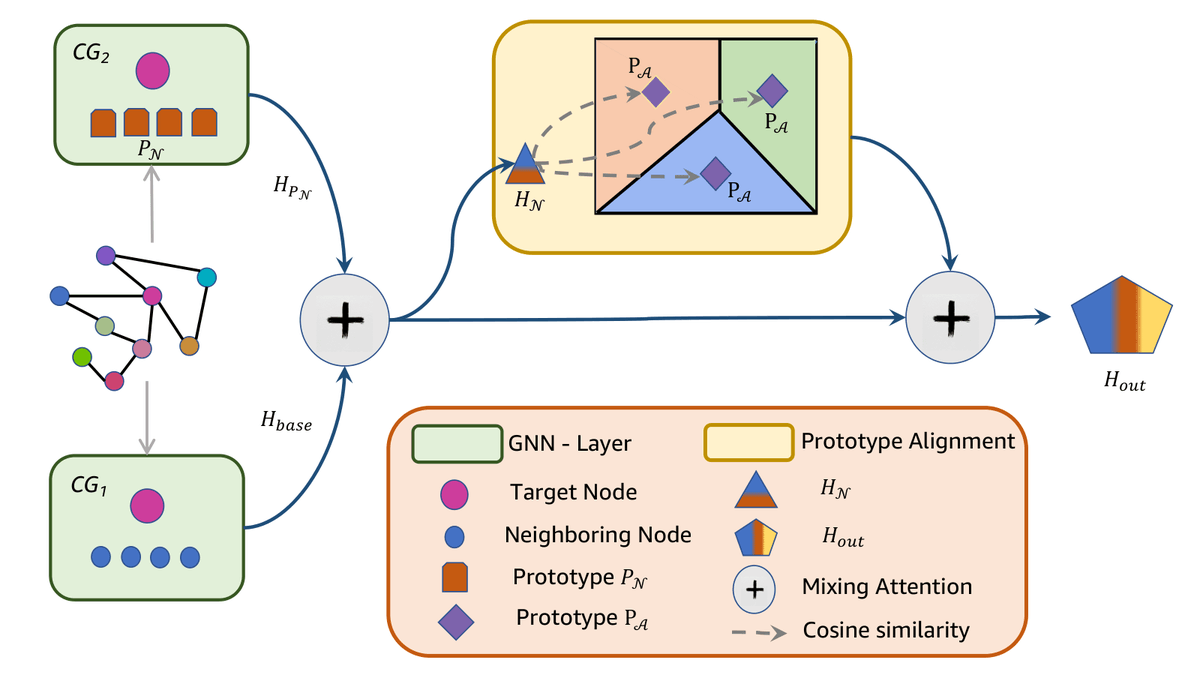
- Prototypes as Neighbors (P_N): A small set of K_N learnable pseudo-nodes that send messages to every real node in the graph. This gives every node access to a global summary of the graph's feature distribution, regardless of how isolated its local neighborhood is.
- Prototypes for Message Alignment (P_A): A second set of K_A prototypes that act as cluster centers. Before messages are passed, they are "snapped" toward the nearest prototype, reducing within-cluster variance and filtering out noise from irrelevant neighbors.
Both prototype sets are trained end-to-end with the rest of the GNN. No pretraining, no separate clustering step.
How it works, step by step
The mechanics are elegant. For each GNN layer, P²GNN runs two parallel message-passing computations -- one on the original graph edges, and one where every node receives messages from the prototype nodes. The two resulting embeddings are then mixed using a learned attention mechanism:
# Pseudocode for one P²GNN layer
H_base = GNN_base(A_base, H_prev)       # standard neighbor messages
H_proto = GNN_proto(A_proto, H_prev)    # messages from K_N prototypes
# Learned mixing weights via sigmoid + softmax
alpha_base, alpha_proto = mix_attention(H_base, H_proto)
H_N = sigma(alpha_proto * H_proto + alpha_base * H_base)
# Message alignment via prototype attention (like Q-K-V attention)
# Query = P_A, Key = H_N, Value = P_A
H_A = softmax(P_A @ H_N.T) @ P_A
# Final mix of aligned and unaligned messages
H_out = sigma(alpha * H_N + alpha_A * H_A)
The alignment step is a special case of transformer-style attention where the prototypes serve as both the query and the value. This forces messages to be expressed in terms of learned cluster centers, which smooths out noise.
Three auxiliary losses keep prototypes well-behaved
Learnable prototypes can degenerate -- they might all collapse to the same vector, or overfit to the training distribution. The authors prevent this with three auxiliary loss terms added to the main task loss:
- Alignment loss: Each prototype should be the closest match to at least some inputs (like K-Means, but differentiable).
- Diversity loss: Maximizes entropy across prototypes to prevent mode collapse -- the failure mode where all prototypes converge to the mean.
- Sparsity loss: L1 + L2 regularization on the prototype matrix to reduce overfitting.
Tested on 18 datasets, including live production systems
The authors demonstrate extensibility to all message-passing GNNs and conduct experiments across 18 datasets, including proprietary e-commerce datasets and open-source datasets, on node recommendation and node classification tasks. The proprietary datasets are massive: graphs ranging from 700K to 3.5M nodes and 10M to 400M edges, representing products as nodes and co-purchase or co-view relationships as directed edges.
On the live production GCN models at Amazon's e-commerce store:
- On E-comm1, P²GNN achieves an average relative improvement of 4% across various evaluation metrics.
- On E-comm2, it delivers a 1.5% performance gain.
On open-source benchmarks, the results are even cleaner. P²GNN achieves an average rank of 1.5 across 8 standard node classification datasets, compared to the next best method ACM-GCN at 3.6. On 6 large-scale datasets, it achieves an average rank of 1.2, beating GloGNN++ (rank 2.3) and LINKX (rank 3.3).
Fraud detection results are also strong. On the YelpChi and Amazon fraud datasets, P²GNN scores AUC-ROC of 84.43 and 97.64 respectively, beating all baselines including specialized fraud-detection GNNs like GHRN and PC-GNN.
The statistical significance is confirmed: across 40 runs with different seeds, P²GNN shows consistent improvement on all 8 benchmark datasets, with statistically significant gains (p-value < 0.05) on 6 out of 8.
The computational cost is modest
Adding two prototype sets sounds expensive, but the scaling is linear in the number of prototypes K, not quadratic in the number of nodes. Compared to approaches that augment graph density by adding edges between nodes (O(|V|²)), the prototype approach scales as O(K × |V|) with K much smaller than |V|. In practice, per-epoch training time increases by roughly 20-50% over the backbone GNN on large datasets -- a reasonable tradeoff for consistent accuracy gains.
Where it falls short
P²GNN is not a silver bullet. The ablation study shows it doesn't always win on Squirrel and Chameleon datasets -- though the authors attribute this to data leakage from duplicate nodes in those benchmarks rather than a fundamental limitation. The method also introduces new hyperparameters: the number of prototypes at each level (K_N and K_A) and three auxiliary loss weights. The authors recommend Bayesian hyperparameter search and starting with high prototype counts and reducing them, but this still adds tuning overhead compared to just running a vanilla GNN.
The real breakthrough: a wrapper, not a replacement
What makes P²GNN practically significant isn't the accuracy numbers -- it's the architecture. P²GNN remains agnostic to class counts and tasks, emphasizing diversity in the feature space for prototypes, affording the model flexibility in determining the number of prototypes per class without imposing an equal-representation constraint. This is a direct contrast to the closest prior work, ProtoGNN, whose prototypes are derived from an independently trained MLP that requires a subset of crucial training data, and whose experiments are confined to binary classification tasks due to the linear increase in required prototypes with the number of classes.
If you're running a GCN, GAT, or GraphSAGE in production and hitting a ceiling on heterophilous graphs, P²GNN is designed to slot in with minimal surgery. The full paper includes Algorithm 1 with the exact integration steps. No code repository has been released yet, but the implementation uses DGL and PyTorch, and the algorithm is straightforward enough to reproduce from the paper.