
Amazon and UMBC's PA³ Cuts AI Agent Token Usage by 40%
A new training recipe from Amazon Alexa AI teaches agents to recall business rules from memory instead of stuffing them into every prompt.
 Pro
Takeaways
- PA³ trains agents to recall business policies from parametric memory instead of loading full policy documents into the prompt
- Achieves 16-point gain over no-policy baseline and 3 points over in-context baselines while using 40% fewer words
- Uses τ-Bench airline and retail domains for evaluation, built on Qwen2.5-Instruct-32B
- Introduces a Jaccard-based PolicyRecall reward and Hallucination Penalty for GRPO training
- Four-stage generate-branch-evaluate-refine loop produces clean chain-of-thought traces using DeepSeek-R1 and Claude-3.5
- Airline gains (147%) dwarf retail (12%) because retail policies are common in pretraining data
Tool-calling agents built on top of LLMs are pretty good at figuring out which function to invoke, but they consistently trip over the fine print. Every business has its own rules about returns, cancellations, refunds, and eligibility, and today the standard fix is to paste the entire policy document into the system prompt. That works, sort of, until you look at the token bill.
A team from the University of Maryland Baltimore County and Amazon Alexa AI has released PA³ (Policy-Aware Agent Alignment through Chain-of-Thought), a training recipe that bakes business rules directly into the model's reasoning process. The result is an agent that recalls only the two or three rules relevant to the current turn, cutting total word usage by 40% while beating in-context baselines of the same size.
The 90,000-token problem
Business policies can range from 10k to 90k tokens, which can significantly increase costs, latency and throughput. That is not a rounding error. τ-Bench, a policy-based tool-calling benchmark, has shown that 95% of inference costs come from input tokens, with only 5% from output. Serve thousands of queries a day and the policy prompt alone dominates your compute spend.
There is also a quality problem. Long prompts trigger the classic needle-in-a-haystack failure mode, where models miss the one clause that actually matters for the current user request. In most conversation turns, the number of relevant policies can be as low as 0 (e.g., a final "Thank You"), and in most cases at most 1-5 policies, for example, the agent only needs the return-policy to initiate a return. Loading the other 40,000 tokens is dead weight.

Teach the model, don't tell the prompt
The core idea is deliberative alignment applied to business rules: fine-tune the model so that when it thinks step by step, it pulls the relevant policy from its own weights rather than from context. For each request, the relevant policies can extend up to 150-400 tokens, which uses up to 225x fewer tokens than the traditional method.
Getting there requires two things: high-quality chain-of-thought traces that name the correct policies, and a reinforcement learning signal that punishes both missed rules and hallucinated ones. PA³ builds both.
Generate, branch, evaluate, refine
Rather than trusting a single LLM pass to produce clean reasoning traces, the authors run a four-stage loop. DeepSeek-R1 first drafts a CoT for a given conversation turn. Then four independent Claude-3.5 evaluators score it against separate rubrics:
- Faithfulness , no policies invented that are not in the document. Requires a perfect 10.
- Completeness , every rule needed for the response is present.
- Atomicity , no irrelevant rules dragged in.
- Style , reads like natural thought, not a copy-paste from the policy doc.
If any rubric fails, a summarizer agent writes up what went wrong and the CoT gets regenerated. The pipeline attempts at most four refinement rounds before dropping the example. Average rubric scores climb from roughly 7.5 to 8.8 across refinement rounds, and Faithfulness sees the biggest gain.
The three-stage training recipe
Starting from Qwen2.5-Instruct-32B, the training proceeds in stages that build on each checkpoint:
- PA¹ , Continual SFT. Standard fine-tuning on a general function-calling dataset plus the APIGen-MT policy-adherent tool-calling data, with policies still in context.
- PA² , CoT-augmented SFT. Same trajectories, but policies are removed from the prompt and the filtered chain-of-thought traces are added as training targets. This is where the model actually memorizes the rules.
- PA³ , GRPO. Reinforcement learning on 900 unseen turns using a custom reward stack.
A reward that punishes hallucinated rules
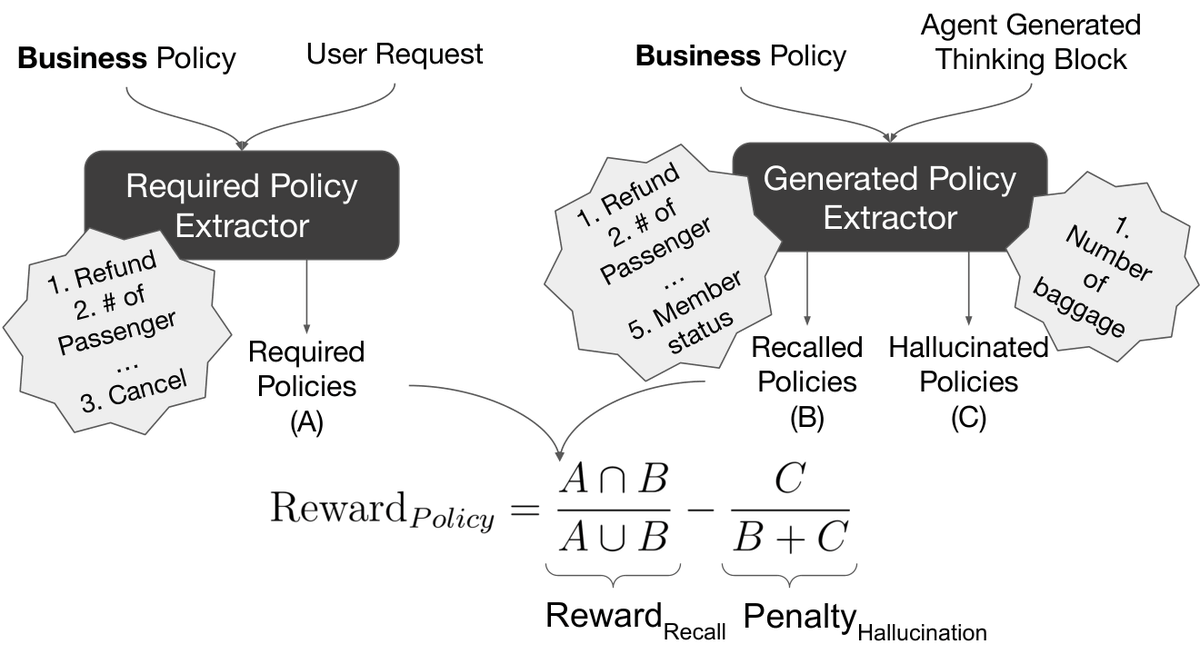
The GRPO stage is where the paper's novel contribution lives. The authors introduce a PolicyRecall reward computed as the Jaccard score between the set of policies the model cites in its reasoning and the ground-truth set of relevant policies. Using Jaccard instead of raw recall matters: it penalizes the model for citing every policy just to game the reward, because the union in the denominator grows.
A separate Hallucination Penalty hits the model whenever it cites a policy that does not exist in the source document at all, scored as the fraction of mentioned policies that are fabricated. A length penalty on the thinking block, borrowed from DAPO, keeps the model from spiraling into repeated verification loops. The final reward combines format, turn correctness, PolicyRecall, hallucination, and length terms into a range of -4 to 5.
What the numbers say
Evaluation runs on τ-Bench's airline and retail domains using pass@1 across five trials.
| Model | Airline | Retail | Avg | Words |
|---|---|---|---|---|
| GLM-4.5 (355B, with policy) | 55.35 | 79.50 | 67.42 | 40.3k |
| Qwen-2.5-32B (with policy) | 27.95 | 58.04 | 43.00 | 39k |
| xLAM-2-32B (with policy) | 37.35 | 63.70 | 50.52 | 45k |
| PA¹ (no policy) | 17.15 | 58.72 | 37.93 | 30k |
| PA² (no policy) | 36.95 | 63.07 | 50.01 | 45k |
| PA³ (no policy) | 42.00 | 65.51 | 53.75 | 27k |
PA³ beats xLAM-2 by roughly 3 points on average while running 40% leaner. The airline domain sees a 147% relative improvement over xLAM, while retail only moves 12%. The authors attribute this gap to the fact that the "airline" policies are substantially more out-of-distribution, unlikely to have appeared during pre-training. As a result, pretrained models have little to no parametric knowledge of this domain. Retail policies like standard return windows are already baked into most base models.
Where it breaks
The obvious limitation is policy churn. Training on a specific version of a policy document means that when the business updates its rules, the model needs retraining. The authors ran a synthetic override experiment on τ-Bench airline, replacing single policies with contradicting versions, and PA³ hit only 53% override accuracy , just above random. If your rules change weekly, this approach is not yet ready to replace in-context prompting.
Two other caveats: reasoning-block output tokens go up, which partially offsets input token savings for non-reasoning models. And CoT generation is expensive upfront, though the authors argue this is a one-time cost amortized across production traffic. Code, data, and models will be released on acceptance.