
Amazon and CMU's FraudFox Catches Adaptive Fraudsters With Kalman Filters
Amazon's production system uses Extended Kalman Filters and Pareto fronts to blend fraud oracles, adapt to shifting attacker tactics, and respect business budgets.
 Pro
Takeaways
- Amazon deployed FraudFox, an adaptive fraud-detection system that blends multiple risk oracles under business constraints.
- Extended Kalman Filter with a forgetting parameter continuously reweights oracles as fraud patterns shift.
- New labeled orders get exponential importance weights based on distance to the decision boundary, catching adversarial 'flocking'.
- Optimal pass-versus-investigate boundary is derived analytically as a hyperbola from cost-benefit first principles.
- Particle swarm optimization pre-computes a Pareto front over investigations and dollars captured for fast business adaptation.
- System is linear in input size, sub-second per decision, and in production with visible fraud-loss reduction.
Fraud detection at ecommerce scale is a moving target. The moment a rule works, fraudsters probe around it, adjust their behavior, and slip through just under whatever threshold you set. A team from Amazon and Carnegie Mellon has published FraudFox, a deployed system that treats this as an explicit adversarial-adaptation problem and adds a second, often ignored dimension: the fact that the business itself keeps changing the rules of engagement, such as how many human investigators are available in a given month.
FraudFox is scalable, adaptable to changing fraudster behavior, and already in production at Amazon, where it augments a fraud prevention sub-system and has led to significant performance gains. The paper, from Matthew Butler, Yi Fan, and Christos Faloutsos, is worth reading closely because it is one of the rare descriptions of what actually ships inside a large retailer's risk stack.
The Smith problem
The motivating example is deliberately small: how suspicious is 'Smith', trying to buy $500 shoes, on Monday 3am? In practice, several risk-assessment modules, which the authors call oracles, each produce a score for that order. The real questions are how to combine those scores into a single decision, and how to do it when the ground-truth distribution keeps shifting under you.
The team frames two research problems. First, oracle-weighting: how to merge the risk scores from a handful of risk-assessment modules in an adversarial environment, and given historical data on orders, prices, and what happened afterwards, which transactions should we pass versus send to human investigators? Second, business adaptation: the business restrictions could be 'at most x investigations are feasible', or 'at most $y lost due to fraud', and those numbers change.
Kalman filters, but for fraud
The core trick is to treat the ensemble weights as a hidden state and update them with an Extended Kalman Filter (EKF). An EKF is a recursive Bayesian estimator that maintains a mean and covariance for a latent state and updates them incrementally as new observations arrive. Here the state is the vector of oracle weights, and each new labeled order (fraud or honest) is an observation used to nudge those weights.
One approach to address the first problem is by using Extended Kalman Filters with dynamic importance weights, to automatically and continuously update the weights for each oracle. Two extensions make it work in the wild:
- Exponential forgetting. The authors derive a modified EKF update with a scalar forgetting parameter
a. Whena > 2, the covariance grows with each update, effectively downweighting older observations so the model tracks non-stationary fraud patterns. - Adversarial importance weights. Fraudsters cluster near the decision boundary trying to sneak under it. FraudFox assigns each new labeled order a weight
γi = β exp(-α Di), whereDiis the distance from the current decision surface. Orders closer to the boundary count more, so the model reacts to exactly the traffic that is trying to game it.
A hyperbola for pass or investigate
The second half of the paper derives the decision surface itself from first principles. Given a fraud probability s, order value v, investigation cost c, friction cost f, profit margin m, and false-dismissal loss d, the authors show the optimal boundary between pass and investigate is a hyperbola in the (score, value) plane. The intuition: naively multiplying price by fraud probability sends every expensive order to a human, which is wrong. The hyperbolic surface trades off the four costs explicitly.

This matters for a subtle reason. The importance-weighting scheme above needs a decision surface to measure distances from. Deriving the surface analytically instead of picking it heuristically means the two components are consistent with each other.
Pre-computing the Pareto front
The business-adaptation piece is the part that will feel familiar to anyone who has watched a fraud team scramble when leadership changes the budget. FraudFox uses particle swarm optimization to sweep hyperparameters and pre-computes a Pareto front of models in a two-dimensional business-metric space: number of investigations performed versus fraud dollars captured per investigation.

When a constraint changes (more or fewer investigators, tighter loss ceiling), the team picks a different point on the pre-computed frontier rather than retraining. Non-dominated points are those whose north-east quadrant is empty, meaning no other configuration beats them on both axes.
Does it actually work?
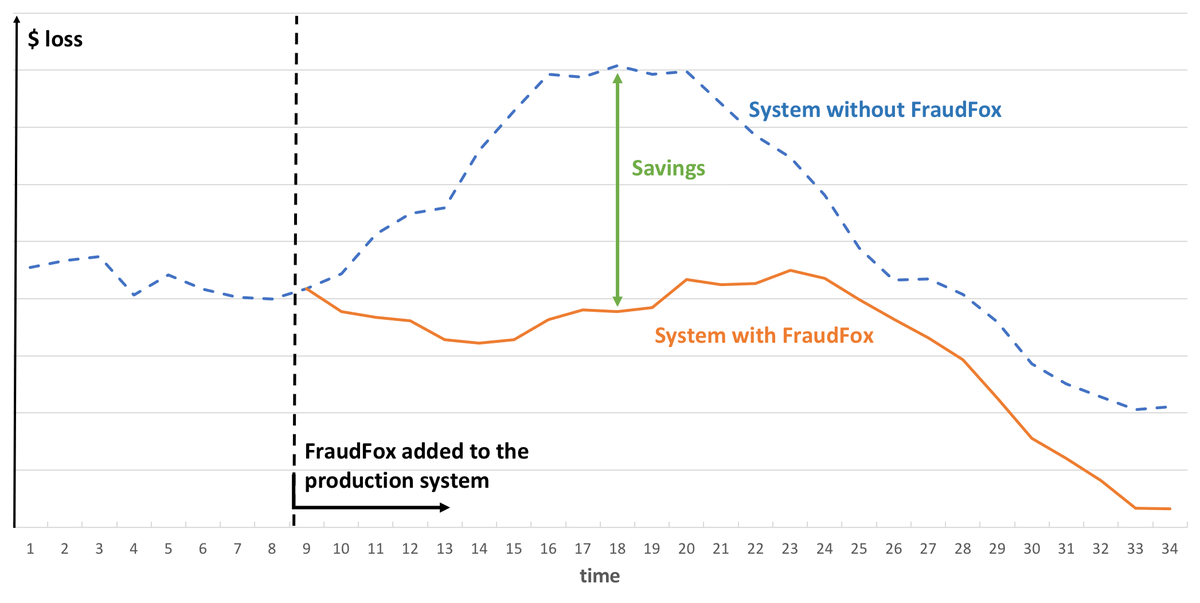
The production evidence in the paper is a losses-over-time plot showing a visible drop after FraudFox turns on. A synthetic sanity check makes the adaptation behavior more legible: with two oracles, one near-perfect and one near-random, the authors flip their roles at t=30 and watch three variants respond. The no-adaptation baseline stays broken. Both FraudFox variants recover, and the exponentially-forgetting version recovers faster.
Complexity is also friendly: linear in the number of orders and quadratic in the number of oracles, with sub-second decisions and training that takes minutes on a stock machine. There is no public code release, and the production numbers are reported as relative improvements rather than absolute fraud dollars, which is standard for this kind of applied-data-science paper.
Where it fits and where it does not
FraudFox is best understood as an orchestration layer, not a fraud model. It assumes you already have several risk oracles that produce calibrated-ish scores, and its job is to blend them, adapt the blend, and turn the blend into a pass or investigate action under budget constraints. The logistic-regression backbone means each oracle contributes linearly, so if you need complex interactions between signals you would push that into the oracles themselves.
The framework is also tied to a two-action world (pass or investigate) and a scalar per-order label. Multi-step review workflows, step-up authentication, or graph-based collusion detection sit outside its scope. But for the specific job of continuously reweighting an ensemble against adaptive adversaries while honoring a headcount budget, the combination of EKF forgetting, adversarial distance-based weighting, an analytically derived decision surface, and a pre-computed Pareto front is a genuinely tidy answer.