
AlphaApollo Pushes a 7B Model Past Frontier Math Scores
AlphaApollo combines tool-augmented reasoning, turn-level RL, and iterative self-evolution to push small open-source models far beyond their baseline math performance
 Pro
Takeaways
- AlphaApollo is a self-evolving agentic reasoning system combining tool use, turn-level RL, and multi-round solution refinement for hard math problems.
- Multi-turn RL training boosts Qwen2.5-7B-Instruct average accuracy on competition math from 8.77% to 20.35% (Avg@32).
- A propose-judge-update evolution loop further improves results at test time; Qwen3-4B jumps from 26.81% to 47.10% average accuracy with evolution enabled.
- The system achieves over 85% tool-call success by pairing a Python interpreter with a RAG-based library documentation retrieval module.
- Turn-level GRPO decouples model outputs from tool responses during RL training, solving a key instability problem in agentic training pipelines.
- Code is open-source at github.com/tmlr-group/AlphaApollo; supports Qwen2.5, Qwen3, and Llama3.2 with vLLM/SGLang backends.
Getting a language model to reliably solve hard math problems is still an open problem. Even frontier models like GPT-5 and Gemini 2.5 Pro score only around 25% and 22% on Humanity's Last Exam. The bottleneck isn't just model size -- it's the inability to use tools reliably and to refine solutions over multiple attempts. A new paper from researchers at Hong Kong Baptist University, Stanford, and RIKEN introduces AlphaApollo, a self-evolving agentic reasoning system designed to attack both problems at once.
Two problems, one system
AlphaApollo targets two bottlenecks in foundation-model reasoning: limited capacity for long-horizon, multi-step problem solving, and unreliable test-time refinement without trustworthy verification. These aren't new observations -- the community has known for a while that next-token prediction alone struggles with exact arithmetic and symbolic manipulation. What's new is how AlphaApollo addresses both in a single, unified framework.
The dominant paradigm of scaling LLMs through increased training compute has yielded remarkable but plateauing gains on reasoning benchmarks. A complementary paradigm has emerged: Test-Time Compute (TTC) Scaling, wherein additional computation is invested at inference time to improve output quality without altering model weights. AlphaApollo sits squarely in this camp, but goes further by combining RL-based post-training with structured tool use and multi-round evolution.
Three layers of intelligence
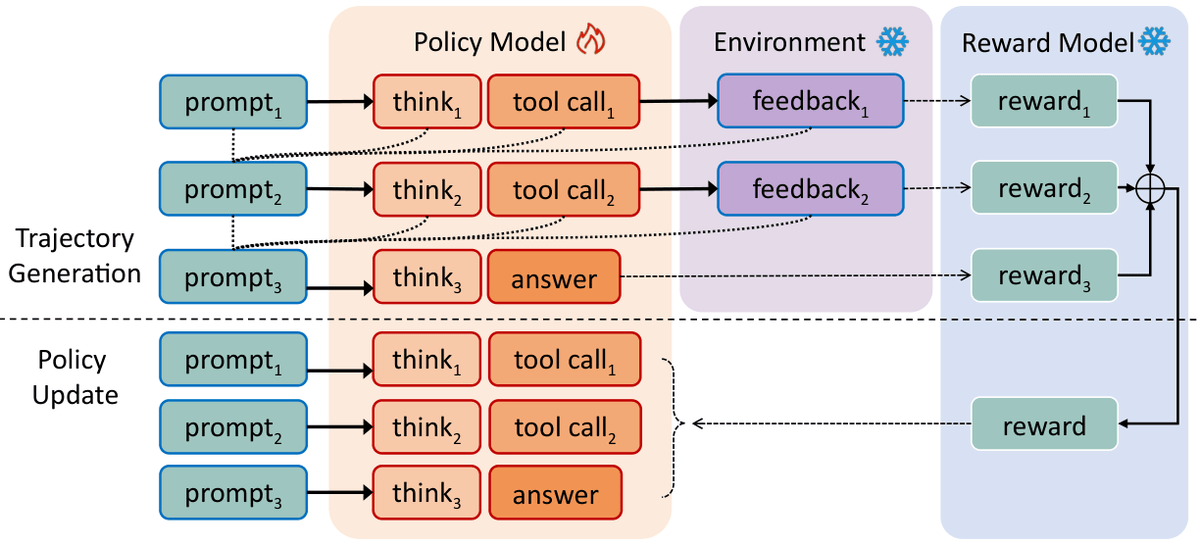
AlphaApollo orchestrates models and tools via three components: multi-turn agentic reasoning, which formalizes model-environment interaction with structured tool calls and responses; multi-turn agentic learning, which applies turn-level reinforcement learning to optimize tool-use decisions while decoupling actions from tool responses for stable training; and multi-round agentic evolution, which refines solutions through a propose-judge-update loop with tool-assisted verifications and long-horizon memory.
Think of these as three stacked improvements. The first layer gives the model access to tools. The second layer trains it to use those tools well. The third layer lets it keep trying, learning from each failed attempt.

How it actually works
The system couples a computation tool -- Python with numerical and symbolic libraries -- and a retrieval tool for task-relevant external information, to execute exact calculations and ground decisions. On the Python side, this means access to SymPy for symbolic math, NumPy for matrix operations, and SciPy for optimization and numerical methods. The retrieval module does RAG over library documentation, so when a model tries to call a SymPy function incorrectly, it can look up the right API signature on the fly.
The multi-turn reasoning loop works like this:
- The model receives a problem and outputs either a tool call (wrapped in
<python_code>tags) or a final answer (wrapped in<answer>tags). - The environment executes the tool call and returns the result as feedback.
- The model sees the result and continues reasoning, with the full history as context.
- This repeats up to a configurable maximum number of turns.
The training objective is where AlphaApollo diverges from naive approaches. Most agentic RL systems optimize over the entire trajectory -- model outputs and tool responses together. This is unstable because the tool responses aren't generated by the model and shouldn't be in the gradient signal. AlphaApollo uses turn-level GRPO (Group Relative Policy Optimization -- a variant of PPO that normalizes rewards across a group of sampled trajectories instead of using a separate value network), computing the policy gradient only over model-generated tokens at each turn, while masking out tool responses entirely.

The evolution layer adds a fourth agent role on top of the solver: an Abstractor that compresses the full reasoning trajectory into a concise solution, an Evaluator that verifies the solution using tools, and a Summarizer that synthesizes multiple evaluator verdicts into a single judgment. The system supports multi-round, multi-model solution evolution via a shared state map that records candidates, executable checks, and feedback for iterative refinement. Each round, the solver sees the previous attempt and its verdict, and tries again.
The numbers
Across seven math reasoning benchmarks and multiple model scales, AlphaApollo improves performance through reliable tool use (over 85% tool-call success), substantial gains from multi-turn RL -- Avg@32 for Qwen2.5-1.5B-Instruct goes from 1.07% to 9.64%, and Qwen2.5-7B-Instruct from 8.77% to 20.35% -- and improvements from evolution, with Qwen2.5-3B-Instruct going from 5.27% to 7.70% and Qwen2.5-14B-Instruct from 16.53% to 21.08%.
The benchmarks used are competition-level math: AIME 2024, AIME 2025, CMIMC 2025, HMMT Feb and Nov 2025, BRUMO 2025, and SMT 2025. These are not easy datasets -- they're the kind of problems that stump most undergraduates. The metric Avg@32 means the average accuracy when sampling 32 solutions (a measure of how often the model gets it right on any given attempt), while Pass@32 measures whether at least one of 32 samples is correct.
The evolution gains are particularly striking on stronger models. On Qwen3-4B-Instruct, enabling evolution boosts average accuracy from 26.81% to 47.10% -- a jump of over 20 percentage points. On AIME24 alone, the gain is +36.70 percentage points.

What the model learns to do
The paper includes case studies showing four distinct cognitive behaviors that emerge from training:
- Decomposition: Breaking a complex problem into sub-problems and solving each with code.
- Correction: Identifying when an intermediate Python result contradicts the reasoning and revising the approach.
- Verification: Running code to double-check a symbolic result before committing to an answer.
- Backtracking: When a reasoning path leads to a contradiction, retracing steps and trying a different strategy.
These behaviors aren't explicitly programmed -- they emerge from the turn-level RL training. The model learns that calling Python is rewarded when it leads to correct answers, and that checking your work before submitting is a good strategy.
Where it falls short
The system is currently validated only on mathematical reasoning. The paper is explicit that this is an ongoing project, and the benchmarks are all competition math. It's not yet clear how the framework generalizes to code generation, scientific reasoning, or open-ended tasks where there's no clean ground-truth verifier. The evolution gains also scale with model size -- smaller models like Qwen2.5-1.5B see more modest improvements from evolution than the 14B variant, suggesting the approach benefits most when the base model already has some reasoning capacity. Full-parameter fine-tuning also outperforms LoRA in the experiments, which means the training compute requirements are non-trivial for larger models.
What's available
The code is available at https://github.com/tmlr-group/AlphaApollo. This project is ongoing, and the team welcomes feedback from the community and will frequently update the technical report. The system supports multiple inference backends including vLLM, SGLang, HuggingFace Transformers, and external APIs, and works with Qwen2.5, Qwen3, and Llama3.2 model families. LoRA support is included for parameter-efficient fine-tuning of larger models.
The real story here isn't just the benchmark numbers. It's that a 7B model trained with AlphaApollo's turn-level RL can match or exceed what a much larger model achieves without it -- and that the evolution mechanism keeps improving performance at test time without any additional training. For teams working on math-heavy applications or building reasoning pipelines on top of open-source models, this is a framework worth watching closely.