
Allen Institute's vla-eval Fixes Robot AI Benchmarks With a 47x Speedup
A new open-source harness unifies 14 robotics benchmarks and 6 VLA models behind two commands, delivering 47x faster evaluations and exposing hidden pitfalls that swing scores by 55 points.
 Pro
Takeaways
- vla-eval unifies 14 VLA benchmarks and 6 model servers behind two commands.
- WebSocket plus msgpack protocol with Docker isolation cuts integration from O(N x M) to O(N + M).
- Episode sharding and batch inference deliver 47x speedup: 2,000 LIBERO episodes in 18 minutes.
- Audit of six VLA codebases reproduces published scores within a few points across three benchmarks.
- Hidden preprocessing details can swing scores by up to 55 percentage points on a single parameter.
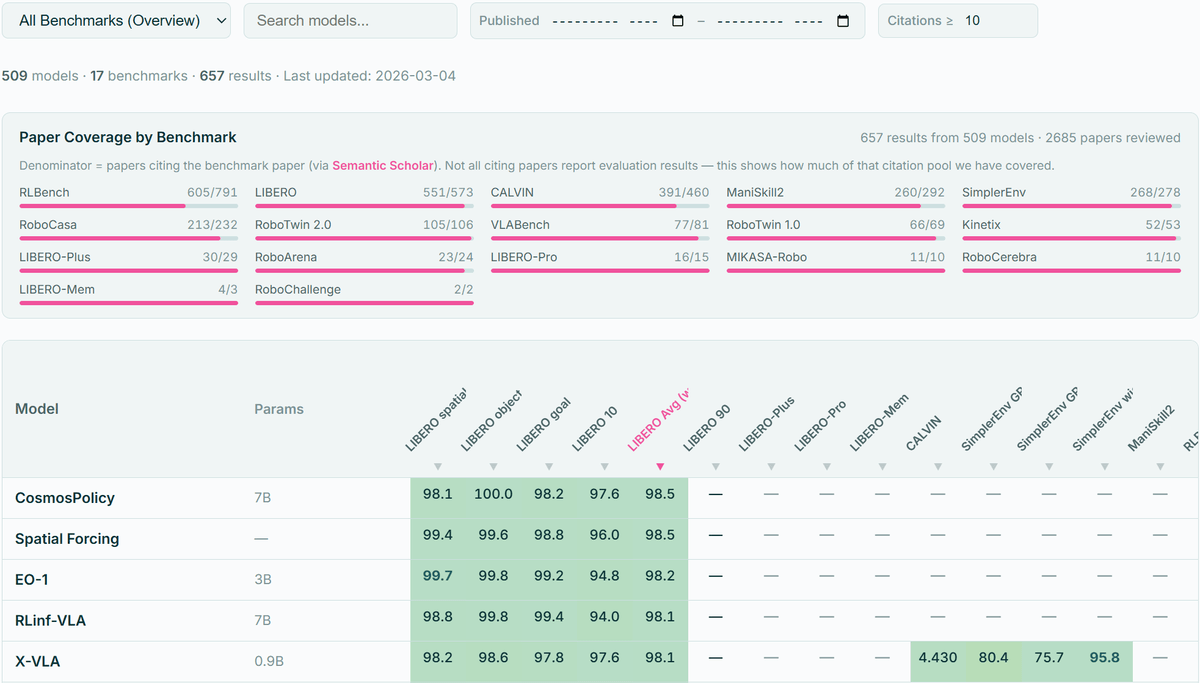
- Leaderboard aggregates 657 published results across 17 benchmarks; 81% of models tested on only one.
Evaluating a Vision-Language-Action model has become a small engineering project of its own. Each robotics simulator ships its own Python runtime, its own asset pipeline, and its own half-documented protocol, and no single environment can host them all. A team from MAUM.AI, the Allen Institute for AI, and Seoul National University just released vla-eval, an open-source harness that collapses this mess into two commands and, along the way, audits how reproducible the current VLA literature actually is.
The short version: the paper shows that most published scores do reproduce closely, but only after uncovering undocumented tricks where a single wrong flag can drop success rates by tens of percentage points. It also ships a leaderboard aggregating 657 results across 17 benchmarks.
Why VLA evaluation is broken
VLA models are large multimodal policies that map camera frames and a language instruction directly to robot actions. To argue that a policy generalizes, papers typically report numbers on several simulators, and this is where the pain begins. LIBERO requires Python 3.8 with robosuite, ManiSkill2 requires Python 3.10 with SAPIEN, CALVIN requires Python 3.8 with PyBullet, and no single environment can satisfy all constraints simultaneously.
The dependency mess is only half the problem. Evaluation protocols are frequently underspecified: seeds, episode counts, and preprocessing details are omitted from papers, and a single undocumented parameter can shift success rates by up to 55 percentage points. Multiply that by N models and M benchmarks and comprehensive evaluation becomes impractical for anyone who is not a large lab.
The design: decouple the model from the simulator
vla-eval borrows its philosophy from lm-evaluation-harness in the language-model world. It isolates each benchmark inside a Docker container and connects it to model servers via a WebSocket and msgpack protocol. Models integrate once by implementing a single predict() method; benchmarks integrate once via a four-method interface (reset, step, make_obs, get_step_result). After that, any model can be pointed at any benchmark automatically.

Two other details matter for practitioners:
- Each model server declares dependencies via PEP 723 inline metadata, and vla-eval serve launches it through uv run, creating an isolated environment automatically. Conflicting pins like
transformers==4.40.1for CogACT versustransformers>=4.44for X-VLA can coexist. - Docker images are published to ghcr.io with versioned tags and bundle scene files, textures, and robot descriptions, so there is no ad-hoc asset scavenger hunt before a run.
The full cross-evaluation matrix works automatically, reducing integration effort from O(N x M) to O(N + M).
47x speedup by attacking the real bottleneck
Once inference and simulation are decoupled, parallelism becomes tractable. The authors use episode sharding across K Docker containers plus batched forward passes on the model server, tuned with a demand-supply model where environment throughput has to stay below the model's supply ceiling to prevent queue buildup.
The interesting finding is that the model was never the bottleneck. On LIBERO with CogACT-7B, episode sharding from K=1 to K=50 increases environment throughput by 32.6x, while batch inference from B=1 to B=16 increases model server throughput by only 2.8x. Combined, 2,000 episodes complete in about 18 minutes versus around 14 hours sequentially, a 47x wall-clock speedup. Because the ceiling is set by the simulator rather than the network, the speedup transfers to any model plugged into the harness.
The reproducibility audit
The team then used their own tool to re-run six published VLA codebases (OpenVLA, OpenVLA-OFT, pi-0.5, GR00T N1.6, DB-CogACT, and X-VLA) across LIBERO, CALVIN, and SimplerEnv. Most results land within a point or two of the reported numbers, but the debugging stories are where the value lives:
- Using the wrong proprioceptive state source in X-VLA on LIBERO drops success rate from 97.8% to 42%, a 55 percentage point swing from one parameter.
- Confusing absolute and delta action modes (both valid 7D vectors, indistinguishable from data alone) produces 0% as positions accumulate and the robot diverges.
- OpenVLA-OFT uses a quaternion-to-axis-angle conversion without antipodal normalization, and flipping the sign convention dropped LIBERO-Goal from 97% to 83% and LIBERO-Long from 95% to 56%.
- OpenVLA applies a center crop at evaluation time that is not documented in the paper; omitting it costs about 3 percentage points.
- GR00T expects end-effector pose as proprioceptive input, but this field exists only in an internal simulator fork, not in official SimplerEnv; without it, scores drop from 30-55% to 0%.
None of these are bugs in the models. They are the kind of undocumented tribal knowledge that quietly makes the entire field look less reproducible than it is.
A leaderboard for a fragmented field
Alongside the framework, the authors published a VLA leaderboard aggregating 657 results across 17 benchmarks, extracted from 1,704 papers using Claude Code as a scraping agent and then reviewed by a human. The picture it paints is stark. 81% of the 509+ models are evaluated on only one benchmark, and only 6% on three or more. Cross-benchmark comparisons, in other words, are almost never done in the current literature.
When to reach for it, and when not to
vla-eval is most useful if you are training or fine-tuning a VLA and want honest numbers on more than one simulator without spending weeks on Docker archaeology. It is also useful for reviewers and reproducers who want a canonical protocol to point to. The current limits are worth flagging: the audit covers six codebases across three simulation benchmarks, and leaderboard results are extracted from published papers, not independently verified. Supported metrics are limited to task success rate; finer-grained dimensions such as subtask progress, task efficiency, and safety are not yet supported. Real-robot evaluation is on the roadmap but not shipped.
Everything, including the harness, evaluation configs, versioned Docker images, and full reproduction logs, is available on GitHub.