
Allen Institute's MR-Search Teaches AI to Reflect Between Web Searches, Boosting Accuracy 19%
MR-Search trains search agents to reflect between attempts, delivering 9-19% gains over sparse-reward RL baselines across eight QA benchmarks.
 Pro
Takeaways
- MR-Search reframes agentic search as meta-RL where the agent reflects on past episodes and uses them as context for the next try (paper).
- Achieves 9.2% (7B) and 19.3% (3B) relative gains over Search-R1 baselines across eight QA benchmarks.
- Uses a critic-free turn-level RLOO advantage with discounted cumulative rewards for credit assignment.
- Beats process-reward baselines like StepResearch and PPRM without any external annotations or reward models.
- Scales at test time: performance keeps rising with more reflection turns, unlike single-turn Search-R1.
- Code and training data available at github.com/tengxiao1/MR-Search.
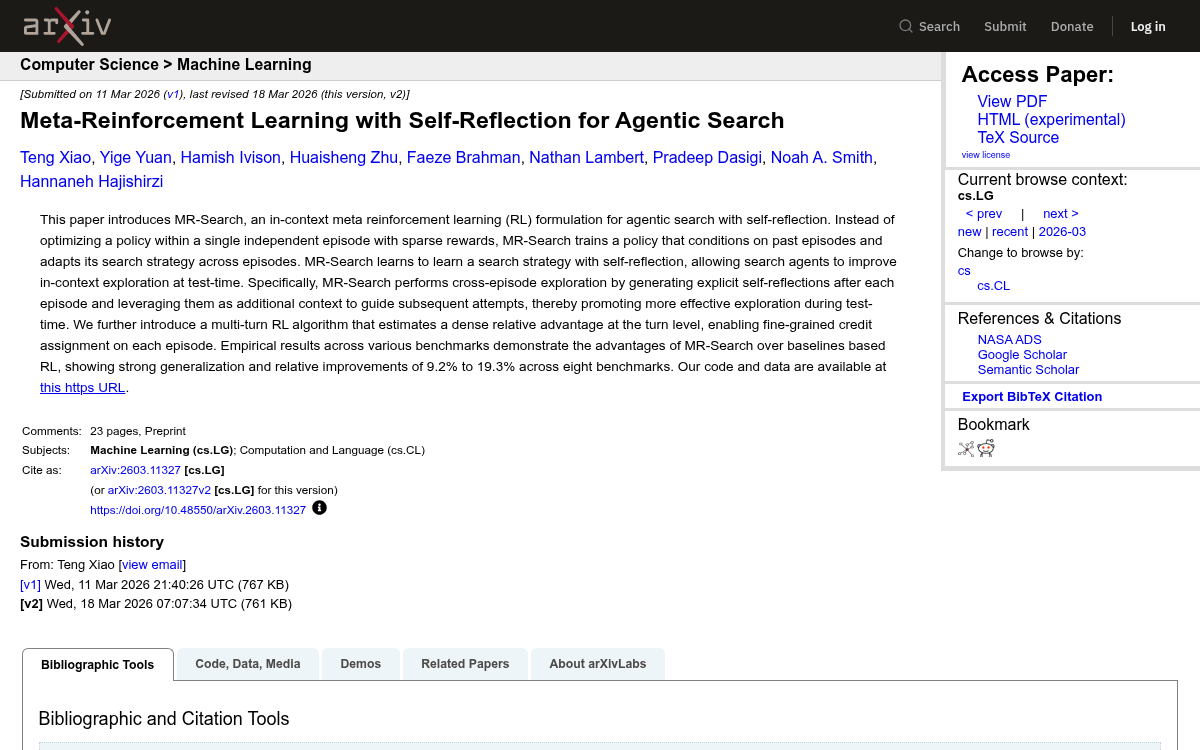
Training language model agents to search the web with reinforcement learning has become the go-to recipe for building deep research systems. The problem is that these agents only get a reward when they produce the final answer, so they have no idea which of the twelve tool calls they made was actually useful. A new paper from the Allen Institute for AI and the University of Washington called MR-Search proposes a fix: teach the agent to reflect on its own previous attempts and use those reflections as extra context for the next try.
Sparse rewards, muddled credit
Most current search agents follow the ReAct pattern of interleaving thought, action, and observation, and are trained end-to-end with RL algorithms like PPO or GRPO. These methods mainly focus on the correctness of the final answer and only receive sparse rewards at the end of each trajectory, without providing precise credit assignment for intermediate steps. That leaves the agent susceptible to inefficient exploration, local optima, and error amplification across multi-turn tool use.
The usual workaround is to bolt on a process reward model or LLM judge that scores intermediate steps. But these approaches rely on external annotations, which are both costly and difficult to reuse when task requirements change, and model-based rewards tend to introduce reward hacking and training overhead.
Turning independent tries into a conversation with yourself
MR-Search reframes the problem as in-context meta-reinforcement learning. Instead of treating each attempt at answering a question as an isolated episode, the agent runs several episodes in sequence, writes an explicit self-reflection after each one, and feeds that reflection forward as context for the next attempt.

Each meta-episode is modeled as a sequence of episodes, encouraging early exploration and subsequent exploitation of accumulated context. The authors describe it as meta-learning how to generate effective self-reflection, so the agent progressively refines its search strategy at test time without any reward signal from the environment during inference.
The motivation is grounded in a specific observation about LLM failure modes: model limitations often stem from insufficient exploration within a single trajectory rather than inadequate reasoning capacity, and incorrect answers tend to recur across parallel samples. Reflecting sequentially breaks that loop in a way that sampling more trajectories cannot.
How the training loop works
The algorithm is straightforward once you accept the meta-episode framing:
- The agent completes an initial episode with reasoning, search queries, and a final answer.
- A reflection prompt kicks off another episode conditioned on the previous trajectory.
- This repeats N-1 times, producing a meta-episode of N candidate answers.
- Each episode gets its own reward from the verifier comparing the extracted answer to ground truth.
- Rewards are propagated backward with a discount factor to give earlier reflections credit for later successes.
For policy optimization, MR-Search uses a group of G meta-episodes and computes a leave-one-out advantage at the turn level. Compared to GRPO, RLOO provides an unbiased advantage estimation. The team then adds a discounted cumulative advantage so rewards from later episodes flow back to earlier turns, which is important because a wrong answer in episode two might still contain useful information that drives the correct answer in episode three. The whole thing stays critic-free, avoiding the auxiliary value model that PPO requires.

The numbers
MR-Search was evaluated on seven QA benchmarks (NQ, TriviaQA, PopQA, HotpotQA, 2WikiMultiHopQA, Musique, Bamboogle) plus ASearcher, a synthetic dataset requiring longer-horizon multi-turn search. Training merges NQ and HotpotQA, using Qwen2.5-3B-Base and Qwen2.5-7B-Base with a 2018 Wikipedia dump as the knowledge source.
On the 7B model, MR-Search averages 46.0% exact match across the seven benchmarks compared to 42.1% for Search-R1 and 43.4% for StepResearch, which uses external process rewards. MR-Search achieves a substantial margin over GRPO with outcome rewards (Search-R1), yielding 9.2% and 19.3% relative improvements on average for the Qwen2.5-7B-Base and Qwen2.5-3B-Base, respectively. The gap is largest on the smaller 3B model, where sparse-reward RL struggles to elicit multi-turn behavior at all.
On the harder ASearcher dataset, MR-Search posts 10.2% and 9.5% relative improvements over Search-R1 in EM and F1 respectively. It also scales gracefully with test-time compute: adding reflection turns beyond the three used in training keeps improving accuracy, whereas Search-R1 plateaus almost immediately because its objective was never optimized for multi-turn refinement.
What the ablations reveal
Several design choices carry weight. Setting the discount factor to zero, which eliminates credit assignment across episodes, tanks performance and pushes training into poor local optima. Swapping the RLOO-based objective for PPO or MT-GRPO also underperforms, and both actually do worse than plain Search-R1 on single-hop questions, suggesting the meta-RL framing needs the right advantage estimator to pay off.
The team also explored some useful extensions:
- Short context: keeping only the immediately preceding episode as context (instead of all prior ones) largely preserves performance, addressing the linear context growth problem.
- Step-level meta-RL: treating each tool call as a micro-episode with an intermediate answer, providing denser credit signals.
- Masked exploration: zeroing out gradients on early exploration episodes helps on ASearcher, which demands more tool interaction.
Where it falls short
The authors are upfront about limitations. The evaluation is confined to short-answer QA with exact-match scoring, not the long-form deep research responses that verification remains genuinely hard for. It also uses a single fixed Wikipedia retriever rather than heterogeneous tools like web browsing plus search. And context length grows linearly with the number of reflection turns, which the short-context variant only partially mitigates.
Availability
Code and data are on GitHub, built on top of the Search-R1 codebase and the VeRL RL framework. Training runs on 8 H100 GPUs with 2 more serving the retriever, using AdamW at a 1e-6 learning rate with a group size of 5 and 300 total training steps. The generation and reflection prompts are simple enough to drop into an existing ReAct setup, so if you already have a Search-R1 style pipeline, adapting to MR-Search is mostly a change to the rollout structure and advantage computation rather than a full rewrite.