
Allen Institute's MolmoBot Beats Real-World Robot Training With Pure Simulation
Allen AI trained robot policies purely in simulation and hit 79.2% real-world pick-and-place success, beating π0.5 at 39.2%.
 Pro
Takeaways
- MolmoBot achieves 79.2% zero-shot real-world pick-and-place, beating π0.5's 39.2% despite using zero real robot data
- MolmoBot-Data: 1.7M trajectories, 295M frames, 94k environments, 11k objects, 5,704 robot-hours generated in ~6,500 GPU-hours
- Three architectures released: Molmo2-based flagship, a π0 replica, and a lightweight SPOC variant for edge/RL
- MolmoBot-Pi0 with identical π0 architecture beats π0.5, isolating data (not architecture) as the key factor
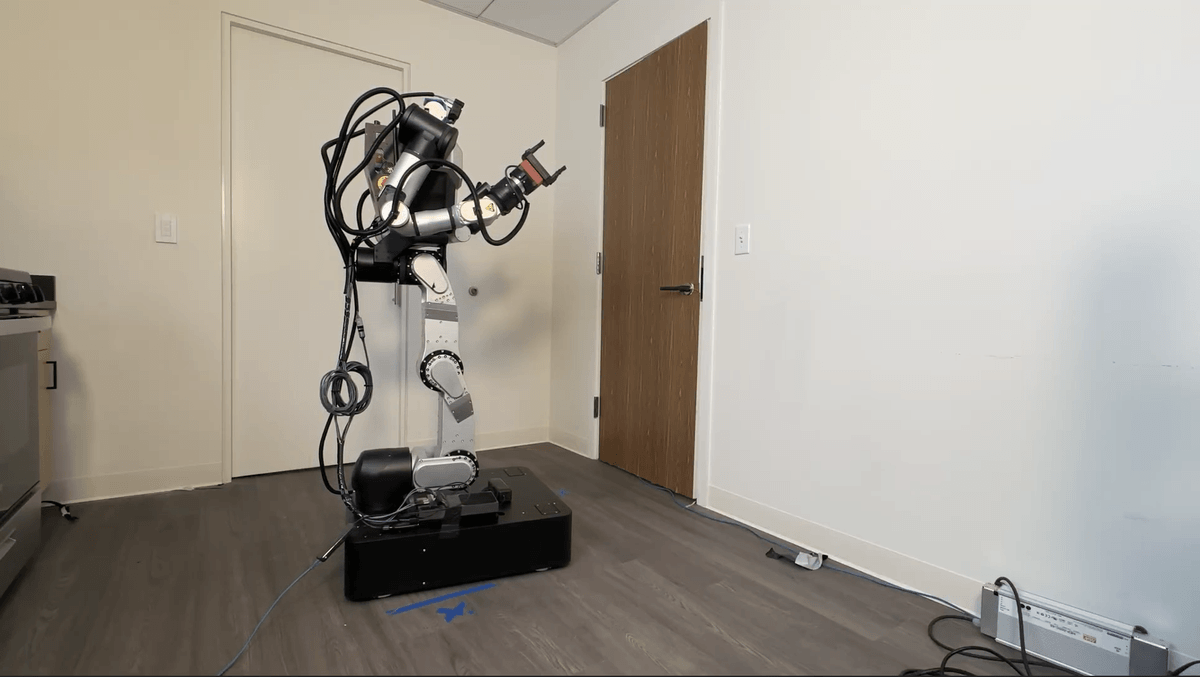
- Evaluated on Franka FR3 (tabletop) and Rainbow RB-Y1 (mobile manipulation, doors, drawers, cabinets)
- Fully open: code, data engine, weights, and dataset all released
A team at the Allen Institute for AI has challenged one of robot learning's most stubborn assumptions: that policies trained only in simulation cannot survive contact with the real world. Their new system, MolmoBot, learns manipulation entirely from synthetic trajectories and then transfers zero-shot to two physical robots, outperforming a state-of-the-art baseline trained on more than 10,000 hours of real robot demonstrations.
MolmoBot is an open manipulation model suite trained entirely in simulation, with zero-shot transfer to real-world robots and no real-world data collection or fine-tuning. On tabletop pick-and-place, it achieves a 79.2% success rate in real-world evaluations across four settings, versus 39.2% for π0.5.

Why the sim-to-real wall keeps standing
Robot foundation models from labs like Physical Intelligence, NVIDIA, and Google DeepMind are typically bootstrapped on massive real-world teleoperation datasets. The reasoning is familiar: simulators can't render photorealistically, physics engines are approximate, and any policy trained purely in sim tends to fall apart the moment it meets real lighting, real friction, and real objects.
That belief carries a real cost. Physical data is slow, expensive, and hard to reproduce. Data mixtures, collection processes, filtering decisions, scaling regimes, and training recipes behind the strongest models are often only partially disclosed, so most of the community adapts existing checkpoints rather than training from scratch. MolmoBot argues the bottleneck lies in access to sufficiently large and diverse simulation pipelines rather than in the sim-to-real gap itself.
A procedural data factory built on MuJoCo
The core release is MolmoBot-Engine, a procedural pipeline that spawns manipulation episodes inside MolmoSpaces, a photorealistic simulation platform with 94,000+ indoor environments. The design bet is that manipulation policies benefit more from diversity across objects, viewpoints, and configurations than from photorealistic rendering.