
Allen Institute Proves GPT-5 Chat Loses to Itself After a Few Turns
A new benchmark from Ai2 measures the pure multi-turn gap in chat models, and shows 10k synthetic conversations can close 12% of it.
 Pro
Takeaways
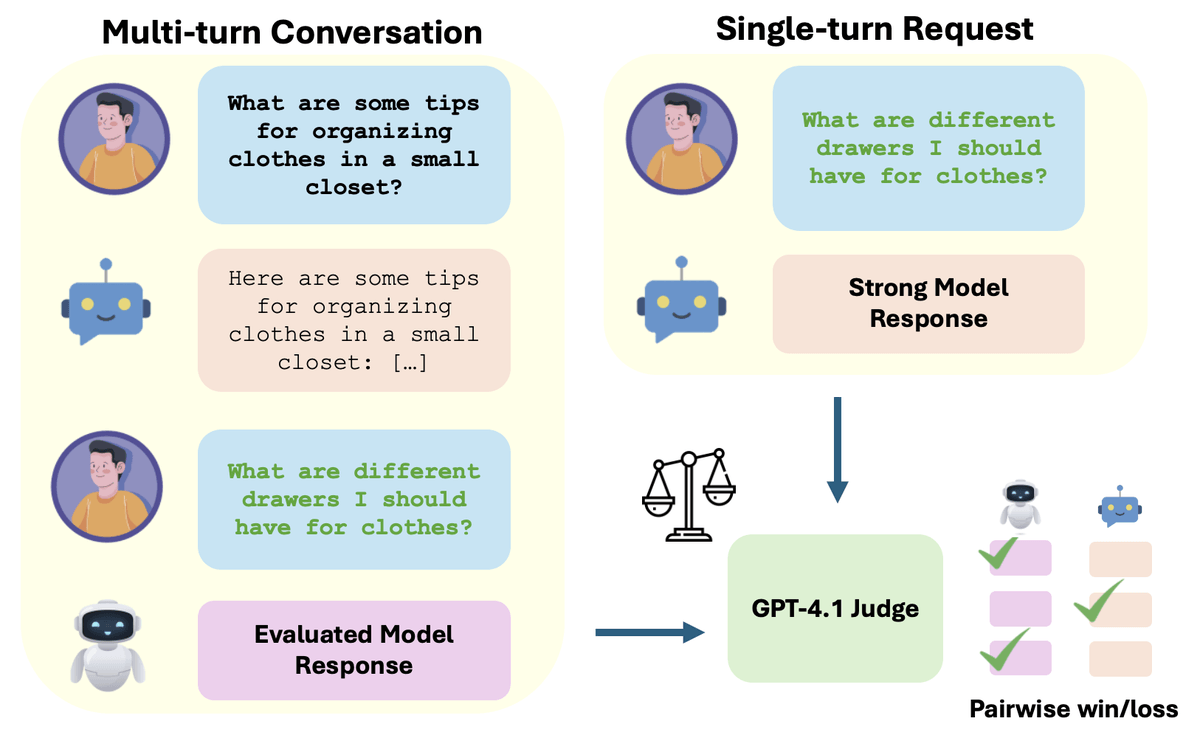
- Ai2 and UW introduce TurnWiseEval, isolating multi-turn ability by pairing each conversation with an AlpacaEval single-turn equivalent.
- Even GPT-5 Chat scores 40.2% against its own single-turn baseline on TurnWiseEval-Self.
- TurnWiseData generates synthetic user turns independently from a seed, avoiding drift and user simulation.
- Adding 10k synthetic conversations to Olmo 3 7B post-training yields a 12-point gain.
- Multi-turn preference tuning preserves single-turn IFEval and MMLU scores while narrowing the gap.
- Benchmark uses GPT-4.1 as judge and caps conversations at eight turns to avoid long-context confounds.
Chat models are trained and evaluated almost entirely on one-shot prompts, yet real users rarely stop after one message. A team from the Allen Institute for AI and the University of Washington put a number on that mismatch, and it is bigger than you might expect: even GPT-5 Chat underperforms its own single-turn baseline when the conversation stretches to a few turns.
Their paper introduces two artifacts. TurnWiseEval is a benchmark that isolates multi-turn ability from everything else a model happens to be good at. TurnWiseData is a synthetic pipeline for generating multi-turn training data from any single-turn dataset. Together they suggest the multi-turn gap is real, measurable, and cheap to close.
Why existing multi-turn benchmarks fall short
Existing multi-turn dialogue benchmarks like MTBench and MTEval are saturating, and they conflate task difficulty with conversational difficulty. If a model scores low on MT-Bench, you cannot tell whether it struggles with the underlying task or with tracking a conversation. That ambiguity makes it hard to attribute low performance to a genuine multi-turn weakness rather than general ability on similar tasks.
TurnWiseEval fixes this with a simple trick: every multi-turn conversation in the benchmark has a matching single-turn counterpart drawn from AlpacaEval. Because each conversation has a 1:1 single-turn complement, a model's multi- and single-turn abilities can be compared directly.