
Allen Institute Mouse Data Boosts Human Brain Cell Classification by Transfer Learning
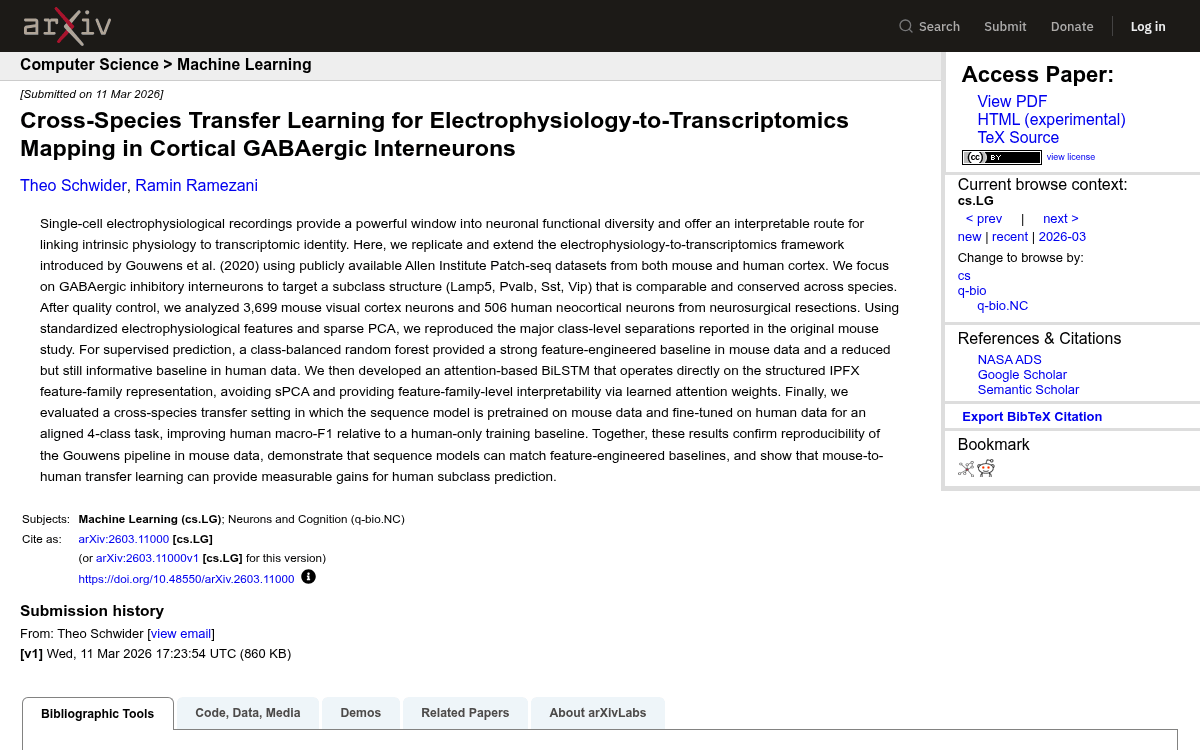
A replication study extends Patch-seq cell-type classification with an attention BiLSTM and shows mouse pretraining lifts human macro-F1 by roughly 2 points.
 Pro
Takeaways
- Replicates the Gouwens 2020 electrophysiology-to-transcriptomics pipeline on Allen Institute Patch-seq mouse and human data.
- Analyzes 3,699 mouse V1 neurons and 506 human neocortical neurons across four inhibitory subclasses.
- Attention BiLSTM over 12 IPFX feature families hits 0.8923 macro-F1 on mouse, matching random-forest baseline without sparse PCA.
- Joint mouse+human pretraining lifts human macro-F1 from 0.6580 to 0.6795 with lower variance across folds.
- Learned attention weights recover known biology: Pvalb attends to subthreshold features, Lamp5 and Sst to spike derivatives.
- Full pipeline is reproducible from public IPFX tooling and arXiv paper.
Linking how a neuron fires to what genes it expresses is one of the hardest problems in cellular neuroscience. A new study on arXiv tackles it head-on, replicating a widely cited mouse pipeline from the Allen Institute and pushing it further with an attention-based sequence model and cross-species transfer learning. The upshot: pretraining on mouse recordings measurably improves cell-type prediction in human cortex, where labeled data is scarce.
The problem with reading neurons
Patch-seq is a technique that pairs whole-cell electrical recordings with single-cell RNA sequencing from the same neuron, giving researchers both a functional and a molecular fingerprint. Large Patch-seq atlases, particularly from the Allen Institute, make it possible to learn these mappings from thousands of neurons under standardized protocols. The catch is that human datasets are tiny compared to mouse, deeply imbalanced across cell subclasses, and subject to distribution shift from differences in tissue source and recording conditions.
The authors focus on GABAergic inhibitory interneurons, the brain's main inhibitory cells, which split into four canonical subclasses conserved across species: Lamp5, Pvalb, Sst, and Vip. After quality control, they analyzed 3,699 mouse visual cortex neurons and 506 human neocortical neurons from neurosurgical resections. That roughly 7-to-1 ratio is exactly the setting where transfer learning tends to earn its keep.
Rebuilding the Gouwens baseline
The first contribution is a clean reproduction of the Gouwens et al. 2020 pipeline. Current-clamp recordings were pushed through the Allen Institute's IPFX package, which extracts biophysically meaningful features like spike threshold, afterhyperpolarization, sag, adaptation indices, and subthreshold responses. These are grouped into 12 feature families, then compressed with sparse PCA into 44 components and fed to a class-balanced random forest.
On the mouse held-out split the baseline hit 90.72% accuracy and 0.8728 macro-F1. On human data, using 5-fold stratified cross-validation, it dropped to 75.18% accuracy and 0.6589 macro-F1, mostly because Pvalb dominates the human cohort at nearly 58% while Lamp5 sits below 10%.

Treating feature families as a sequence
The second contribution swaps sparse PCA for a sequence model. Instead of flattening features, the 12 IPFX families are treated as 12 timesteps fed into a bidirectional LSTM. A self-attention layer then learns which families matter most for each cell, producing both a weighted context vector for classification and a directly interpretable importance map. The team layered on standard tricks progressively: SMOTE oversampling on training data only, then an ArcFace-style angular-margin classifier head in place of the standard softmax classifier to improve embedding separability and robustness, especially for minority classes.
Each increment paid off on mouse data. Macro-F1 climbed from 0.8601 for the plain BiLSTM to 0.8923 for the full ArcFace + attention + SMOTE variant, with accuracy reaching 92.35%. On human data the sequence models matched but did not beat the random-forest baseline in isolation, landing around 0.67 macro-F1 across variants.
Where the transfer actually helps
The most interesting result comes from cross-species training. A naive sequential pretrain-then-fine-tune setup was unstable, so the authors switched to joint supervised training: one shared encoder feeds two separate classifier heads, one for mouse labels and one for human labels, with mixed mini-batches from mouse and human in each epoch. The two-head design prevents label-space conflicts. Only after joint training does the model get a short human-only fine-tuning pass.
On the aligned 4-class human task, macro-F1 rose from 0.6580 to 0.6795 and accuracy from 77.10% to 79.05%, with lower variance across folds. That is a modest but consistent lift, and it comes with tighter error bars, which matters when human sample sizes are in the hundreds.
What the attention weights reveal
Because the model attends over named feature families, the interpretability story is unusually crisp. Lamp5 and Sst placed the largest weight on the first_ap_dv family, whereas Pvalb emphasized subthreshold-related families (step_subthresh and subthresh_norm). Pvalb interneurons are known fast-spiking cells with distinctive subthreshold behavior, so the model is latching onto biophysically sensible signatures rather than dataset artifacts.

Caveats worth knowing
The work does not claim a breakthrough in raw accuracy. It is a careful replication plus a modest architectural extension plus a modest transfer-learning gain. The authors flag several ceilings on further progress:
- Human Patch-seq labels remain noisier and less uniformly sampled than mouse.
- Engineered IPFX features may compress away subtle waveform differences that a raw-trace model could catch.
- Biological divergence between mouse and human interneurons imposes an intrinsic transfer ceiling that no amount of pretraining will remove.
- They did not benchmark transformer-style sequence models or 1D CNNs on raw voltage traces, either of which could push performance further.
No code repository is linked in the paper, but every data source is public: mouse recordings on DANDI:000020, human recordings on DANDI:000636, and human subclass metadata in the Allen Institute human_patchseq_gaba repository. Combined with IPFX, that is enough to reproduce the full pipeline end-to-end, which is arguably the most useful thing this paper delivers: a reusable, transfer-ready template for anyone doing cell-type prediction from electrophysiology when human data is the bottleneck.