
Alibaba's Uni-ASR Beats Streaming Rivals Without Sacrificing Offline Accuracy
Alibaba's Uni-ASR fuses streaming and non-streaming speech recognition into one LLM-based model, closing the accuracy gap for real-time transcription.
 Pro
Takeaways
- Alibaba's Uni-ASR unifies streaming and non-streaming ASR in one LLM-based model with no architectural switch.
- Built on a Conformer encoder plus Qwen3-1.7B decoder, jointly trained on non-streaming, standard streaming, and context-aware streaming.
- A latest-token fallback decoding strategy re-decodes each chunk's final token when the next chunk arrives, adding no latency.
- Fallback cuts average WER by 19.88% at 320 ms chunks versus greedy streaming decoding, matching beam search at greedy speed.
- Beats Speech ReaLLM, SpeechLLM-XL, and MoCha-ASR on streaming AISHELL and LibriSpeech at 1000 ms chunks.
- Non-streaming results are competitive with Seed-ASR, FireRedASR, and Qwen3-ASR across AISHELL, LibriSpeech, FLEURS, and WeNetSpeech.
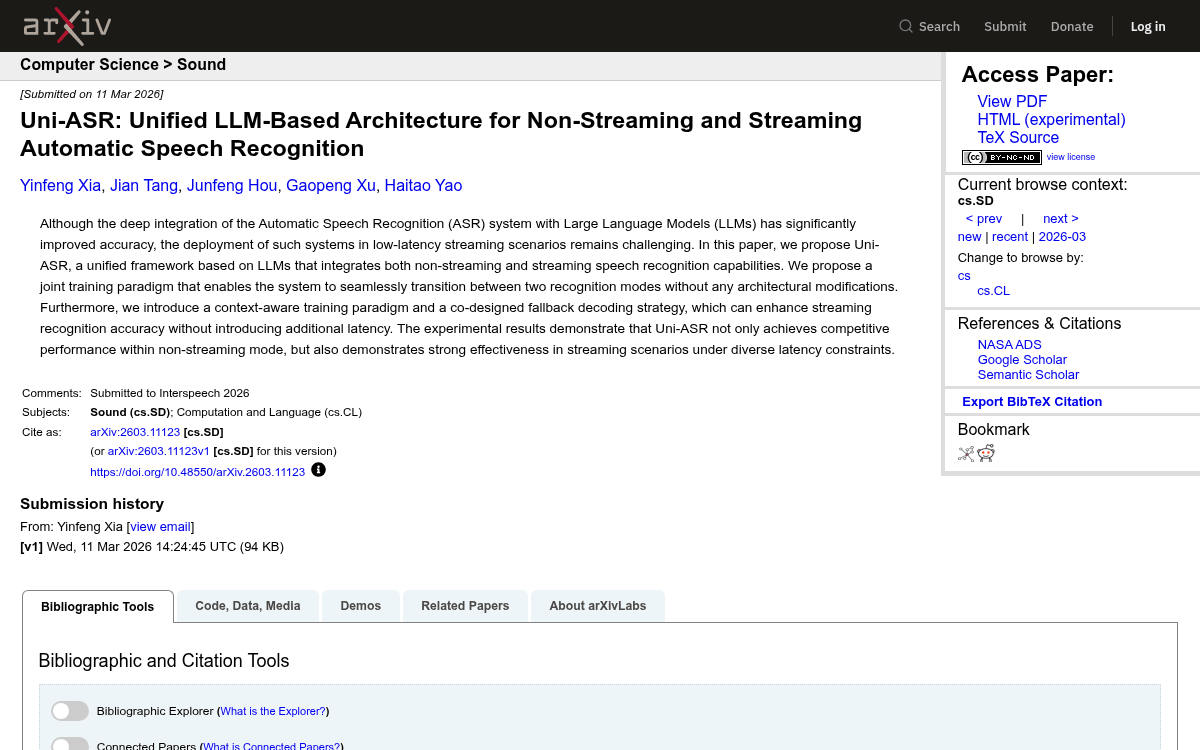
Speech recognition built on top of large language models has become the accuracy leader, but it has a painful trade-off: the same architectures that dominate offline transcription tend to stumble in real-time, low-latency scenarios. A team from Alibaba's Qwen and Tongyi groups is proposing a way to have both. Their new system, Uni-ASR, is a single LLM-based ASR model that can switch between full-utterance and streaming recognition without any architectural changes, and it holds its own against dedicated streaming systems.
Why streaming has been the sore spot for LLM-based ASR
Systems such as Seed-ASR, FireRedASR, Fun-ASR, Qwen3-ASR and Index-ASR have demonstrated marked superiority over conventional attention-based encoder-decoder architectures, achieving substantial gains in semantic disambiguation, contextual coherence, and transcription fluency. The catch is that these gains assume the model gets to look at an entire utterance before decoding, which does not work for real-time captioning, live translation, or voice agents.
Existing workarounds fall into two uncomfortable camps. One retrofits streaming onto a non-streaming model with tricks like hold-n, wait-k, or local agreement, which selectively emit partial hypotheses rather than generating full chunk-level predictions, but pays for it with redundant recomputation and unpredictable latency spikes. The other builds dedicated streaming models such as Transducer-Llama, SpeechLLM-XL, Speech ReaLLM, and MoCha-ASR, but these either treat the LLM as an auxiliary component, are only validated on small LMs, or add heavy machinery to the inference pipeline.
One model, two modes
Uni-ASR keeps the now-standard three-part recipe: an audio encoder, an audio adapter, and an LLM-based decoder. Specifically, the audio encoder employs the Conformer architecture to extract high-level speech representations, the audio adapter comprises two linear layers with an intermediate ReLU activation, and the decoder leverages the pre-trained Qwen3-1.7B language model to autoregressively generate transcriptions.
The interesting part is training. Instead of picking a mode, Uni-ASR is trained on three paradigms mixed together in equal parts:
- Non-streaming (NS): the classic teacher-forced setup where the model sees the whole utterance and predicts the transcript.
- Standard streaming (SS): speech is chopped into fixed-length chunks, forced-aligned to text, and speech and text tokens are interleaved according to a predefined N:M ratio, and unoccupied text positions within each segment are filled with a pad token. In practice they use a 2:1 speech-to-text token ratio.
- Context-aware streaming (CS): a variant designed to match how the model actually decodes at inference time.
During streaming inference, key-value caches computed during both prefill and decode stages are incrementally accumulated across chunks, while caches derived from prior chunks remain strictly immutable and are efficiently reused in subsequent processing. In other words, each new audio chunk is treated like the next turn in a multi-turn chat, so nothing gets recomputed.
The fallback trick that actually moves the numbers
The core innovation sits in the interaction between the CS training paradigm and a matching decoding strategy called latest-token fallback. The idea: the final token of each chunk is the most likely to be wrong because it sits right on the acoustic boundary with limited context. So Uni-ASR emits it provisionally, then re-decodes it once the next chunk arrives.
To make the model comfortable with that behavior, training deliberately corrupts the sequences to match: the last text token of each interleaved speech-text segment is replaced by pad, and the end-of-sequence token is omitted from each text segment. At inference, upon receiving a new speech chunk, the LLM discards the KV cache generated by the previous decoding round and resets the output sequence by replacing its last text token by pad, then regenerates that token with the new acoustic context in view. Because it stays inside the current inference window, latency does not budge.
How it performs
Uni-ASR is trained on a Chinese-English bilingual mix of AISHELL, WeNetSpeech, FLEURS, LibriSpeech, GigaSpeech, and in-house data. The audio encoder is initialized from FireRedASR-AED and trained inside the WeNet framework with both full and dynamic chunk attention so the same encoder supports both modes.
In non-streaming mode, Uni-ASR lands in the same ballpark as leading open systems: 1.44 CER on AISHELL-1, 2.60 on AISHELL-2, 1.93 WER on LibriSpeech test-clean, and 4.11 on test-other. In streaming mode with 1000 ms chunks, it beats native streaming rivals like Speech ReaLLM, SpeechLLM-XL, and MoCha-ASR, and the only model ahead of it, Qwen3-ASR-1.7B, relies on iterative and repetitive non-streaming decoding passes, incurring substantial computational overhead compared to native streaming architecture.
The ablations show why the fallback strategy matters, especially when latency is tight:
| Chunk length | Fallback vs greedy (avg WER reduction) |
|---|---|
| 1000 ms | 11.43% |
| 640 ms | 13.50% |
| 320 ms | 19.88% |
The fallback decoding strategy delivers enhanced streaming decoding accuracy and optimized inference efficiency under real-world deployment conditions, and it consistently matches or beats beam search at greedy-decoding speed. It cannot fully cancel the latency-accuracy trade-off though: progressively reducing the length of speech chunk from the baseline of 1000 ms to 640 ms and 320 ms incurs relative average WER increases of 10.02% and 32.15%, respectively.
Where this fits in practice
The pitch is straightforward for anyone shipping ASR in production. You maintain one model, one set of weights, and one training pipeline, and choose the mode at inference time based on what the application needs:
- Non-streaming for podcast and meeting transcription, video subtitling, and any batch pipeline where accuracy matters more than lag.
- Streaming with 1000 ms chunks for live captions and dictation where a small buffer is acceptable.
- Streaming with 320-640 ms chunks for voice agents and interactive systems where responsiveness dominates.
The obvious limits: the model is currently Chinese and English only, tops out at a 1.7B decoder, and neither code nor weights appear to be released alongside the paper, so third-party validation and drop-in use will have to wait. Latency at very short chunk lengths is still meaningfully worse than at long ones, so applications that need sub-500 ms response with clean-room accuracy will still feel the trade-off, just less severely than before.
The real contribution here is less about a single benchmark number and more about collapsing what has been two separate engineering tracks into one. If unified training paradigms like this hold up at larger scales, LLM-based ASR stops being an offline-only technique and starts looking viable for the full latency spectrum.