
Alibaba's ToCoRL Fixes Qwen3 Factual Recall Without Sacrificing Math Skills
Alibaba's Qwen team proposes ToCoRL, a reinforcement learning framework that teaches a single model to switch between deep reasoning and direct factual recall without capability loss.
 Pro
Takeaways
- Core finding: LLMs have latent "behavioral plasticity" -- prepending just 3 tokens from a direct-answer model can shift a reasoning model's behavior without any training.
- ToCoRL framework: Alibaba's Qwen team proposes using token-conditional generation during RL rollouts to permanently internalize this behavioral shift via a custom KL divergence objective.
- Key result: Starting from Qwen3-30B-A3B-Thinking, ToCoRL improves SimpleQA accuracy from 18.9% to 28.3% while keeping AIME'25 math performance at 81.5%, beating all baselines on both tasks simultaneously.
- Emergent behavior: Training produces a novel "recalibrative reasoning" pattern -- the model gives a direct answer first, then iteratively refines it, rather than doing open-ended chain-of-thought.
- Robustness: The prefix provider model can be as small as Qwen2.5-14B with minimal performance drop, and the behavior transfers to new models via SFT distillation.
- No weights released: The paper includes full pseudocode and training details; no public model checkpoint is available yet.
There is a persistent tension at the heart of modern large reasoning models: the same step-by-step thinking that makes them exceptional at math makes them surprisingly bad at answering simple factual questions. By conditioning generation on carefully selected token prefixes sampled from responses exhibiting desired behaviors, LLMs can seamlessly adapt their behavioral modes at inference time, switching from step-by-step reasoning to direct answering without retraining. Researchers from Alibaba's Qwen team and Shanghai Jiao Tong University have now turned this observation into a principled training framework called Token-Conditioned Reinforcement Learning (ToCoRL).
The Reasoning Tax on Factual Recall
Large Reasoning Models (LRMs) are trained to think before they answer. That works beautifully for problems that require multi-step decomposition, but it actively hurts performance on factual questions. Unlike complex math problems that require step-by-step reasoning to bridge the abstract problem and the correct answer, factual questions only require instruction-following skills, and the question-answer mapping usually exists in the pre-training corpus. When a reasoning model is asked "What year was this beetle species described?", it doesn't need to derive anything. It just needs to retrieve. But its training pushes it to reason anyway, and that reasoning introduces spurious associations, unverified information, and potential hallucinations that derail the answer.
SimpleQA scores, which test factual accuracy on real-world knowledge questions, are notably low across the Qwen3 family. The apparent mechanism: aggressive optimization for coding and math performance appears to have displaced some of the model's general world knowledge. The paper quantifies this gap clearly: on the SimpleQA benchmark, Qwen3-30B-A3B-Thinking scores 18.9% while its Instruct counterpart scores 22.1%, despite the Thinking model being the more capable of the two on math tasks.

Token Forcing: A Behavioral Shortcut
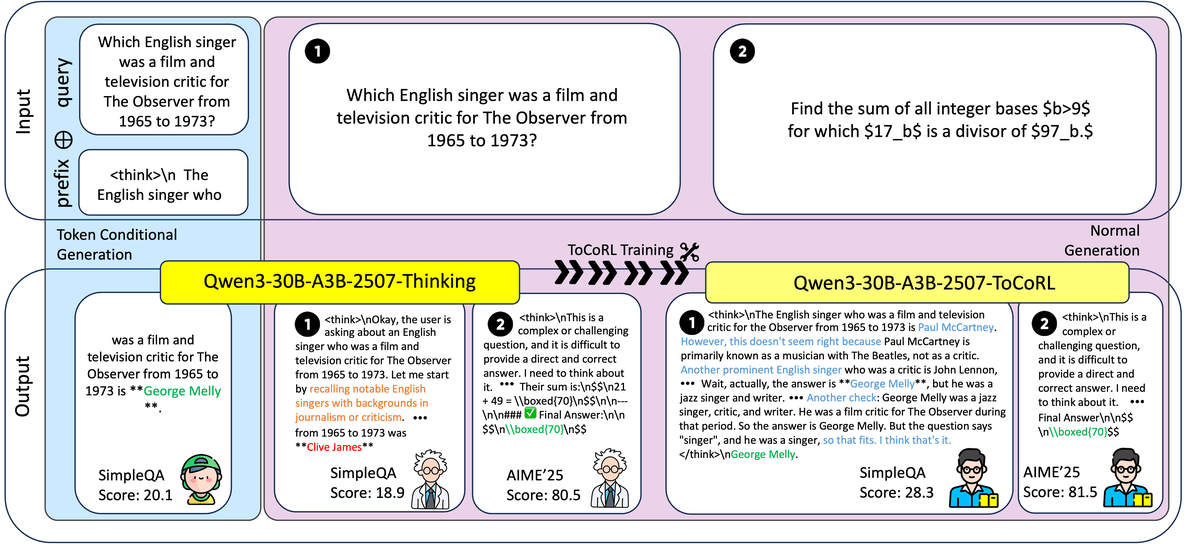
The key insight in this paper is that LLMs already contain the behavioral patterns needed to answer factually. They just need the right nudge to activate them. The researchers call this "behavioral plasticity" and expose it through a technique called token-conditional generation, or token forcing.
The mechanism is simple:
- Take a factual question and generate a short direct answer using an Instruct model.
- Extract just the first few tokens of that direct answer (as few as 3 tokens).
- Prepend those tokens to the Thinking model's generation context, after the
<think>tag. - Let the Thinking model continue generating from there.
This inference-time editing requires no additional training and introduces no new knowledge, so the performance gains and the decrease of response length can only be attributed to the model's inherent behavioral plasticity. Just forcing those first few tokens shifts the model from a 1,255-token average response to an 891-token average, and bumps SimpleQA accuracy from 18.9% to 20.7%. The model already knew how to answer directly. It just needed a push.
The problem is that token forcing at inference time is fragile. It requires pre-generated responses from a helper model, and the behavioral shift is unstable. That is exactly the gap ToCoRL is designed to close.

Making Plasticity Permanent with RL
ToCoRL is a principled framework that leverages RL to internalize this chameleon-like plasticity, transforming transient inference-time adaptations into stable and learnable behavioral patterns. The core idea is to use token-conditional generation not just at inference time, but during the RL rollout stage itself, as a way to guide exploration toward the desired behavior.
Standard RL for LLMs (like GRPO) samples responses from the current policy and updates based on reward. ToCoRL modifies the rollout by sampling from a mixed policy: some fraction of rollouts come from the model normally, and the rest come from token-forced generation. This mixed rollout is used to compute a customized KL divergence term that pulls the model toward the target behavior while the standard policy gradient term reinforces what actually works. The key properties of this design:
- Correctness-aware exploration: Token-forced rollouts that get the right answer are reinforced; those that get it wrong are suppressed. The model is nudged toward the behavior, not blindly forced into it.
- Stability via KL coefficient: The KL term regulates how aggressively the model is pushed, preventing catastrophic behavioral collapse.
- No expert policy required: Unlike imitation learning, ToCoRL does not assume the token-forced policy is always correct. It just uses it as a behavioral scaffold.
Practically, during each training step, the algorithm flips a weighted coin. With probability proportional to 1/(1+λ), it samples a normal rollout. Otherwise, it constructs a token-forced rollout by prepending the <think>\n token plus a few tokens from an Instruct model's direct answer, then lets the Thinking model continue. Both types of rollouts are pooled, advantages are estimated across the group, and the model is updated.
What Emerges: Recalibrative Reasoning
The most interesting result is not just that the model gets better at factual questions. It is that an entirely new behavioral pattern emerges that was not explicitly programmed. After training with ToCoRL, the LRM consistently starts its response with a direct answer. It then tends to perform recalibrative reasoning, where it repeatedly generates answers it currently deems to be correct, uses them as context for subsequent generation, and terminates with a summary once it becomes confident in the answer.
This is qualitatively different from both the original step-by-step reasoning and the Instruct model's direct answering. The model gives an initial answer, then iteratively refines it using only the question itself as context, avoiding the tangential associations that plague the original Thinking model. For easy questions, it answers and stops. For hard ones, it cycles through candidates until it converges.
The Numbers
The paper benchmarks ToCoRL against three baselines: standard GRPO, Adaptive-Thinking (which adds a length penalty to discourage long reasoning), and Instruct-Tuning GRPO (which adds a prompt instruction to reason adaptively). All experiments start from Qwen3-30B-A3B-Thinking and train jointly on 10K factual and 10K math query-answer pairs.
| Method | SimpleQA | AA-Omniscience | AIME'24 | AIME'25 |
|---|---|---|---|---|
| Thinking (baseline) | 18.9 | 16.1 | 84.8 | 80.5 |
| Instruct (baseline) | 22.1 | 10.5 | 75.2 | 61.3 |
| w. GRPO | 23.6 | 16.7 | 89.5 | 81.4 |
| w. Adaptive-Thinking | 23.9 | 16.0 | 86.9 | 78.9 |
| w. Instruct-Tuning GRPO | 21.1 | 14.8 | 87.8 | 80.4 |
| w. ToCoRL | 28.3 | 18.6 | 89.0 | 81.5 |
ToCoRL improves accuracy on the SimpleQA benchmark from 18.9 to 28.3. Moreover, the emergent behavior coexists with mathematical reasoning capabilities without interference, improving accuracy on the AIME'25 benchmark from 80.5 to 81.5. The competing methods either fail to meaningfully improve factual accuracy (GRPO reaches only 23.6) or do so at the cost of math performance (Adaptive-Thinking drops AIME'25 from 80.5 to 78.9). ToCoRL is the only method that improves both simultaneously.
Robustness and Transferability
The paper runs thorough ablations. The KL coefficient λ and prefix length k can be varied substantially with only minor performance fluctuations. More importantly, the prefix provider does not need to be a large model: using Qwen2.5-14B-Instruct instead of the 235B model as the prefix source drops SimpleQA accuracy by only 0.5 points. ToCoRL's efficacy is almost independent of the prefix provider's capacity, as long as the initial tokens attempt to provide a direct answer.
The emergent behavior also transfers. The team distilled the ToCoRL-trained model's responses into an SFT dataset and used it to train from a base model. That SFT-initialized model, when further trained with GRPO, reached 29.1 on SimpleQA and 62.0 on AIME'25, outperforming all baselines including those that used responses from the much larger 235B Instruct model as SFT data.

What This Means in Practice
The practical implication is significant. Today, teams building on reasoning models typically have to choose: use the Thinking model and accept poor factual recall, or use the Instruct model and sacrifice math and reasoning performance. ToCoRL suggests a third path: a single model that routes its own behavior based on the problem type, without any external classifier or prompt engineering.
The method is also general. Token-conditional generation is evidently applicable to a wide variety of settings. For other tasks where the desired behavior can be encoded in token prefixes, ToCoRL can take effect by seamlessly injecting the target behavior and evolving the most effective behavioral pattern. The authors frame this as a paradigm shift: instead of training separate specialized models, diverse behaviors can be programmed within a unified model by learning to control the token-level patterns that guide behavioral expression.
No code or model weights are released alongside the paper, but the full paper includes pseudocode for the training loop and detailed experimental settings. The approach builds on standard RL infrastructure (the team used Megatron for parameter updates and vLLM for rollouts), making it reproducible for labs with access to comparable compute.