
Alibaba's ReMe Lets a Small AI Agent Outperform Models Twice Its Size
A new procedural memory framework distills, adapts, and prunes agent experiences, letting an 8B model beat a 14B one on tool-use benchmarks.
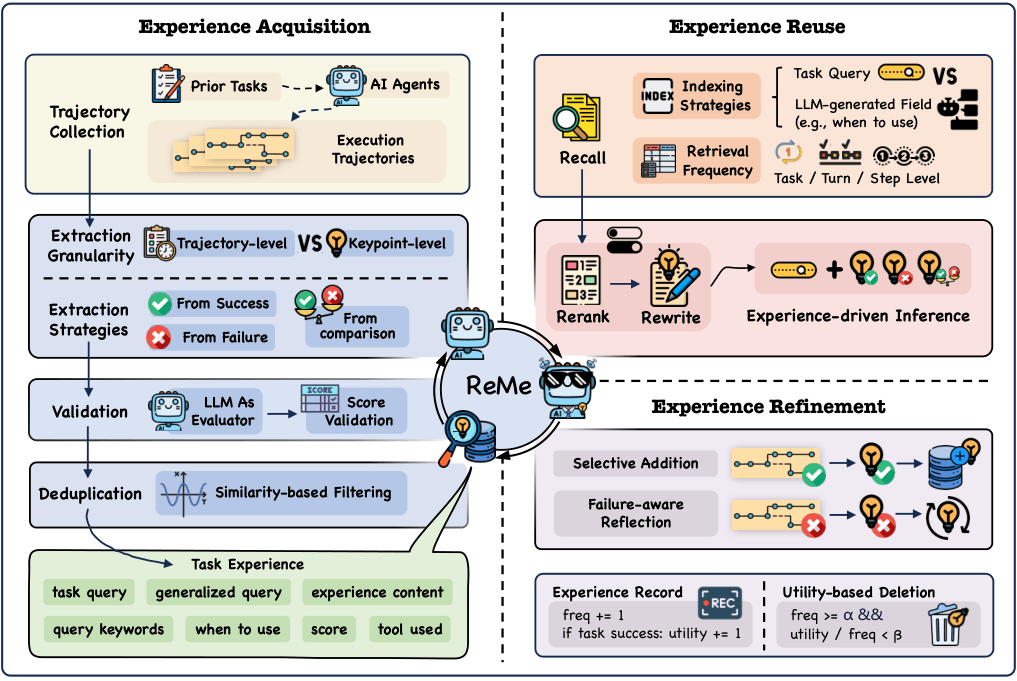
Takeaways
- ReMe replaces passive memory accumulation with a distill-reuse-refine lifecycle for LLM agents (paper).
- Qwen3-8B with ReMe beats memoryless Qwen3-14B on average across BFCL-V3 and AppWorld benchmarks.
- Three mechanisms: multi-faceted distillation, context-adaptive reuse via scenario indexing, utility-based pruning of stale memories.
- Keypoint-level experiences outperform trajectory-level ones by 3-4% on Avg@4; K=5 retrieval is optimal.
- Failure-aware reflection loop retries failed tasks up to 3 times, keeping only lessons that lead to success.
- Code and reme.library dataset released at github.com/agentscope-ai/ReMe, ~12% latency overhead.
Most agent memory systems today act like a hoarder's attic. Every trajectory an agent produces gets dumped into a vector store, and when a new task shows up, the agent grabs whatever looks similar and hopes for the best. A team from Shanghai Jiao Tong University and Alibaba's Tongyi Lab argues this passive accumulation is why memory-augmented agents keep hitting a ceiling, and they've released ReMe (Remember Me, Refine Me) to address it.
Qwen3-8B equipped with ReMe outperforms larger, memoryless Qwen3-14B on tool-use benchmarks, suggesting that a well-curated experience pool can substitute for a few billion extra parameters.
Why static memory rots
Procedural memory is the "how-to" knowledge an agent accumulates from doing tasks, as opposed to the factual knowledge baked into weights. If an agent has already figured out how to place a stock order, it shouldn't have to rediscover the procedure from scratch next time. Prevailing approaches, though, typically treat memory as inert storage built on either raw trajectories or summarized workflows corresponding to entire trajectories.
That creates three concrete failure modes the authors identify:
- Coarse-grained trajectory-level experiences may introduce irrelevant information that can prevent the agent from grasping the core logic.
- Fetched experiences are applied without adaptation, leading to failures in slightly shifted scenarios.
- Lack of timely update strategies causes the experience pool to degrade into a mixture of valid insights and toxic noise.
Memories that were once helpful can become misleading as tasks drift, and nothing in existing frameworks ever throws them away.