
Alibaba's ProbeRAG Forces LLaMA to Stop Ignoring Retrieved Facts, Hitting 89.2 F1
ProbeRAG cracks open the black box of RAG faithfulness by reading hidden states directly, boosting F1 by 3 to 10 points across benchmarks.
 Pro
Takeaways
- ProbeRAG detects RAG knowledge conflicts by reading hidden states, not by prompting or decoding tricks
- Aligned and conflicting knowledge form linearly separable clusters in LLM latent space
- Three-stage pipeline: knowledge pruning, latent probing, conflict-aware attention fine-tuning
- Beats CANOE and Context-DPO by 3-10 F1 points across FaithEval, ConFiQA, and SQuAD
- Probes trained on MQuAKE generalize to RAG benchmarks at 82-88% accuracy
- Full code and evaluation harness available at github.com/LinfengGao/ProbeRAG
Retrieval-augmented generation was supposed to solve hallucinations. Instead, it produced a new failure mode: models that receive perfectly good context and still ignore it, either defaulting to what they memorized during pretraining or blending the two sources into something that resembles neither. A new paper from Xiamen University, Hong Kong Polytechnic, and Alibaba, titled Beyond Black-Box Interventions, argues that fixing this requires looking inside the model rather than nudging it from the outside.
The team introduces ProbeRAG, a framework that reads a model's hidden states to detect when retrieved context conflicts with parametric memory, then steers attention toward the conflicting evidence during generation. On the ConFiQA multi-conflict benchmark, it pushes LLaMA-3.1-8B-Instruct from 28.0 F1 with vanilla RAG to 89.2 F1, with similar gains on Qwen3-8B and Mistral-7B-v0.3.
Why RAG keeps ignoring its own evidence
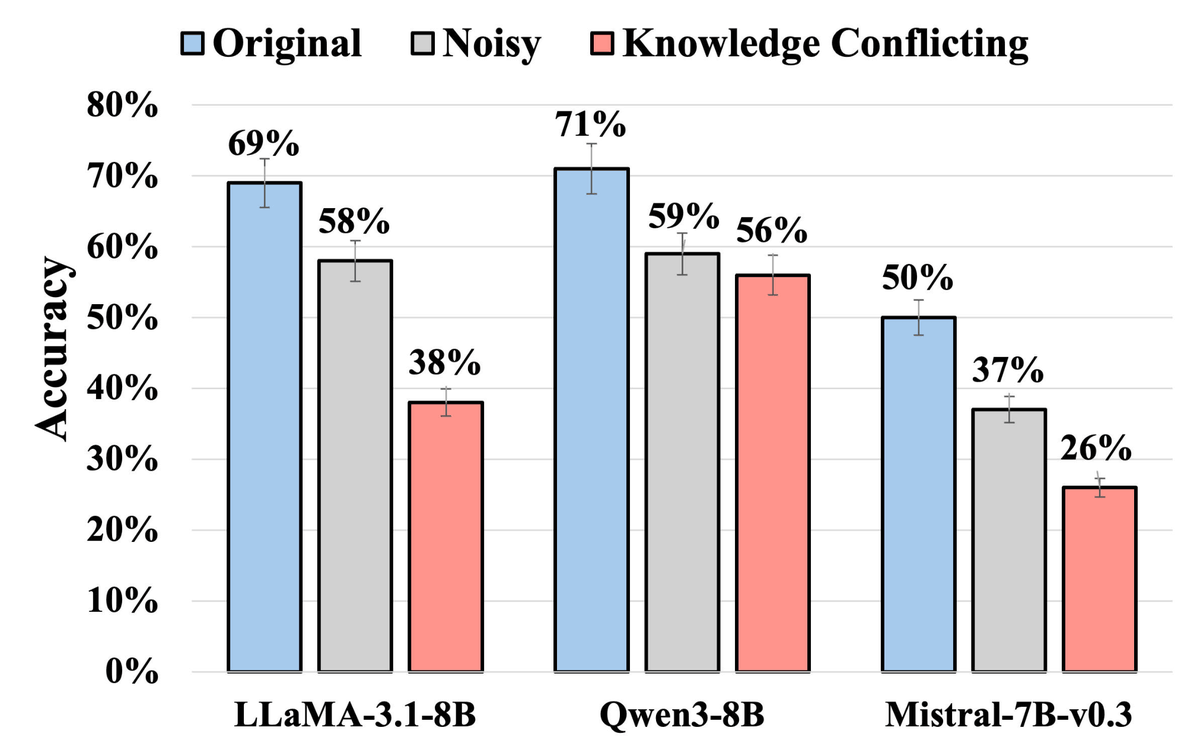
The paper opens with a diagnostic that will feel familiar to anyone running a production RAG stack. Fed clean context, Qwen3-8B hits 71% accuracy. Add semantically related but topically irrelevant passages (contextual noise) and it drops to 59%. Introduce counterfactual entities that contradict what the model already knows (knowledge conflict) and it falls further to 56%.
Existing fixes fall into three camps, all of which treat the LLM as a sealed box:
- Prompt-based methods like Self-RAG or context-faithful prompting, which are brittle and prompt-sensitive
- Decoding-based methods like Context-Aware Decoding (CAD) or COIECD, which reweight token probabilities but break when context is noisy
- Preference optimization like Context-DPO or CANOE, which need large curated preference datasets