
Alibaba's NavForesee Beats Navigation AI by 11 Points With Predictive Foresight
Alibaba's NavForesee fuses hierarchical language planning with a dual-horizon world model, hitting 66.2% success and 78.4% oracle success on R2R-CE navigation.
 Pro
Takeaways
- Alibaba's Amap group unveils NavForesee, a 3B VLM unifying language planning and world model prediction.
- Backbone is Qwen2.5-VL-3B-Instruct with dream queries producing dual-horizon depth and semantic forecasts.
- Predicts DINOv2 and SAM features instead of pixels, avoiding expensive video generation for foresight.
- Hits 66.2% SR and 78.4% OSR on R2R-CE, an 11-point OSR gain over prior work.
- Training data of 1.5M samples was auto-annotated using Gemini 2.5 Pro on R2R-CE and RxR-CE.
- Ablations show planning and semantic foresight matter more than depth prediction; no code released.
Embodied navigation agents built on vision-language models keep tripping over the same rock: they can read a long instruction like "go up the stairs, turn left, enter the second door, and walk to the bed," but they lose the plot halfway through. A team from Alibaba's Amap group is proposing a fix that squeezes two usually-separate ideas, high-level planning and predictive imagination, into a single 3B parameter VLM. Their system, NavForesee, hits a 66.2% success rate and a 78.4% oracle success rate on the R2R-CE benchmark, with the oracle number beating prior work by nearly 11 points.
The two failure modes of navigation VLMs
Vision-and-Language Navigation (VLN) asks an agent to follow a natural language instruction through a photorealistic 3D environment, producing continuous waypoints until it reaches the goal. The authors identify two persistent limitations: a planning and memory deficit where deployable VLMs get "lost" due to limited context windows, and a lack of predictive foresight since current models are reactive and cannot anticipate future environmental states.
Prior research has attacked these on separate fronts. One line curates chain-of-thought reasoning datasets to boost VLM planning. Another builds world models that predict future frames or latent states to score candidate actions. A VLM-centric agent can suffer from semantic hallucinations where its plan disconnects from visual reality, while a world model without language guidance experiences semantic drift with predictions untethered from the instructional goal. NavForesee's bet is that these two capabilities should share weights and mutually reinforce each other.
How the pieces fit together
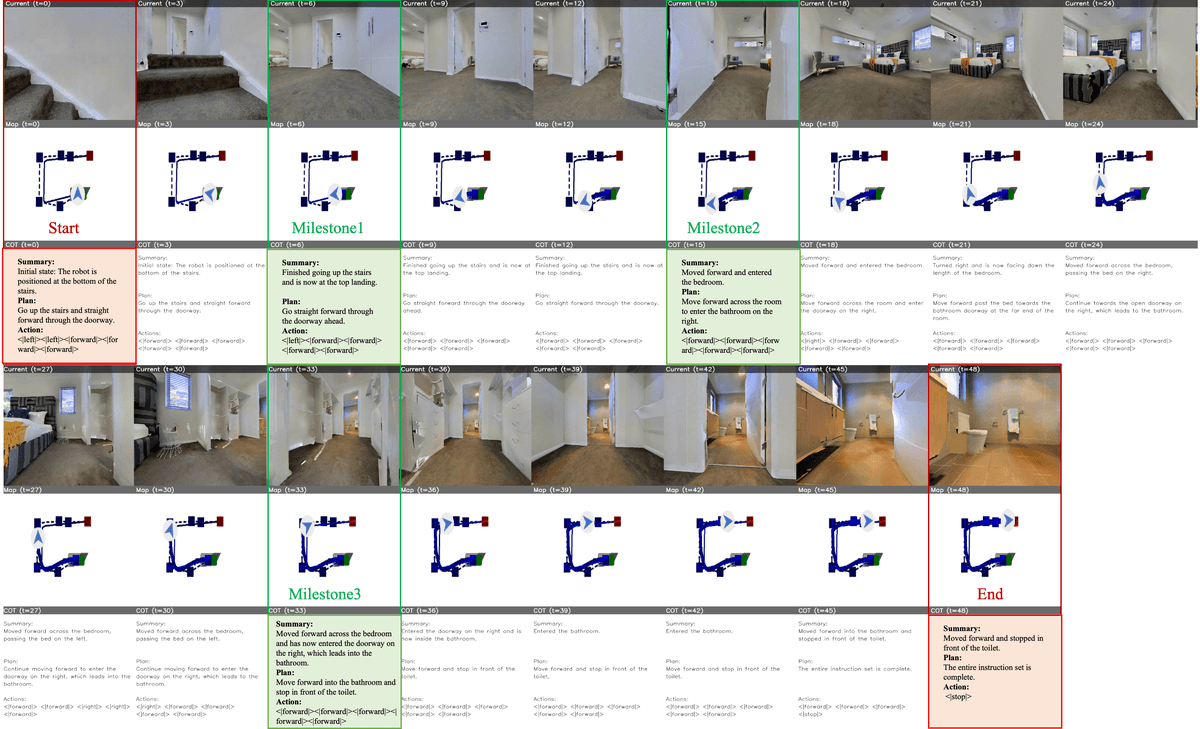
The backbone is Qwen2.5-VL-3B-Instruct, extended with two training objectives that are interleaved batch-by-batch. On the planning side, the model autoregressively decomposes an instruction into sub-instructions, tracks which ones are completed, and formulates the next one. On the prediction side, learnable "dream queries" get appended to the multimodal input and are processed under a structured attention mask to produce future features.

The world model deliberately skips pixel generation. Instead, NavForesee forecasts a compact set of high-level features, specifically depth, DINOv2, and SAM features, that capture essential geometric and semantic information. Two horizons are predicted:
- Short-term: a fixed 5-step lookahead for obstacle avoidance and local dynamics.
- Long-term: an adaptive horizon that stretches to the next navigation milestone, encoding what the environment should look like when the current sub-goal is complete.
Long-horizon predictions depend on short-horizon predictions to ensure temporal coherence, while mutual attention between depth and semantics queries is masked to prevent cross-modal leakage. An action query attends to everything and feeds a small MLP head that emits continuous waypoints plus a stop flag.
A dataset built by Gemini 2.5 Pro
To train the hierarchical planner, the authors needed milestone-level labels that don't exist in the raw VLN datasets. They fed each episode from R2R-CE and RxR-CE into Gemini 2.5 Pro with a structured prompt that decomposes long instructions into sub-instructions and identifies keyframe milestones. Every sampled waypoint gets three labels: a summary of completed sub-instructions, the next planned instruction, and a discrete language action (forward, left, right, stop). The pipeline produces approximately 1.3M training samples from RxR-CE and 0.2M from R2R-CE.

Numbers on R2R-CE and RxR-CE
On the R2R-CE val-unseen split, NavForesee posts a Success Rate of 66.2%, an Oracle Success Rate of 78.4%, a Navigation Error of 3.94 m, and SPL of 59.7. The gains over prior state-of-the-art include a 1.1% SR improvement, a 10.9% OSR jump, and a 0.3 m NE reduction, attributed to the world model prediction module enabling better environmental dynamics capture and exploration. On RxR-CE, results are more mixed. NavForesee performs slightly worse than SOTA methods on RxR-CE, indicating limited generalization to more complex environments, and the authors note they train solely on R2R-CE and RxR-CE while other methods exploit larger and more diverse datasets.
The ablations tell a cleaner story about what actually matters:
- Removing the VLM planning module drops SR from 66.2% to 48.8%, a 17-point collapse.
- Removing long-term milestone prediction drops SR to 58.6%.
- Removing all three modules (planning, long-term, short-term) drops SR to 52.6%.
- Semantic feature prediction matters more than depth: killing semantics drops SR to 60.0%, killing depth drops it to 61.8%.
That last finding is interesting on its own. The authors argue high-quality semantic foresight matters more for navigation than short-term geometric precision, because semantics anchor the long-term goal while depth mostly helps local execution.
What this is good for, and what it isn't
NavForesee is a research prototype from the Amap group at Alibaba, and no code or weights have been released with the paper. The base model is a public Qwen2.5-VL-3B, and training used 64 NVIDIA H20 GPUs for three epochs, so reproduction is heavy but not extreme. It's aimed squarely at instruction-following continuous VLN in indoor scenes, using panoramic RGB without depth sensors or wheel odometry at inference.
The weaker RxR-CE performance is the clearest caveat. RxR uses coarser turn increments, a narrower field of view, and multilingual instructions with longer trajectories, and NavForesee lags CorrectNav there by roughly 3 SR points. Anyone building on this should also note the reliance on Gemini 2.5 Pro for milestone annotation, which bakes a proprietary model into the training recipe. Still, as a demonstration that unifying planning and world modeling inside one VLM outperforms bolting them together, it's a clean result and a template worth studying.