
Alibaba's MM-CondChain Exposes a Brutal Flaw in Today's Top AI Agents
A new benchmark for multi-layer visual conditional reasoning shows even Gemini-3-Pro tops out at 53% F1, revealing where MLLMs break.
 Pro
Takeaways
- MM-CondChain benchmarks multi-layer visual conditional reasoning with programmatically verified ground truth. Paper
- Gemini-3-Pro tops the leaderboard at 53.33 average Path F1, GPT-5 second at 50.34.
- Models systematically over-assume conditions hold, scoring far worse on False-path hard negatives.
- Path F1 drops 29 to 33 percent as chain depth goes from 2 to 6 layers.
- Covers three domains: natural images, charts, and GUI trajectories, 975 paired samples total.
- Dataset on Hugging Face, pipeline on GitHub.
A team from Alibaba's Accio Lab and Zhejiang University has released a benchmark that puts a hard number on something practitioners have long suspected: today's multimodal models are not reliable at following visual workflows that branch. MM-CondChain tests whether an MLLM can walk through nested conditional instructions like "if a permission dialog appears and the interface is green, click Allow, otherwise..." where each decision hinges on multiple visual facts verified from the image.
The headline result: even the strongest model attains only 53.33 Path F1, with sharp drops on hard negatives and as depth or predicate complexity grows. Gemini-3-Pro leads, GPT-5 follows at 50.34, and most open-source models sit well below that.
Why existing benchmarks miss the point
Visual reasoning benchmarks like CLEVR, GQA, and SugarCrepe test single-layer compositions ("is the object red and large?"). Instruction-following benchmarks like IFEval treat constraints as independent checkboxes. Neither captures the workflow pattern where the model must verify a multi-factor visual condition at each step, and the outcome of each step then determines the subsequent reasoning path.
The other gap is negative examples. Prior contrastive benchmarks change one attribute in one layer. Real-world failures involve chains where flipping a single condition three layers deep should reroute the entire execution path, and the model has to catch it.

The VPIR trick: verify the logic before writing the prose
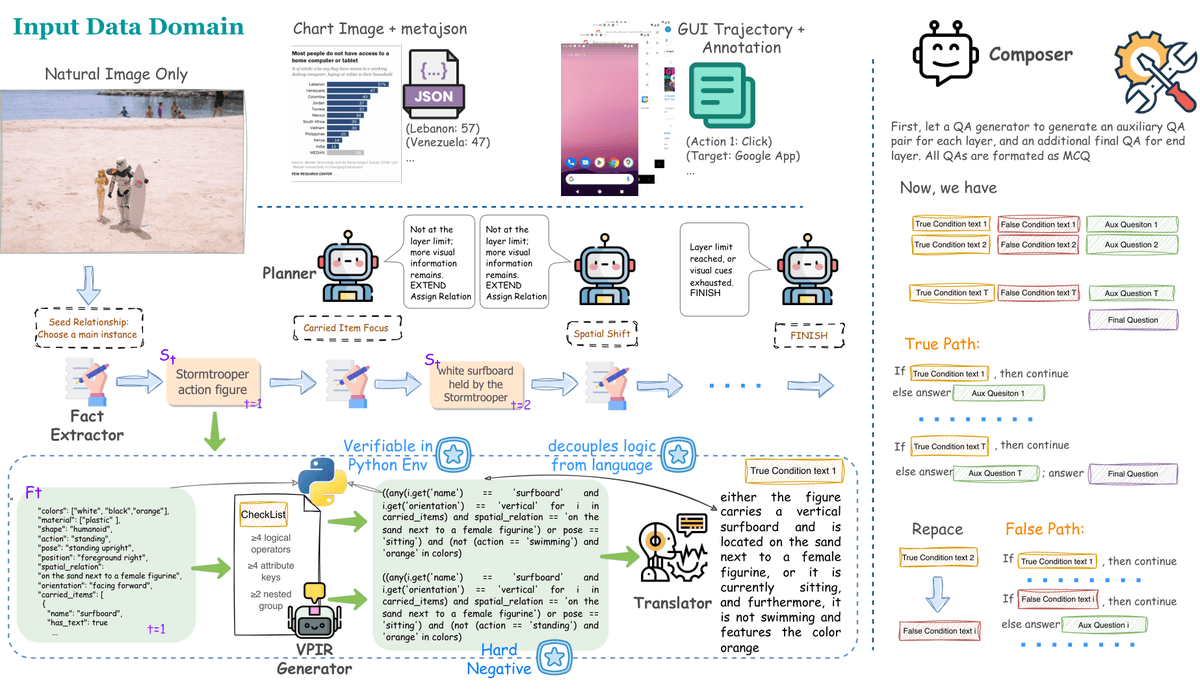
The core methodological contribution is the Verifiable Programmatic Intermediate Representation, or VPIR. Naively asking an MLLM to generate deep conditional reasoning chains produces contradictions and ungrounded claims. Instead, the pipeline decouples logical construction from language rendering: each layer is first expressed as an executable Python-like predicate, mechanically checked against structured visual facts extracted from the image, and only then rewritten into natural language.
Each layer is built in four stages:
- Relational strategy: a Planner chooses whether to deepen (zoom into the same subject) or transition (move to a related entity).
- Structured fact extraction: the extractor produces a JSON dictionary of typed attributes like
{color: "red", position: "left"}. - VPIR generation: a true predicate
p_tand a counterfactual~p_tare synthesized as executable code, then run in a sandbox with whitelisted operators likelen,any,all. - Rendering: an LLM translates the verified predicate into English.
A dedicated Verifier double-checks grounding, non-repetition, and semantic fidelity between the code and the prose. If verification fails repeatedly, the Planner triggers ROLLBACK and resumes from the last good prefix. Once the chain finishes, a Composer compiles two nearly isomorphic evaluation instances: a True-path where all conditions hold, so the control flow reaches the terminal layer, and a False-path where one condition is swapped for its counterfactual, forcing early termination.
The result is a hard negative that differs from the true instance by a single flipped predicate hidden inside a nearly identical instruction. There's no shortcut through surface patterns.
Three domains, one engine
The pipeline is instantiated across 398 natural images from SAM and GQA, 200 chart images from ChartQA spanning bar, line, and pie charts, and 377 GUI interaction trajectories with 3,421 total screenshots from AITZ, for 975 paired samples. Domain adapters handle input quirks (CSV alignment for charts, trajectory completeness checks for GUIs) but the VPIR core stays domain-agnostic.

Where models break
Two patterns stand out. First, most models score much higher on True-paths than False-paths. GPT-4o scores 83.92 vs. 12.81 on Natural, Qwen3.5-9B scores 91.69 vs. 13.10. The models are biased toward assuming conditions hold and continuing down the chain, which is exactly the failure mode you don't want in an agent that could execute an action it shouldn't.
Second, difficulty scales along two independent axes. From depth 2 to depth 6, Path F1 drops by approximately 29 to 33 percent in relative terms across all tested models. Increasing predicate complexity within a single layer causes an additional 28 to 36 percent drop. Errors compound rather than isolate.
Domain difficulty also varies: GUI trajectories are the hardest (best F1 = 40.19), because reasoning over multi-frame action sequences and state transitions is genuinely harder than checking numeric comparisons in a chart.
What it's good for
MM-CondChain is a diagnostic tool, not a training set. It's most useful if you're:
- Building GUI agents or workflow automations where a wrong branch has real consequences.
- Evaluating whether a fine-tune improved actual conditional reasoning versus just single-step visual QA.
- Stress-testing a new MLLM release against depth and predicate-complexity axes independently.
The paired True/False design and multiple-choice format mean scoring is fully deterministic. No LLM-as-judge, no reproducibility drift.
Availability
The dataset is on Hugging Face, and the synthesis pipeline code is on GitHub. Because the VPIR pipeline itself is released, teams can regenerate instances at custom depths and complexity levels rather than treating the 975 samples as fixed. That configurability is probably the more durable contribution: a way to keep making harder examples as models get better, without hand-authoring them.