
Alibaba's Geoparsing Beats GPT-5 on Geometry Diagrams With a 4B Model
Researchers from the Chinese Academy of Sciences and Alibaba built a formal language and dataset that lets small models parse geometry diagrams more accurately than GPT-5.2.
 Pro
Takeaways
- Researchers introduce Geoparsing, a unified formal language covering both plane and solid geometry diagrams.
- GDP-29K dataset contains 20K plane and 9K solid diagrams, including 5,516 handwritten samples.
- Two-stage training combines supervised fine-tuning with GRPO reinforcement learning using rule-based verifiable rewards.
- GDP-4B parser scores 96.4 on PGDP and 94.9 on SGDP, beating GPT-5.2 and Gemini-3-Flash.
- Feeding parsed output to Qwen3-VL-8B yields +10.1% on Geometry3K and +9.0% on PGPS9K reasoning accuracy.
- Data and code released at the Geoparsing project site.
A team from the Institute of Automation at the Chinese Academy of Sciences and Alibaba's Future Living Lab has released a research package aimed at one of the most stubborn weaknesses in multimodal models: reading geometry diagrams. The work, titled Geoparsing, bundles a unified formal language, a 29K-sample dataset called GDP-29K, and a two-stage training recipe that produces a 4B parser outperforming much larger frontier systems on the task.
Why frontier models still trip over triangles
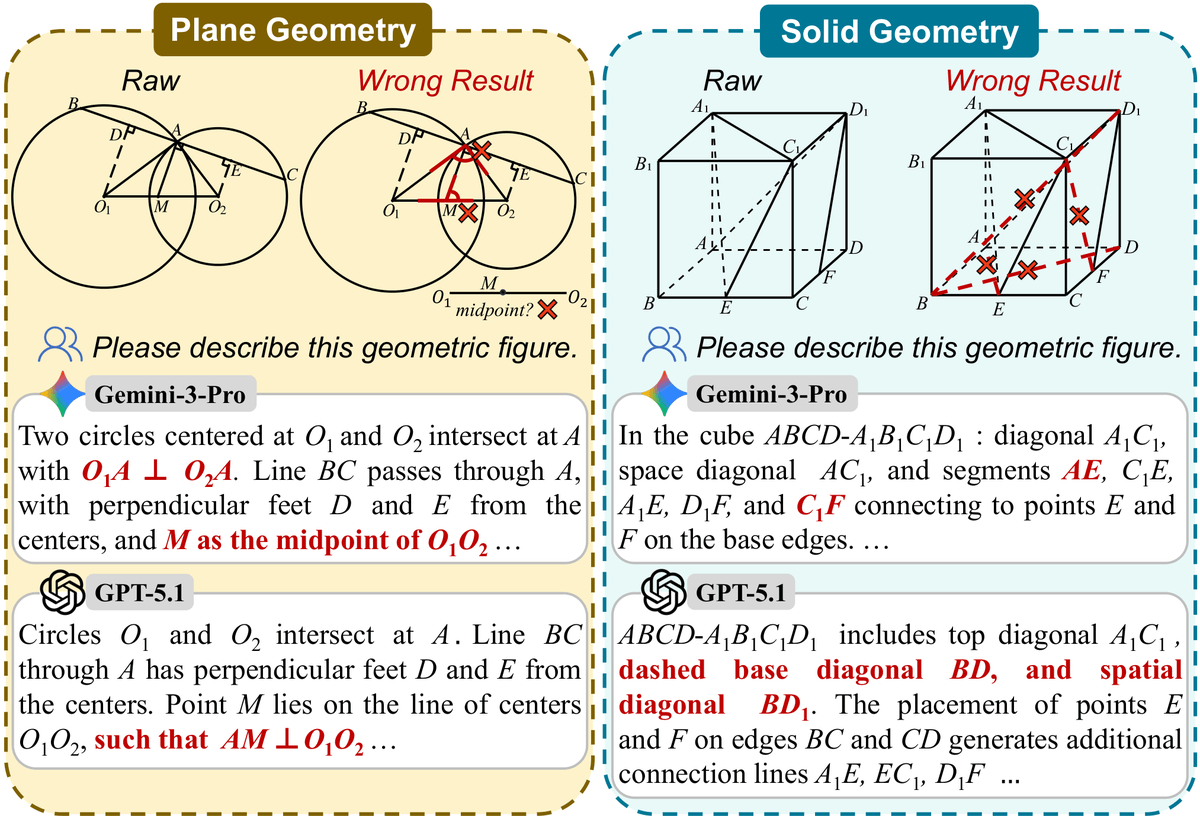
Even the best multimodal LLMs stumble when asked to read a geometry diagram literally. The core difficulty is the demand for precise perception: a model must identify primitives like points, lines, and planes, then comprehend the relations between them. Current systems frequently misinterpret figures at exactly this level. The paper shows Gemini-3-Pro and GPT-5.1 hallucinating labels on relatively simple diagrams, errors that cascade into wrong reasoning downstream.
Earlier work tried to fix this by converting diagrams to symbolic form, a task called geometry diagram parsing (GDP). Those efforts focused almost entirely on plane geometry, introducing formal languages and datasets like PGDP5K and FormalGeo7K, while solid geometry remained underexplored. That gap matters because 3D problems require spatial understanding that flat-diagram formalisms cannot express.
One language for flat and 3D
The authors' first contribution is a formal language that covers both worlds with compatible syntax. It inherits the plane-geometry predicates from PGPS9K (things like line A B C, AB \perp CD on X, m \angle ABC = 41) and extends them to 3D primitives. For comprehensive coverage, solid structures are categorized into polyhedra (cubes, prisms, pyramids, frustums, composite polyhedra) and solids of revolution (spheres, cylinders, cones, truncated cones). Everything decomposes into interpretable primitives, so a shape like