
Alibaba's EcoAlign Cuts AI Safety Costs 5x by Treating Reasoning Like Finance
A cross-institution research team reframes vision-language model safety as a budget problem, using a thought graph and net-present-value scoring to beat chain-of-thought at a fraction of the compute.
 Pro
Takeaways
- Researchers propose EcoAlign, an inference-time framework treating LVLM alignment as budget-constrained economic search.
- Reasoning is expanded as a thought graph, with actions scored by a net-present-value function balancing safety, utility, and cost.
- The weakest-link principle blocks jailbreaks that hide harmful steps behind benign closing advice.
- Across GPT-4o, Gemini 2.5 Flash, Qwen-VL-Max, InternVL3, and Llama-3.2-Vision, EcoAlign beats CoT at a fraction of the cost.
- GPT-4o MMSafety rises from 55.2 to 96.5 at 21.2 cost units versus 104.3 for chain-of-thought.
- No public code yet, but the HTML preprint includes full prompt templates and ablations.
Aligning large vision-language models has long felt like a game of whack-a-mole: bolt on more training, more prompting, more filters, and hope the safety gains outweigh the tax on utility and latency. A new preprint from researchers at Beijing Electronic Science and Technology Institute, Nanjing University, Sun Yat-Sen University, Nanyang Technological University, and Alibaba Group proposes a different lens entirely. Their framework, EcoAlign, treats safety alignment as an economics problem, where the model is a boundedly rational agent trying to spend a finite compute budget on the most valuable reasoning path.
The core claim is that aligning LVLMs is not just a safety challenge but a problem of economic efficiency, and current alignment methods struggle with the trade-off between safety, utility, and operational costs. Reframing the problem this way lets the authors bring in tools from decision theory, most notably net present value and bounded rationality, and use them to steer inference-time search.
Why chain-of-thought defenses keep leaking
The paper picks apart a specific failure mode it calls process-blindness. Traditional safety evaluators grade the final output, ignoring the trajectory the model took to get there. A focus solely on final outputs wastes significant computational budget on unsafe deliberation, and this flaw allows harmful reasoning to be disguised with benign justifications, thereby circumventing simple additive safety scores.
In practice, that looks like a model happily enumerating steps for online fraud or counterfeiting, then closing with a boilerplate suggestion to study cybersecurity. An additive scorer averages the harmful body with the benign coda and calls it safe. Meanwhile the compute for generating the harmful part is already spent. EcoAlign attacks both problems at once by making the reasoning trajectory itself the object of evaluation.
A thought graph priced like an investment portfolio

Instead of a linear chain or a tree, EcoAlign builds a directed acyclic graph of reasoning states, where edges are actions the model can take. Actions fall into three buckets:
- Text generation actions: cheap operations that draft or refine textual thoughts.
- Visual exploration actions: more expensive operations that zoom into image regions and extract fine-grained visual detail.
- Structural optimization actions: merges of equivalent nodes (which actually free up future budget) and pruning of unpromising branches.
Each candidate action is scored by a valuation function that mirrors net present value from finance. The immediate return is the new node's safety times utility divided by its token cost. On top of that, EcoAlign runs a short simulated rollout to estimate discounted future returns, with a discount factor that penalizes distant payoffs. The clever twist is that the rollout horizon is not fixed. It shrinks as the budget dwindles, which the authors describe as budget-aware risk aversion: the poorer the agent gets, the shorter its planning horizon and the more it favors near-certain gains.
The weakest-link safety rule
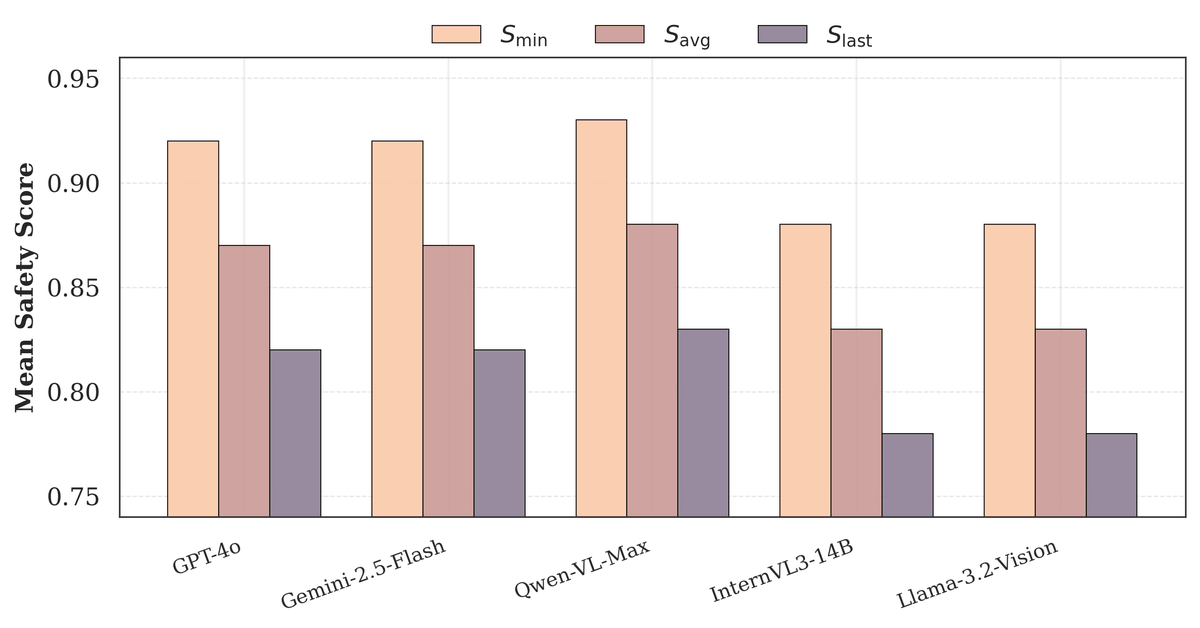
To close the process-blindness gap, EcoAlign refuses to let good later steps launder bad earlier ones. To prevent deception, path safety is enforced via the weakest-link principle. Concretely, a path's safety score is the minimum safety score of any node on it, and any node whose safety score goes negative is pruned immediately, killing that branch.
Ablations show this matters. Swapping the minimum for a path average or a last-node score costs 10 to 14 safety points on average across the tested models. Qwen-VL-Max, for instance, drops from a 0.93 safety score under the minimum rule to 0.85 when only the last step is evaluated.
What the benchmarks show
The authors evaluated across five backbones, three closed (GPT-4o, Gemini 2.5 Flash, Qwen-VL-Max) and two open (InternVL3-14B, Llama-3.2-11B-Vision-Instruct), on six datasets covering safety (MMSafetyBench, MSSBench, SIUO) and utility (OCRBench, MathVista, MMStar). Baselines included the vanilla model, chain-of-thought prompting, chain-of-draft prompting, and VLM-Guard.

The headline numbers are that EcoAlign matches or surpasses state-of-the-art safety and utility at a lower computational cost across all five models. On GPT-4o, MMSafety rises from a base of 55.2 to 96.5 and MathVista utility climbs from 73.1 to 85.4, at an average cost of 21.2 units versus 104.3 for chain-of-thought. For Qwen-VL-Max, EcoAlign hits 93.8 MMSafety at a cost of 12.7, roughly one-ninth what chain-of-thought spends to reach 79.0.
A few other findings worth flagging:
- Removing cost normalization from the valuation function makes GPT-4o's average cost jump from 21.2 to 79.6 with basically no safety benefit, and it actually hurts OCRBench utility (86.0 to 76.1) because unconstrained search wanders.
- The dynamic lookahead beats both a myopic policy that only considers local returns and a fixed-horizon policy that spends the same amount of rollout regardless of remaining budget.
- Sensitivity sweeps land on
k=0.05,B=2000, andδ=0.95as sweet spots. A discount factor of 1.0 (no discount) slightly raises cost and lowers utility, suggesting a small temporal penalty helps steer toward tighter reasoning.
Where it fits, and where it does not
EcoAlign is an inference-time framework, not a fine-tuning recipe, so it plugs on top of any LVLM without touching weights. That makes it a natural fit for teams shipping closed-model APIs where retraining is off the table but token spend still matters. It is also a plausible answer to a real deployment pain point: paying chain-of-thought overhead on every request when only a small fraction actually needs deep deliberation.
The trade-offs are worth naming. EcoAlign still costs more than a bare-bones VLM-Guard style filter (roughly 20x for GPT-4o), and its per-request latency includes the overhead of building the thought graph and running rollouts. On pure utility benchmarks where safety is not at issue, cheaper prompting can occasionally match it. And the entire pipeline leans on the base model's self-evaluation for safety, utility, and novelty scores, which inherits whatever calibration weaknesses the judge has.
Availability
The paper is available on arXiv as an HTML preprint along with the PDF version. The authors do not link a public code release in the preprint, so anyone wanting to reproduce the thought-graph expansion, the multiplicative lookahead valuation, and the Pareto-frontier path extraction will need to implement from the prompt templates and pseudocode in the appendix.