
Alibaba's Bid2X Replaces a Zoo of Ad Models and Lifts GMV by 4.65%
Alibaba's Bid2X unifies fragmented auto-bidding models into one foundation model, lifting Taobao GMV 4.65% and ROI 2.44% in live A/B tests.
 Pro
Takeaways
- Alibaba proposes Bid2X, a single foundation model replacing scenario-specific auto-bidding systems in online advertising.
- Two attention mechanisms model variable correlations from historical data and temporal dynamics from today's trajectory.
- End-to-end zero-inflated projection jointly learns non-zero probability and value, with a convergence proof.
- Trained on eight Taobao datasets covering 132M trajectories; beats all baselines on MAE and RMSE.
- Exhibits power-law scaling with parameters and data, and preserves bid-cost monotonicity 82-85% of the time.
- Live A/B test on Taobao: +4.65% GMV, +2.44% ROI, +7.57% PV versus model-based RL bidder.
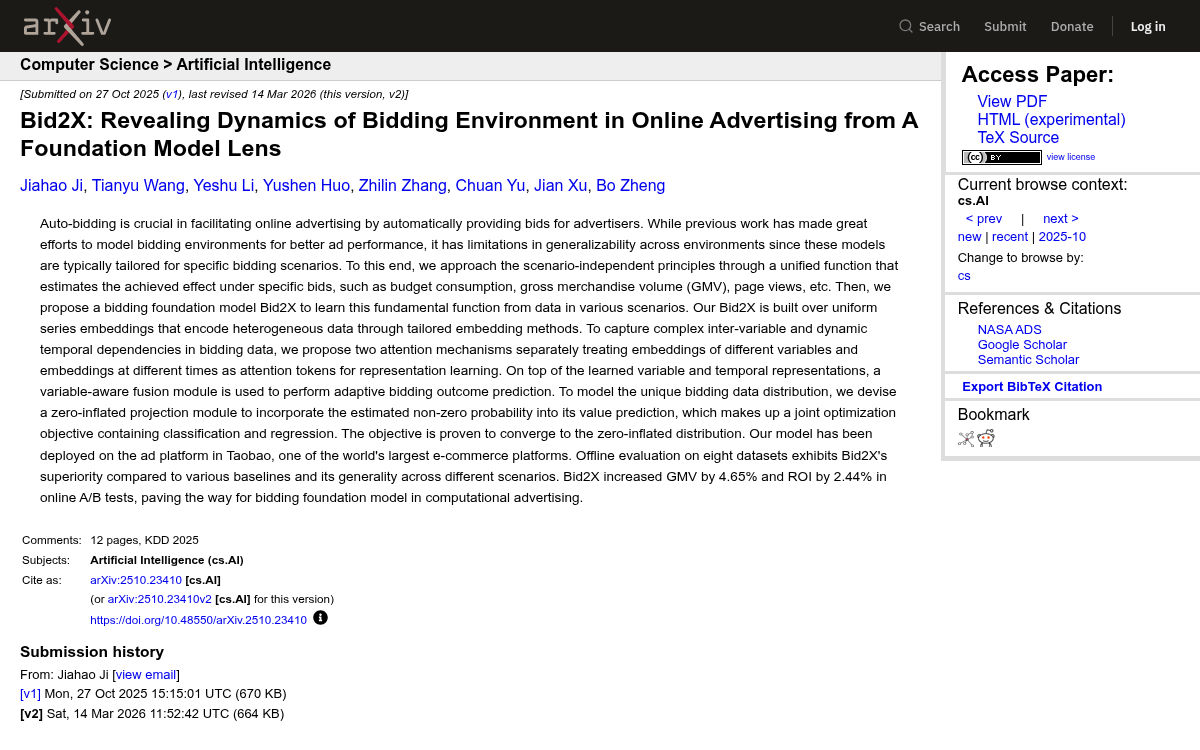
Auto-bidding, the machinery that decides how much an advertiser pays for each ad impression in real time, has always been a patchwork of models. One system handles budget-constrained campaigns, another handles target-ROAS, a third handles specific advertiser segments. Alibaba's ad research team just published Bid2X, a single foundation model that replaces this zoo of specialists and, according to two months of online A/B testing on Taobao, meaningfully outperforms the model-based reinforcement learning system it was benchmarked against.
Why one model per scenario stopped working
Auto-bidding algorithms need to answer a deceptively simple question: given a bid at a certain moment, how much will it cost and what will it earn? Existing approaches model this implicitly, whether through linear programming over historical logs, PID controllers borrowed from control theory, or reinforcement learning with a learned environment model. The problem is generalization. Each of these models is designed and trained for a specific scenario, lacking adaptability to new bidding scenarios and versatility across scenarios.

The authors argue that even though bidding scenarios look different on the surface, they share generalizable physics: more cost-effective impressions produce better performance, bidding environments show closeness and periodicity across time, and the relationship between bid and outcome follows diminishing marginal returns. If those laws hold everywhere, one model should be able to learn them from broad data and transfer across scenarios, much like language foundation models do.
Three problems that make bidding data weird
Building a foundation model here is harder than the analogy suggests. The paper identifies three challenges that don't show up in typical time-series work:
- Heterogeneous data: bidding logs mix point events, time series, discrete categorical fields (advertiser category), and continuous numeric fields (budget). There is no single natural tokenization.
- Dynamic dependencies: the relationship between bid and reward shifts across the day. The same bid may earn more at night than during working hours because shopping behavior changes.
- Zero-inflated distribution: engaging in the bidding process does not guarantee winning impressions, so the data contains many zero values, violating the normal-distribution assumption baked into most neural nets.
How Bid2X is put together
Bid2X frames the task as conditional next-token prediction: given historical trajectories, today's incomplete trajectory, and the next bid, predict the cost, reward, and win count for the next time slot. The architecture has three main pieces working together.

First, a unified embedding layer encodes all the heterogeneous inputs into series representations. Historical data (complete trajectories from prior days) is embedded per-variable, while today's incomplete trajectory is embedded per-timestep, with a right-shift trick to prevent the model from peeking at future target values.
Second, a bidding transformer applies two different attention mechanisms. Variable attention treats each variable (bid, cost, reward, count) as a token and learns their pairwise correlations from historical data. Temporal attention treats each time slot as a token, with causal masking, and learns dynamic dependencies from today's data. A variable-aware fusion module then gates the temporal representation using each target variable's learned representation, so the model can weight temporal history differently when predicting cost versus reward versus count.
Third, and probably the most interesting piece for anyone dealing with sparse targets, is the zero-inflated projection. Instead of the usual two-stage recipe (classifier decides zero or not, regressor handles non-zeros), Bid2X trains both jointly end-to-end. The prediction is Pr(y != 0) * y_hat, and the loss combines cross-entropy on the non-zero probability with MSE on the value. The paper proves this joint objective converges to the true zero-inflated distribution, which the standard MSE objective does not.
Scaling behavior and results
Evaluation covers eight Taobao datasets spanning budget-constrained bidding, target-ROAS, and various advertiser sizes and delivery windows, together holding roughly 132 million trajectories and 3 million bidding records. Baselines include landscape forecasting models (DLF, ADM), heuristic LP, variable-based approaches (MMP, MLP, iTransformer), and temporal transformers (NST, Informer). Bid2X wins across every target variable on every dataset, often by wide margins on MAE and RMSE.
The scaling analysis is where the foundation-model framing earns its name. Model performance follows a power-law relationship with both parameter count and dataset size, with trends spanning more than four orders of magnitude. Larger models also converge faster in terms of tokens processed, matching the sample-efficiency behavior seen in language models.

The model also respects the physics the authors care about. In counterfactual tests where the input bid is multiplied by 0.5, 1.0, 1.5, and 2.0, Bid2X keeps cost monotonically increasing with bid roughly 82 to 85 percent of the time across cost buckets, while Informer only manages about 22 to 26 percent. Prediction error also drops as more of today's trajectory becomes available, which is the predictability property auto-bidders need.
What it moved in production
The online test is what most readers will care about. Bid2X was deployed on Taobao's ad platform and compared against the incumbent model-based RL bidder over roughly two months on around one million campaigns. The deployment is straightforward: the bid at the next time step is chosen so that predicted cumulative cost lands as close as possible to the remaining budget.
| Metric | Change vs MBRL |
|---|---|
| Page views | +7.57% |
| Cost consumed | +2.16% |
| Buy count | +3.89% |
| GMV | +4.65% |
| ROI | +2.44% |
| Latency | +0.05 seconds |
Where it fits, and what is missing
Bid2X is most useful when you operate multiple bidding scenarios and want a single model that transfers across them, including few-shot and zero-shot settings on new advertiser cohorts. It also matters if your target distributions are heavily zero-inflated, since the joint classification-regression objective is a cleaner recipe than the usual two-stage hack.
A few caveats. The paper does not release code or model weights, and the datasets are Taobao's proprietary logs, so reproducing the exact numbers outside Alibaba is not possible from the public writeup. The largest model tested is on the order of a few hundred million parameters and the power-law fits, while clean, span a smaller range than what has been reported for LLMs. And the deployment story is specifically for cost-tracking against a budget target; using Bid2X to directly optimize for ROI or GMV requires a bidding policy built on top of the environment model, which the paper does not detail. Still, the KDD '25 publication is the first serious argument that computational advertising can follow the same foundation-model playbook that has reshaped language and vision.