
Aleph Alpha's HAT Kills the Tokenizer and Still Beats Llama at 70B
Aleph Alpha's HAT models replace fixed tokenizers with a byte-level encoder-decoder wrapped around a Llama backbone, scaling to 70B parameters.
 Pro
Takeaways
- Aleph Alpha released HAT, a tokenizer-free architecture with byte-level encoder and decoder wrapping a Llama-style backbone.
- Models include retrofitted Llama 3.1 8B and 70B variants plus a 7B model trained from scratch on 4T words.
- 7B-DPO preferred over Llama 3.1 8B in 69% of English and 75% of German MT-Bench comparisons.
- Backbone processes word embeddings, not tokens, cutting sequence length and improving compression versus standard tokenizers.
- Handles spelling variations, rare domains, and new languages far better than fixed-vocabulary BPE tokenizers.
- All weights plus 200 pretraining checkpoints available on Hugging Face under a non-commercial research license.
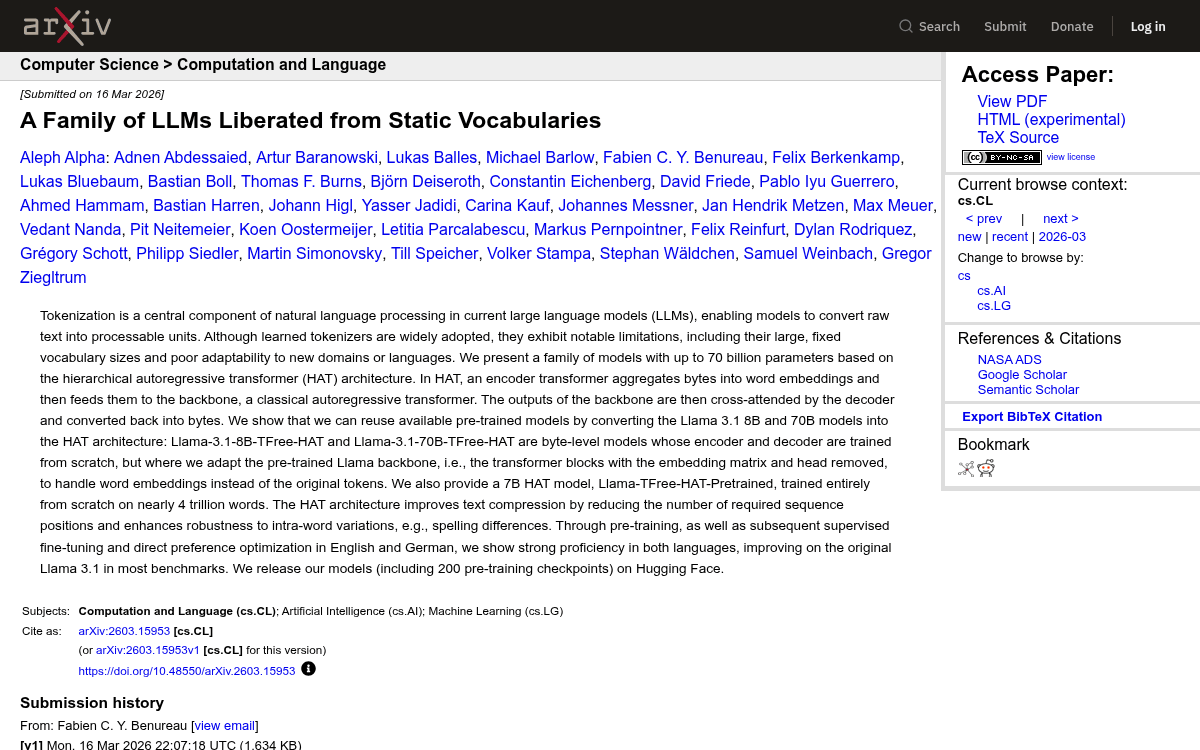
Tokenizers have quietly become one of the most annoying pieces of the modern LLM stack. They are trained separately from the model, ship with a fixed vocabulary, choke on unfamiliar languages, and split rare words into awkward fragments that ruin downstream behavior. Aleph Alpha's new paper, A Family of LLMs Liberated from Static Vocabularies, proposes a way out and backs it with open-weight models up to 70B parameters.
The core idea is the Hierarchical Autoregressive Transformer (HAT): a byte-level architecture that keeps a standard Llama-style transformer at its center but wraps it in a small encoder that folds raw bytes into word embeddings, and a small decoder that unfolds predictions back into bytes. The model operates on raw UTF-8 bytes as its base alphabet, with a tiny vocabulary size of only 256, and can ingest and output any word over that base alphabet.
Why kill the tokenizer
Subword tokenizers like BPE are a compromise. Byte Pair Encoding builds a vocabulary starting from individual bytes and iteratively merging adjacent pairs of tokens that occur most frequently in the corpus until the desired vocabulary size is reached, giving good sequence length compression on the reference corpus while maintaining the ability to handle out-of-vocabulary words using a byte fallback. The problem is that the vocabulary is frozen at training time, tuned to one corpus, and stuffed into an embedding matrix and output head that grow linearly with vocabulary size.
That freeze creates a chain of downstream headaches: poor compression on languages underrepresented in the tokenizer training data, brittleness to typos and formatting quirks, and painful adaptation to new domains. Pure byte- or character-level models solve the flexibility problem but have historically been too slow, since a sentence balloons into a much longer sequence and every position pays full attention cost.
How HAT works
The model uses a hierarchical autoregressive transformer architecture consisting of three components: encoder, backbone, and decoder, together with connector layers between components. Encoder, backbone, and decoder are all instances of autoregressive transformers with pre-norm residual blocks in the style of Llama, using a SwiGLU unit as a feed-forward block, with all model parameters active during training and inference. The backbone model uses standard causal attention, while the encoder and decoder use local causal attention with a finite look-back window.

The flow is straightforward to reason about:
- The encoder reads raw bytes and, at each word boundary, produces a single word embedding via cross-attention over the bytes in that word.
- The backbone, a conventional decoder-only transformer, does next-word-embedding prediction over these compressed positions.
- The decoder takes the backbone's predicted word embedding plus the byte-level context and autoregressively emits the bytes of the next word, one at a time.
The result is that the expensive part of the model, the backbone, sees a sequence measured in words rather than tokens or bytes. The 7B pretraining ran on roughly 1.9 trillion words of DCLM data, corresponding to approximately 2.3 trillion tokens using a conventional tokenizer, with a context window of 3072 words, the equivalent of roughly 3720 tokens. That is a meaningful compression win before you touch anything else.
Two ways to build one
The paper releases models produced by two very different recipes, and this is arguably the most practically interesting contribution.
The first is retrofitting. Llama-3.1-8B-TFree-HAT and Llama-3.1-70B-TFree-HAT are byte-level models whose encoder and decoder are trained from scratch, but where the pre-trained Llama backbone (the transformer blocks with the embedding matrix and head removed) is adapted to handle word embeddings instead of the original tokens. This lets you reuse most of the compute that went into Llama 3.1 rather than starting over.
The second is training from scratch. A 7B HAT model called Llama-TFree-HAT-Pretrained was trained entirely from scratch on nearly 4 trillion words. The HAT architecture improves text compression by reducing the number of required sequence positions and enhances robustness to intra-word variations, e.g., spelling differences.
The team pre- and post-trained their models in English and German on curated corpora. For the retrofitted HAT they initialized the backbone from pre-trained Llama 3.1 weights. In the first pre-training phase, they trained models using a next-byte prediction objective with sequences up to 3,500 words. Llama-TFree-HAT-Pretrained was trained for nearly 4T words, Llama-3.1-8B-TFree-HAT for 134B words, and Llama-3.1-70B-TFree-HAT for 108B words. For reference, the original Llama 3.1 models saw 15T tokens, so the retrofitted variants get away with a fraction of the compute.
Does it actually work
The from-scratch 7B model is the headline result. It shows exceptional German-language performance in this size class, outperforming Llama 3.1 8B in 67% of measured German benchmarks, while matching performance in English. In pairwise judge evaluations, answers from the 7B-DPO model are preferred over those from Llama 3.1 8B in 69% of English cases and 75% of German cases on MTBench.

The 70B experimental release is more mixed. Results on some academic benchmarks lag Llama-3.3-70B-Instruct, but overall performance is largely comparable and the model decidedly beats Llama-3.3-70B-Instruct in direct MT-Bench comparisons in English and German. That is the pattern you would expect: a young architecture with modest post-training budget catches up on subjective quality faster than on knowledge-heavy multiple choice.
What is genuinely new
The HAT approach is not the first attempt at ditching subword tokenization, but a few things make this release land differently:
- Backbone reuse. You can take an existing pre-trained transformer, strip its embedding and head, and graft on a byte-level front and back end. That converts a tokenizer replacement from a full retrain into a much cheaper adaptation.
- Scale. A 70B tokenizer-free model is a first-of-its-kind release. Most prior byte- or character-level work stopped well below that.
- Compression at the backbone. Because the backbone sees words, not bytes, the expensive attention layers do not pay the full byte-level sequence-length tax.
- Robustness. Since there is no fixed vocabulary, the model degrades gracefully on misspellings, unusual casing, and domain-specific jargon rather than fragmenting them into meaningless subword salad.
When you would actually use it
The clearest fit is any workload where a standard tokenizer hurts you: non-English text (especially morphologically rich languages like German), code and structured data, medical or legal jargon, or applications sensitive to typos and formatting drift. At their 7B scale, the models were built to work under deployment constraints, such as on-device processing, local deployment, or other tasks requiring efficient text compression.
The tradeoffs are real, though. The 70B retrofit still trails frontier instruction-tuned models on knowledge benchmarks, and the encoder-decoder wrapper adds implementation complexity compared to a vanilla transformer. Inference tooling is also new territory. To make these models accessible, Aleph Alpha provides two inference implementations: Hugging Face and vLLM.
All of the models, including the 200 pre-training checkpoints, are on Hugging Face under the Open Aleph License, which permits non-commercial research and educational use. If you have been waiting for a serious, scaled attempt at replacing the tokenizer without giving up the ergonomics of the transformer backbone, this is the one to poke at.