
Alberta's Reason2Decide Beats a 32B Model With Just 800M Parameters
A two-stage training recipe teaches small T5 models to explain their own clinical predictions, beating Qwen-3-32B on medical benchmarks with 40x fewer parameters.
 Pro
Takeaways
- Reason2Decide is a two-stage training framework that aligns predictions and rationales in a single small model, available on GitHub.
- Stage 1 pretrains rationale generation, Stage 2 jointly trains prediction and rationale with task-level scheduled sampling.
- Scheduled sampling gradually shifts conditioning from gold labels to the model's own predictions, capped at 90%.
- T5-Large (800M) outperforms zero-shot Qwen-3-32B on all three medical datasets, 40x fewer parameters.
- LLM-generated rationales in Stage 1 match human-authored rationales, cutting annotation costs substantially.
- Evaluated on Alberta Health Link 811 triage, PubMedQA, and BioASQ Task B.
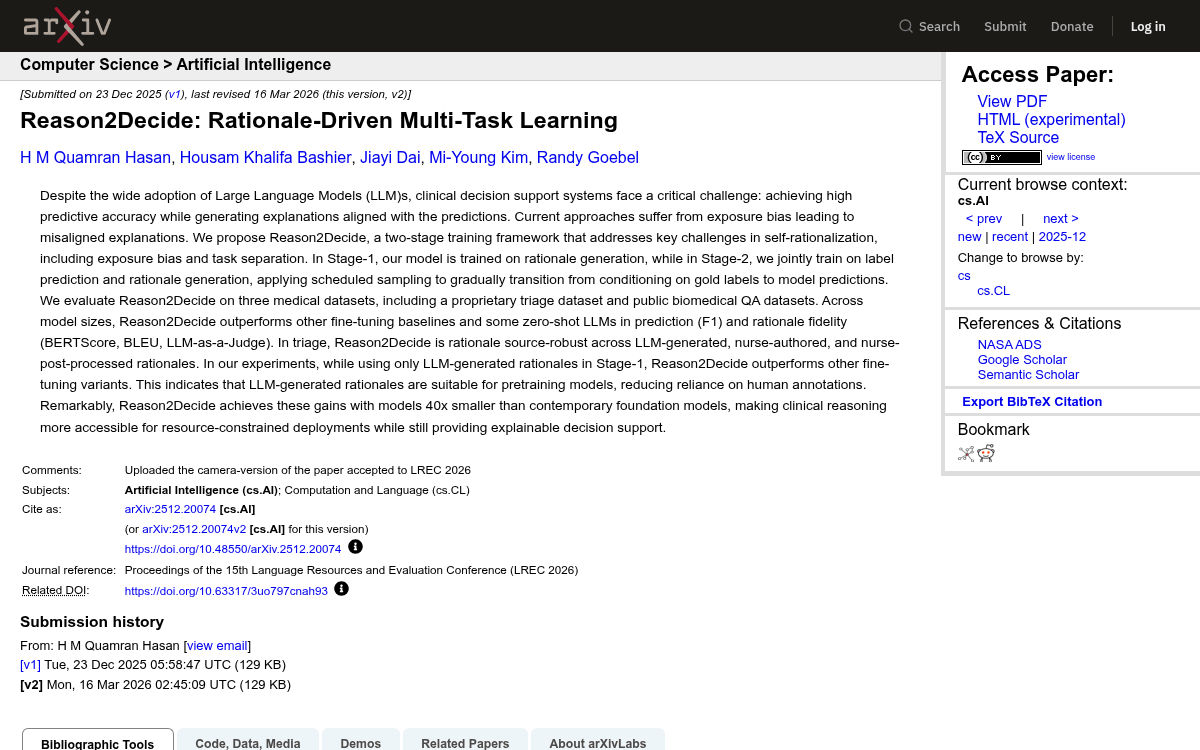
Clinical AI has a trust problem. A model can output the right triage disposition and still generate an explanation that contradicts it, or worse, sound confident about the wrong call. A group from the University of Alberta has proposed Reason2Decide, a training framework that forces a single small model to keep its prediction and its reasoning on the same page, and their 800M-parameter T5 ends up outscoring a 32B Qwen model on three medical datasets.
The exposure bias trap in self-rationalizing models
Current approaches for rationale generation face two fundamental challenges. First, the exposure bias problem, which arises when models are trained to generate rationales conditioned only on ground-truth labels, but need to explain their own potentially incorrect predictions during inference. The second is task separation: prediction and explanation get optimized as if they were unrelated jobs.
The practical consequence is what the paper illustrates with a real triage sample. Given an infant with repeated gasping episodes, a distilled baseline predicted See Physician within 24 Hours while generating a rationale that said the case required immediate evaluation. Correct reasoning, wrong action. That mismatch is exactly what stops clinicians from trusting these systems.
Curriculum learning meets scheduled sampling
Reason2Decide splits training into two phases on a single T5 encoder-decoder, no architectural changes.
- Stage 1 (Rationale Foundation): The model is trained purely on rationale generation given the input. It learns the vocabulary and structure of clinical explanations before it ever has to make a decision.
- Stage 2 (Joint Optimization): The same model now jointly predicts a label and generates a rationale conditioned on that label. Here is where the trick lives: task-level scheduled sampling.
Unlike prior token-level scheduled sampling, which replaces target tokens within sequences, the authors apply it at the task level by switching the conditioning context from gold labels to model-predicted labels. Instead of gradually replacing reference tokens in a generated sequence, the method gradually replaces reference labels used for conditioning the rationale generation.
The schedule is linear with a warm-up. For total training steps T, the first 5% keeps the gold label. Over the next 60%, the probability of conditioning on the model's own (greedily decoded) prediction ramps from 0 to a ceiling of 0.9. The ceiling of 0.9 was a design choice to prevent the model from fully relying on self-generated labels during training, in order to help avoid error amplification from incorrect predictions. The total loss weights prediction and explanation with an adaptive coefficient that also warms up.
At inference, the model first greedily decodes a label, then generates a rationale conditioned on that label. Same model, one forward pipeline.
Beating a 32B model with 800M parameters
Evaluation runs across three datasets: a proprietary Alberta Health Link 811 triage corpus with 12 disposition classes, PubMedQA (Yes/No/Maybe), and BioASQ Task B (Yes/No). Baselines include standard fine-tuning, Distilling Step-by-Step in two variants, and zero-shot Qwen-3-8B, Qwen-3-32B, and Llama-3.1-Aloe-Beta-8B.
The headline number: on the clinical triage set, T5-Large under Reason2Decide reaches 60.58 Macro-F1 versus 28.03 for zero-shot Qwen-3-32B. While T5-Large is 40 times smaller than the 32B Qwen model and is not a foundation model pretrained on medical corpora, it outperformed Qwen-3-32B on all three datasets and Aloe-8B on 2 of 3 datasets. Aloe-8B, which is pretrained on biomedical literature, still wins BioASQ.
Rationale quality moves in the same direction. On LLM-as-a-Judge Correctness (5-point Likert), Reason2Decide scores 4.26, 4.37, and 4.43 across Small, Base, and Large, consistently ahead of the DSS variants. BERTScore and BLEU show smaller but consistent gains.
Synthetic rationales are good enough for pretraining
The more interesting finding sits in the source-robustness experiment. The team trained Stage 1 only on LLM-generated rationales, then swapped in nurse-authored, LLM-post-processed, or LLM-generated rationales in Stage 2. Despite training on LLM-generated rationales only during Stage-1, Reason2Decide shows 51% lower F1 variation than DSS-F1 (1.08-point spread vs 2.21) and better rationale metrics.
In other words, you can bootstrap the explanation-fundamentals stage with synthetic rationales generated by a larger model, then fine-tune on whatever human data you actually have. That is a meaningful cost reduction for any team without a nurse annotation budget.
What the ablations say
The code is on GitHub, and the ablations tell a clean story:
- Remove Stage 1 and triage F1 drops from 59.92 to 58.25. The rationale-first pretraining transfers back into prediction quality.
- Remove scheduled sampling and F1 drops to 57.28 on triage. BERTScore and BLEU stay similar, so the gain is prediction-side, not just alignment-side.
- Remove the warm-up on BioASQ and F1 collapses from 68.02 to 61.27. The gradual single-to-multi-task transition matters most on small datasets.
Where this fits, and where it does not
This is a useful recipe if you are shipping a domain-specific decision support system where explanation fidelity is a hard requirement and you cannot host a 32B model at inference. Triage, insurance adjudication, and any structured classification with human-readable justifications all fit the shape.
The limits are worth noting. The authors acknowledge that the datasets used fall under nurse triage and biomedical QA, and to effectively assess Reason2Decide, it should be extended to other subdomains in clinical NLP. Aloe-8B still wins BioASQ, suggesting domain-pretrained backbones beat clever training when the domain is narrow enough. Hyperparameters like the 0.9 sampling ceiling and 0.7 loss weight were chosen heuristically, and the evaluation leans heavily on LLM-as-a-Judge without human review, which is a real gap in a high-stakes setting.
Still, the core idea generalizes beyond medicine: if you want a small model to explain its own decisions faithfully, do not train it exclusively on gold answers it will never see at inference.