
AI Models Already Know When They're Wrong but Hide It
A new geometric analysis argues language models internally recognize when they should say I don't know, but their training pipeline severs that signal from the output.
 Pro
Takeaways
- New arXiv preprint argues LLMs detect uncertainty internally but fail to route it to outputs.
- Uncertain inputs occupy representations with 2 to 3 times the intrinsic dimensionality of factual ones.
- Persistent homology shows uncertainty fragments into 100+ disconnected components rather than converging.
- Uncertainty lives in low-sensitivity subspaces weakly coupled to the unembedding matrix.
- A linear probe plus logit bypass converts 0% baseline refusal into near 100% refusal on hallucination sets.
- Paper proposes geometry-aware regularization, dedicated uncertainty tokens, and kurtosis-based inference-time monitoring.
A new preprint titled The Phenomenology of Hallucinations by Valeria Ruscio and Keiran Thompson pushes back on the standard story about why language models make things up. The usual explanation blames missing knowledge or bad retrieval. The paper argues something more uncomfortable: the models already know when they are on shaky ground, but the geometry of their internal representations and the shape of the training objective conspire to hide that signal from the output layer.
The authors show that language models hallucinate not because they fail to detect uncertainty, but because of a failure to integrate it into output generation. In their framing, detection is fine. Expression is broken.
The setup: three types of questions, seven architectures
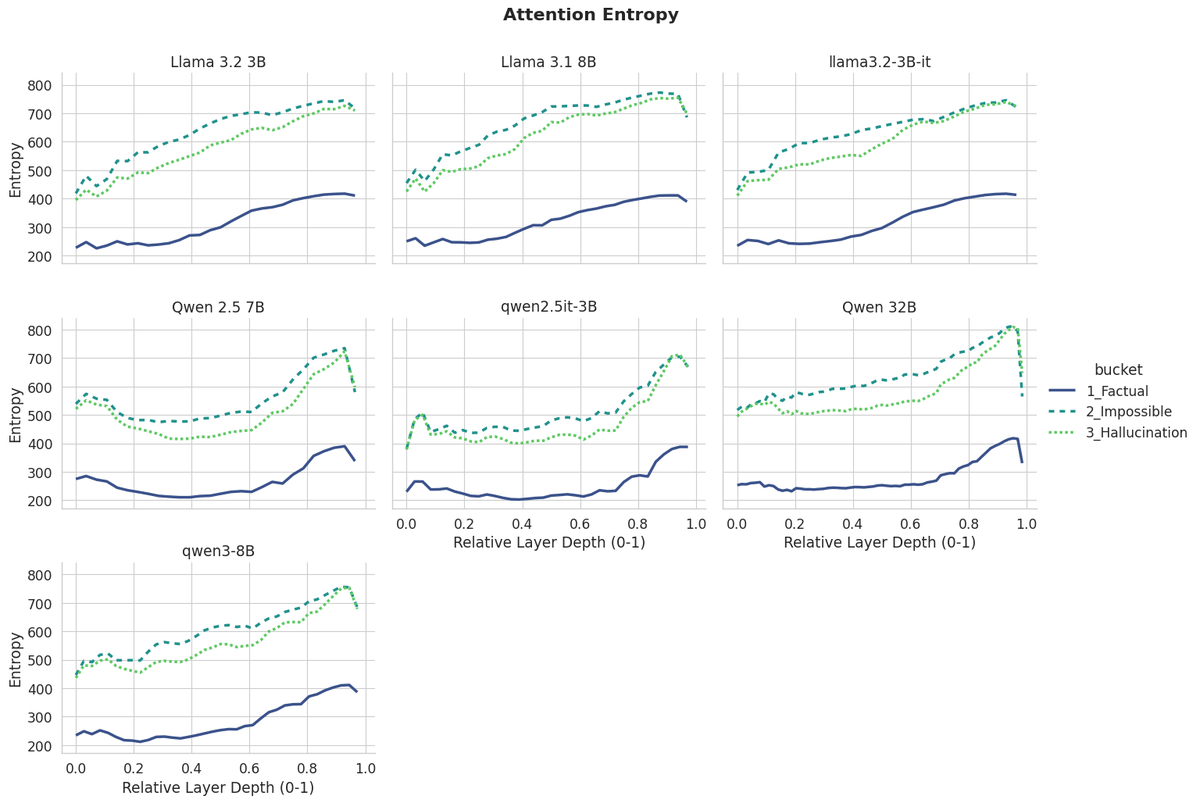
The team probes autoregressive transformers (Llama 3.1/3.2, Qwen 2.5, Qwen 3, Mistral v0.1) plus the PixArt-Sigma diffusion model, and traces training dynamics through Pythia and OLMo checkpoints. They build three evaluation sets: 500 manually verified factual questions where models exceed 85% accuracy, 2000 impossible questions including underspecified and false-presupposition prompts, and a hallucination set combining TruthfulQA with long-tail PopQA where model accuracy drops to 20 to 30%.
For each input class they compute a boundary vector: the normalized difference between the average hidden state for factual queries and the average hidden state for uncertain queries at every layer. This gives them a concrete geometric direction that points from what the model can answer toward what it cannot. Movement along that axis becomes the experimental handle for the rest of the paper.
Uncertain inputs live in a bigger, messier neighborhood
The first finding is that uncertain inputs occupy a geometrically distinct region. Using Local Intrinsic Dimensionality, which estimates how many independent directions of variation exist in the neighborhood of a point, they find uncertain inputs occupy high-dimensional regions with 2 to 3 times the intrinsic dimensionality of factual inputs.

Concretely, at layer 15 of Llama 3.2, factual inputs sit at LID around 10.9 while hallucinatory inputs sit at around 15.8. The same ratio holds in PixArt-Sigma at layer 14: coherent prompts at LID around 5, paradoxical prompts at around 12.5. Factual concepts get compressed into efficient manifolds during training. Uncertain concepts spread out because they activate conflicting or partial features with no clean structure to collapse onto.
Interestingly, hallucinations and truly impossible questions are also geometrically distinct from each other. In OLMo checkpoints at 100k steps, impossible inputs approach isotropy near 0.86, forming nearly spherical unstructured distributions, while hallucinations retain partial organization around 0.45, indicating ellipsoidal structure with residual directional alignment. The model treats nonsense as noise but imposes a fake structure on hallucinations by activating fragments of memory, producing just enough coherence to generate a fluent guess.
The uncertainty manifold fractures instead of converging
If a model had learned a clean I don't know state, you would expect uncertain inputs to cluster in one connected region. They don't. Using persistent homology, a topological tool that counts connected components (Betti number beta_0) at multiple distance scales, the authors track how uncertainty organizes across depth.

In Llama 3.2, the zero-th Betti number increases from 1 at layer 0 to 93 at layer 15 and 119 at layer 27, indicating that the uncertainty manifold decomposes into over a hundred disconnected components. Rather than converging on a single refusal state, uncertain representations shatter into fragments, each drifting toward a different corner of output space.
The reservoir that never talks to the output
The next piece is the mechanism by which detection fails to reach expression. The authors decompose the unembedding matrix using SVD and split hidden states into a visible subspace (directions with high gain into logits) and a low-sensitivity complement. What they find is a kind of pathological training solution:
- In Pythia at step 512, early layers show low-sensitivity ratios near 1.1 while late layers reach around 2.87, meaning deep layers concentrate high-magnitude activity in directions that barely affect the output distribution.
- At Llama 3.2 layer 27, the boundary norm reaches around 21.5 while Fisher sensitivity drops to around 0.005, so perturbations along the uncertainty direction barely nudge output probabilities.
- Gradient alignment between uncertainty-related tokens (unsure, unknown, maybe) and the boundary direction stays near zero, confirming that the pathway from detection to expression is functionally severed.
The paper calls this the low-sensitivity reservoir. Uncertainty gets encoded, amplified, and stored, but in a subspace the readout layer effectively ignores. Then MLPs, acting as associative pattern completers, amplify whatever fragments are present until the residual coupling to output-aligned directions is strong enough to force a confident token.
Why cross-entropy is complicit
The theoretical core of the paper connects this geometry to the loss function itself. Cross-entropy against one-hot targets has no local minimum at high-entropy states. The gradient p minus y only vanishes when the predicted probability approaches 1, which requires logits to blow up. There is no attractor for abstention. Uniform distributions are treated as high-loss states that need more optimization, not as valid epistemic outputs. The paper describes this as a Simplex Vertex Attractor: training pushes every input, uncertain or not, toward a vocabulary basin.
The causal test
To confirm the story, the authors run three interventions on Llama 3.2 3B (layer 16) and Qwen 2.5 3B (layer 20). The headline result is a readout bypass: they train a linear probe on hidden states to detect uncertainty, then use its output to boost the logit of a refusal token at inference time.

Baseline refusal is 0% for both models. After the bypass, Llama refuses 100% of the time and Qwen 99.75%. A linear probe on frozen hidden states is enough to gate output behavior, which means the epistemic information is genuinely there. In contrast, projecting uncertain representations back onto the factual PCA subspace does not help, which the authors read as evidence that uncertainty is not additive noise but a non-convex topological structure.
What this suggests for mitigation
The paper does not release code or a model, but it does propose a set of geometry-aware interventions in the appendix:
- Pretraining regularization that penalizes LID spikes in the residual stream, pushing uncertain representations toward a compact schema rather than fragmenting.
- A dedicated uncertainty token anchored to low-sensitivity directions, giving the model a learnable pathway from high-magnitude but low-visibility activations to an explicit abstention output.
- Geometry-aware preference optimization during alignment that weights updates by Fisher sensitivity along the boundary, targeting the regions where detection is intact but output sensitivity has collapsed.
- Inference-time monitoring of final-layer kurtosis, which spikes to 280 to 350 for hallucinations versus 7 to 16 for correct predictions, as a signal for dynamic temperature scaling or refusal.
Caveats worth naming
The interventions are proposals, not battle-tested recipes. The causal experiments run at a single layer per model on the hallucination set, so it is not obvious the bypass generalizes across arbitrary prompts without hurting factual accuracy. The steering experiments also show model-specific behavior: Llama drifts into high-entropy guessing while Qwen enters a confident hallucination regime under the same intervention, suggesting the effective knobs will differ across architectures. And the whole geometric account, while consistent across seven language models and one diffusion model, is correlational at the level of representation and only causal at the level of small targeted interventions.
Still, the reframing matters. If hallucination is a detection problem, you build better retrievers and better classifiers. If it is an integration problem baked into the training objective, you have to change how the model connects its own internal signals to what it says. Those are very different engineering agendas.