
AI Content Labels Make Users Worse at Spotting Misinformation, Study Finds
A 1,354-person study finds AI image labels backfire — making users more gullible to old-fashioned misinformation and more skeptical of true AI-illustrated news
 Pro
Takeaways
- Main finding: A 1,354-person survey shows AI image labels cause overreliance — users treat absence of a label as proof a post is true, making them more vulnerable to non-AI misinformation.
- Quantified backfire: Labeling correctly boosted accuracy on AI-generated false posts (84.9% vs 82.1%), but simultaneously reduced accuracy on true AI-illustrated posts and human-made fake posts.
- Mislabeling amplifies risk: Users rely on labels even when they are wrong; unlabeled AI fakes in a labeled environment benefit from an implied-truth halo.
- Regulatory context: China, the EU, and U.S. states are all mandating AI content labels, but the study suggests the policy assumption — transparency equals protection — is flawed without user education.
- Users want labels but overestimate them: 75.7% of participants want AI labels on social media, yet the same participants showed worse overall misinformation detection when labels were present.
- The full paper (CHI 2026) recommends pairing labels with user education, transparent error rates, and provenance signals for authentic content, not just AI-generated content.
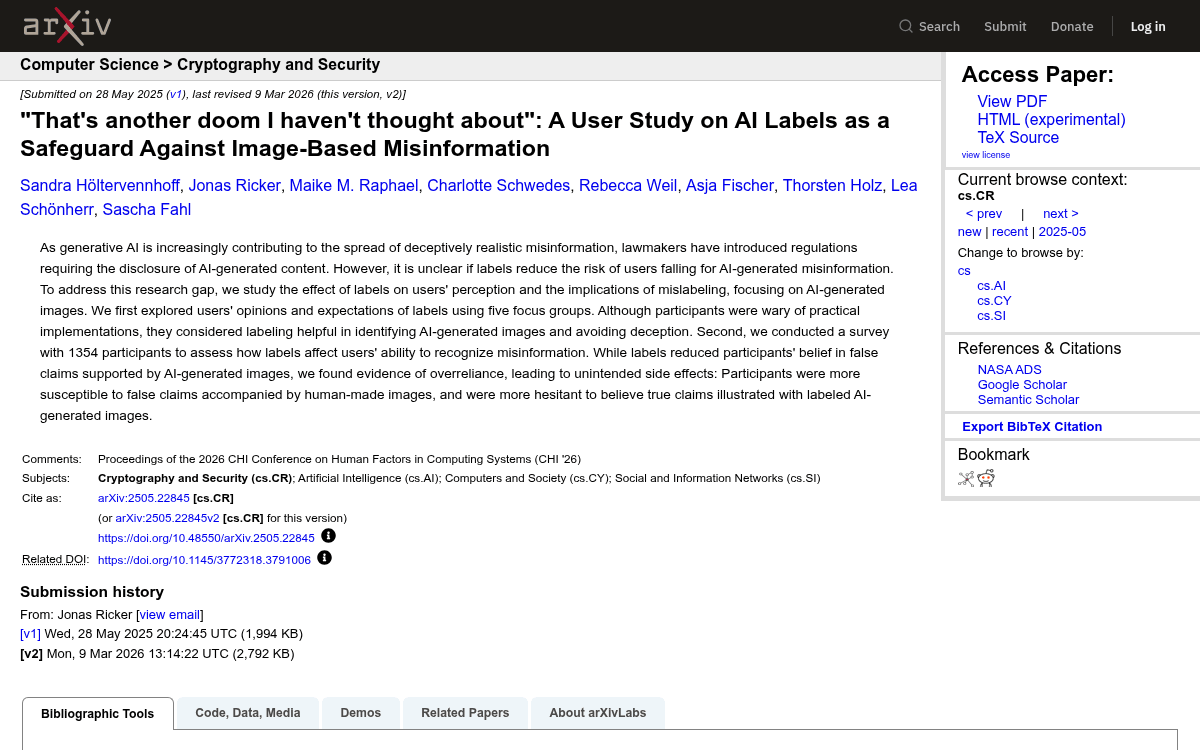
Lawmakers around the world have been racing to mandate AI content labels as a frontline defense against synthetic misinformation. The EU's AI Act, China's new labeling rules that took effect in September 2025, and a wave of U.S. state laws all rest on the same assumption: if users know an image is AI-generated, they will think more critically and be harder to deceive. A new peer-reviewed study published at CHI 2026 puts that assumption to the test , and the results are more complicated than regulators might hope.
The Label Paradox
The core finding is what the researchers call overreliance. Instead of nudging users to think harder about whether a claim is true, AI labels appear to function as a simple shortcut: labeled image means the post is probably false; no label means it is probably true. That mental model works fine when the label is correct , but it creates two dangerous blind spots.
- Participants were more susceptible to false claims accompanied by human-made images , because the absence of a label was read as a credibility signal.
- Participants were more hesitant to believe true claims illustrated with labeled AI-generated images , dismissing accurate information simply because the picture was synthetic.
In signal detection theory terms (a framework borrowed from psychology that separates a person's ability to distinguish true from false from their general tendency to be skeptical), sensitivity was actually higher in the control group compared to both treatment groups . In other words, people who saw no labels at all were better at telling real news from fake news than people who had labels to lean on.
How the Study Was Designed
The research team, based at CISPA Helmholtz Center for Information Security and Ruhr University Bochum, ran two back-to-back studies. First, five focus groups with 18 participants from the EU and U.S. surfaced qualitative concerns about how labels work in practice. Then came the main event: a pre-registered online survey with 1,354 participants to assess how labels affect users' ability to recognize misinformation .
The survey used a 2 × 2 × 3 mixed factorial design , a setup that crossed two variables within each participant (image origin: human or AI; claim veracity: true or false) against three between-participant groups (control, labeling, mislabeling). Each participant rated 24 simulated social media posts sourced from real fact-checking sites like Snopes and AFP Fact Check, covering everything from political events to celebrity news. The design was intentionally built to catch side effects that earlier studies missed by only testing AI-generated images paired with false claims.
The three groups worked like this:
- Control: No labels shown at all.
- Labeling: All AI-generated images were correctly labeled "AI-Generated."
- Mislabeling: Two out of six images per condition were mislabeled , some real photos got the AI label, some AI images went unlabeled.
The Numbers Behind the Backfire
For AI/false posts, the probability that participants correctly judged a post as false was 84.9% if the image was labeled and 82.1% if it was unlabeled. So labels do help against the specific threat they were designed for. The problem is the collateral damage. The accuracy for AI/true posts was lower in the treatment groups, and the accuracy for human/false posts was also lower in the treatment groups. Users were simultaneously more likely to dismiss true AI-illustrated news and more likely to fall for traditional photo-based misinformation.
Mislabeling made things worse in a predictable way: users are influenced by the presence or absence of labels when judging a post's claim, regardless of whether an image is correctly labeled or mislabeled. Thus, in a context where labels are present, they are more likely to fall for misinformation conveyed through unlabeled AIGIs. Adversaries who know how to strip metadata or use custom generation tools that bypass detection could exploit this directly , their unlabeled fakes would benefit from the implied-truth halo that labels create around everything else.
What Users Actually Think
The qualitative focus groups revealed a telling gap between perception and reality. Many participants liked the concept of AI labels, generally considering them helpful for distinguishing real from AI-generated images and useful to uncover AI-generated misinformation. At the same time, most participants did not consider AI labels a perfect solution to counter misinformation, raising both overarching concerns and reservations regarding individual labeling mechanisms.
Three labeling mechanisms were discussed , self-disclosure (users tag their own content), metadata standards like C2PA (cryptographic provenance embedded in the file), and automated AI detection. Each had a fatal flaw in participants' eyes:
- Self-disclosure: Most participants questioned other users' honesty and were uncomfortable with mechanisms that solely rely on it.
- Metadata: Considered the most trustworthy in theory, but some participants were genuinely surprised at how easily metadata can be removed and had thought that it would require more technical expertise.
- AI detection: Participants doubted reliability and worried about who controls the training data, fearing intentional bias in what gets flagged.
Despite all of this, 75.7% of survey participants would like to see AI labels on real social media platforms, while only 13.5% were against them. Users want labels , they just overestimate what labels can do.
The Regulatory Mismatch
The timing of this research is pointed. China's major social media platforms rushed to comply with a new law that took effect in September 2025, requiring all AI-generated content online to be labeled, whether it is text, images, video, or audio, implicitly and explicitly. The EU AI Act imposes similar disclosure obligations on large platforms. In the U.S., California will enforce the AI Transparency Act, which requires AI systems with more than 1 million monthly visitors to implement proper AI detection tools and content disclosures. A bipartisan House bill would extend mandatory labeling to federal agencies.
All of this regulation is built on the assumption that transparency equals protection. As lawmakers continue to pursue label-focused laws, the effectiveness of disclosures has been questioned , researchers from Stanford found that labels improve transparency but showed no evidence that they significantly change the persuasiveness of the content. The CHI 2026 study goes further, showing that labels can actively make some misinformation easier to believe.
What Should Actually Change
The authors stop short of saying labels are useless. Their argument is that labels are being deployed without the infrastructure needed to make them work safely. They lay out four concrete recommendations:
- Education first: Platforms must tell users explicitly that an AI label signals origin, not falsehood. Right now, most platforms introduced labels quietly, and many users never noticed them.
- Reduce mislabeling: Platforms relying solely on self-disclosure should reconsider, since bad actors simply will not comply. Occurrences of mislabeling should be transparently addressed with an appeals process.
- Transparency about the mechanism: Users need to know how detection works, what its error rate is, and who controls it , otherwise distrust fills the vacuum.
- Certify authentic content too: Rather than only flagging AI, platforms should also surface provenance signals for real content. YouTube's "Captured with a camera" disclosure, which uses C2PA metadata to confirm authenticity, is cited as a positive example.
The deeper implication is that AI labels pose the threat that they might delude users into a false sense of security , a particularly dangerous outcome when the misinformation landscape includes plenty of conventional photo manipulation that has nothing to do with generative AI. Labels that make users more trusting of unlabeled content hand a ready-made attack vector to anyone willing to skip the watermark.