
AI Assistance Quietly Steers Pathologists Wrong 7% of the Time
A study of 28 pathologists shows AI boosts diagnostic accuracy but nudges experts toward wrong answers 7% of the time, worse under time pressure.
 Pro
Takeaways
- AI assistance improved pathologists' tumor cell estimates but caused a 7% automation bias rate of flipped-correct answers.
- Time pressure did not raise how often bias occurred, but made errors substantially worse when it did.
- Mixed-effects modeling showed AI advice weighted 0.44 versus 0.55 for the pathologist's own estimate.
- Anchoring persisted even when the AI was less accurate than the pathologist's independent guess.
- More experience and higher baseline confidence reduced AI reliance; confidence while using AI increased it.
- Experiment code is open source on GitHub under CC BY 4.0.
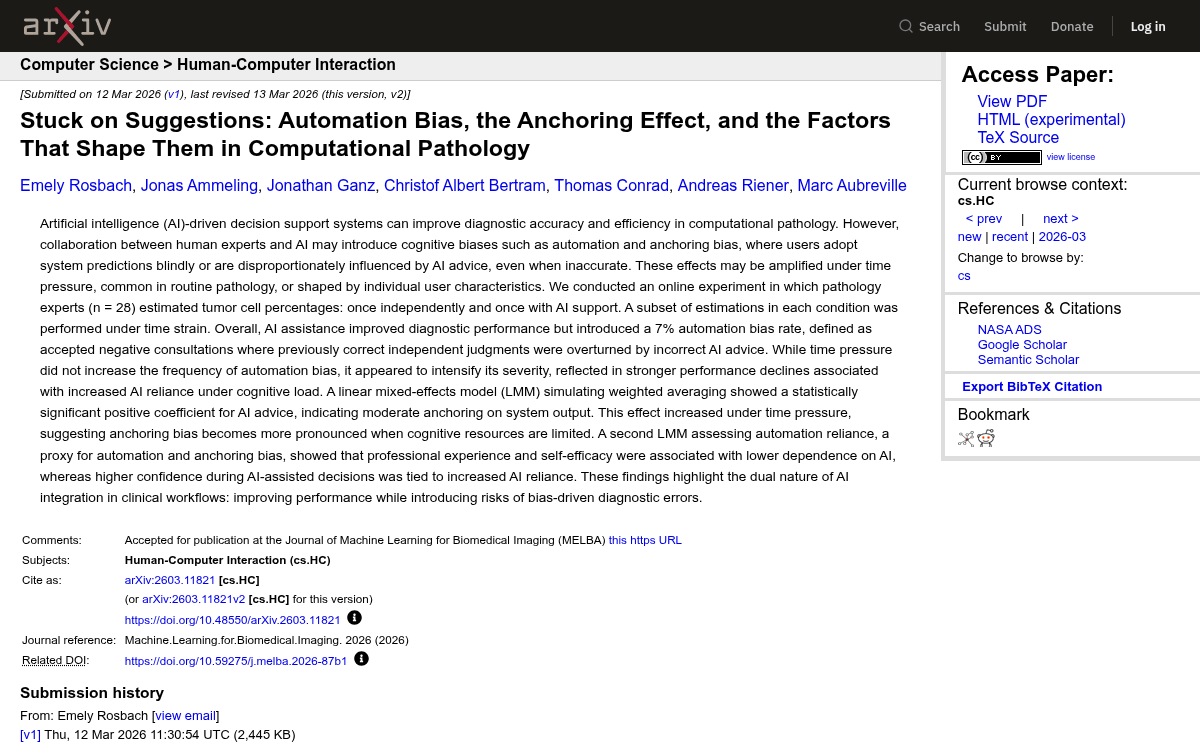
When an AI tool whispers a suggestion in a pathologist's ear, does the expert still think independently, or quietly defer to the machine? A new study from researchers at Technische Hochschule Ingolstadt and collaborators put that question to 28 practicing pathology experts, and the results are a mixed bag for anyone building clinical decision support systems.
The paper, titled Stuck on Suggestions, measures two well-known cognitive traps in human-AI collaboration. Automation bias is the tendency to accept a machine's answer without scrutiny. Anchoring bias is the tendency for whatever information you see first, correct or not, to skew everything that follows. Both matter enormously when the task is diagnosing cancer.
The task: guessing tumor content from a slide
The participants estimated tumor cell percentage (TCP), the proportion of neoplastic cells in a tissue sample, across 20 image patches from H&E-stained slides. TCP matters clinically because each molecular assay possesses a unique sensitivity threshold requiring a specific level of tumor DNA to ensure robustness and accurate interpretation of test results. Get it wrong, and downstream genetic tests can produce false negatives that misroute treatment.
The experiment used a 2x2 within-subjects design: with or without AI support, with or without a 10-second countdown timer to simulate time pressure. Each pathologist did the task twice, separated by a two-week washout period to blunt learning effects. The AI itself was no strawman: a real FCOS-based object detector with a ResNet-18 backbone pretrained on ImageNet trained on the BreCaHad breast cancer dataset. On roughly half the study slides it produced accurate predictions; on the rest it made realistic errors from covariate shift.

AI helps, but plants a 7% landmine
The headline win: AI assistance improved overall accuracy. A repeated-measures ANOVA found a statistically significant main effect of AI integration on subject performance, and AI support also softened the performance hit from time pressure that was visible in the baseline.
The catch is what the authors call accepted negative consultations, cases where a pathologist got the answer right on their own, then changed to a wrong answer after seeing incorrect AI advice. Out of 560 AI-supported TCP assessments, medical experts aligned with AI advice contradictory to their initial estimates in only 67 instances. Of these, 29 were positive consultations, in which provision of correct AI guidance prompted revision of an initially erroneous assessment. The other 38 were the bad kind, giving an automation bias rate of approximately 7%. That is squarely inside the 6-11% range seen in other medical specialties.
Time pressure does not create the bias, it sharpens it
The frequency of automation bias stayed flat at roughly 7% whether or not the timer was on. But the severity got worse under pressure. Mean absolute deviation from ground truth on those flipped cases jumped from 19.42 without time pressure to 27.79 with it. Participants leaned harder on AI when the clock was ticking, and when the AI was wrong, they followed it further off a cliff.
Quantifying the anchor
To measure anchoring itself, the authors fit a linear mixed-effects model that treats the final AI-aided estimate as a weighted average of the pathologist's independent estimate and the AI's prediction. The model returned coefficients of 0.55 for the independent estimate and 0.44 for the AI prediction, both highly significant. Translation: pathologists gave the AI's answer nearly the same weight as their own initial judgment. Under time pressure the AI's coefficient climbed to 0.48, closing the gap further.
Notably, the anchoring effect persisted even when the AI's advice was worse than the pathologist's own guess. Although the effect was attenuated when AI advice was of lower quality, it remained reliably present, suggesting that participants were not fully able to disregard inaccurate AI suggestions, even when they likely recognized their diminished reliability.
Who is more resistant to AI's pull?
A second mixed-effects model examined which user traits predict reliance on AI advice. Three effects came out clean:
- Professional experience mitigates reliance. More years in the field, less deference to the machine (coefficient -0.06, p < 0.001).
- Self-efficacy mitigates reliance. Higher confidence during the unaided baseline meant lower AI reliance later (coefficient -0.03, p = 0.050).
- Confidence during AI-assisted work amplifies reliance. Feeling reassured by the AI's presence actually increased dependence on it (coefficient 0.08, p < 0.001).
That last point is the most uncomfortable finding. Users who feel more confident when the AI is helping them are the ones most likely to be silently anchored to whatever it says.
Why this matters for anyone shipping clinical AI
Most published work on clinical decision support systems reports aggregate accuracy gains and stops there. This study is a reminder that the human-in-the-loop is not a neutral filter. Adding AI to a workflow creates new failure modes that do not exist in either pure-human or pure-AI systems, and those failures cluster around edge cases where the model is wrong and the human is rushed.
Practical implications for product and research teams:
- Measuring net accuracy hides negative consultations. Track flip rates from correct-to-incorrect explicitly.
- Interfaces that show AI output before the human commits an estimate will anchor harder. The study's UI intentionally showed AI advice after the baseline round.
- Time pressure is not a nuisance variable, it is a bias amplifier. Any evaluation done in unhurried conditions is likely underestimating real-world overreliance.
- Confidence calibration cuts both ways. Explanations and confidence cues that make users feel good about AI-assisted decisions may be increasing rather than reducing the risk.
Availability and caveats
The source code for the experimental platform is on GitHub, and study materials plus recorded participant data ship in the paper's supplementary material under CC BY 4.0. The trained detector is not released as a standalone model, but the training recipe is fully described.
The obvious limits: n = 28 is small, TCP estimation is one narrow task, and the countdown timer is a crude proxy for the kind of grinding caseload pressure that pathologists actually experience. The authors are upfront about all of this. Still, the convergence of their 7% figure with prior work across cardiology, prescribing, and other specialties suggests automation bias is a stubborn feature of human-AI collaboration in medicine, not an artifact of any single study design.