
AgentEA's Debate Club of AI Agents Hits Near-Perfect Knowledge Graph Matching
AgentEA replaces single-pass LLM reasoning for entity alignment with a two-stage multi-agent debate, hitting near-perfect scores on major benchmarks.
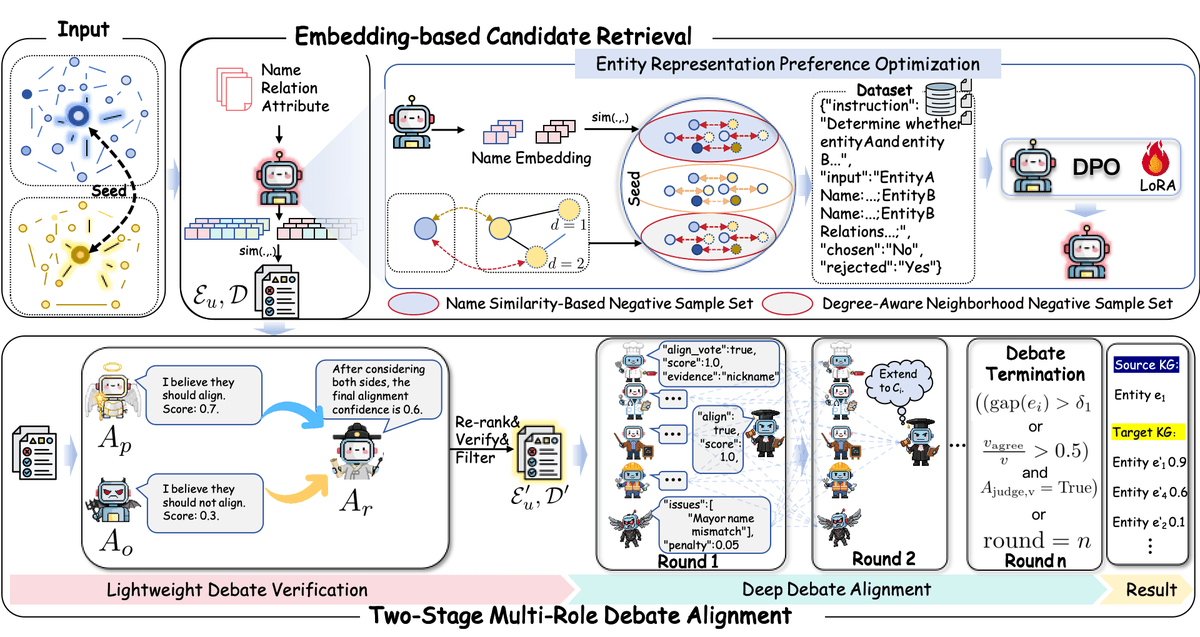
Takeaways
- AgentEA introduces the first multi-agent debate framework for entity alignment across knowledge graphs, with code on GitHub.
- Fine-tunes LLaMA3-8B with DPO using name-similarity and degree-aware hard negatives to improve candidate retrieval.
- Two-stage debate: lightweight three-agent verification filters easy cases, deep six-agent debate handles disputed ones.
- Specialized agents cover alias, type, attribute, neighborhood, plus an adversarial attack agent and a judge.
- Achieves 0.996 Hits@1 on DBP15K FR-EN and 1.000 on DWY DBP-WIKI, beating ChatEA, EasyEA, ProLEA.
- Performance is stable across GPT and Qwen backbones, showing gains come from debate structure not model choice. Read the paper.
Matching entities across different knowledge graphs sounds simple until you realize that two graphs can describe the same person, place, or event with wildly different names, attributes, and structural neighborhoods. A new framework called AgentEA tackles this by throwing a debate club at the problem: multiple LLM agents argue for and against each candidate match, with a judge agent making the final call.
The approach pushes entity alignment performance close to saturation on standard benchmarks, and the authors have released the code.
Why single-LLM reasoning keeps failing
Entity alignment (EA) aims to identify entities referring to the same real-world object across different knowledge graphs. Recent approaches based on large language models typically obtain entity embeddings through knowledge representation learning and use embedding similarity to flag an alignment-uncertain set. For each uncertain entity, a candidate list is retrieved by embedding similarity to support later reasoning and decision making.
That pipeline has two structural weaknesses. If the correct target never makes it into the candidate list, no amount of clever reasoning can recover it. And the LLM gets one shot at reasoning over the candidates without any mechanism to challenge its own conclusions. As the authors put it, the reliability of the candidate set and the reasoning capability of the LLM jointly bound the quality of every downstream alignment decision.

Fixing the embeddings first
Before any debate happens, AgentEA improves the quality of the candidate list. The team fine-tunes a LLaMA3-8B encoder using Direct Preference Optimization on entity pairs, and the interesting part is how they construct hard negatives: