
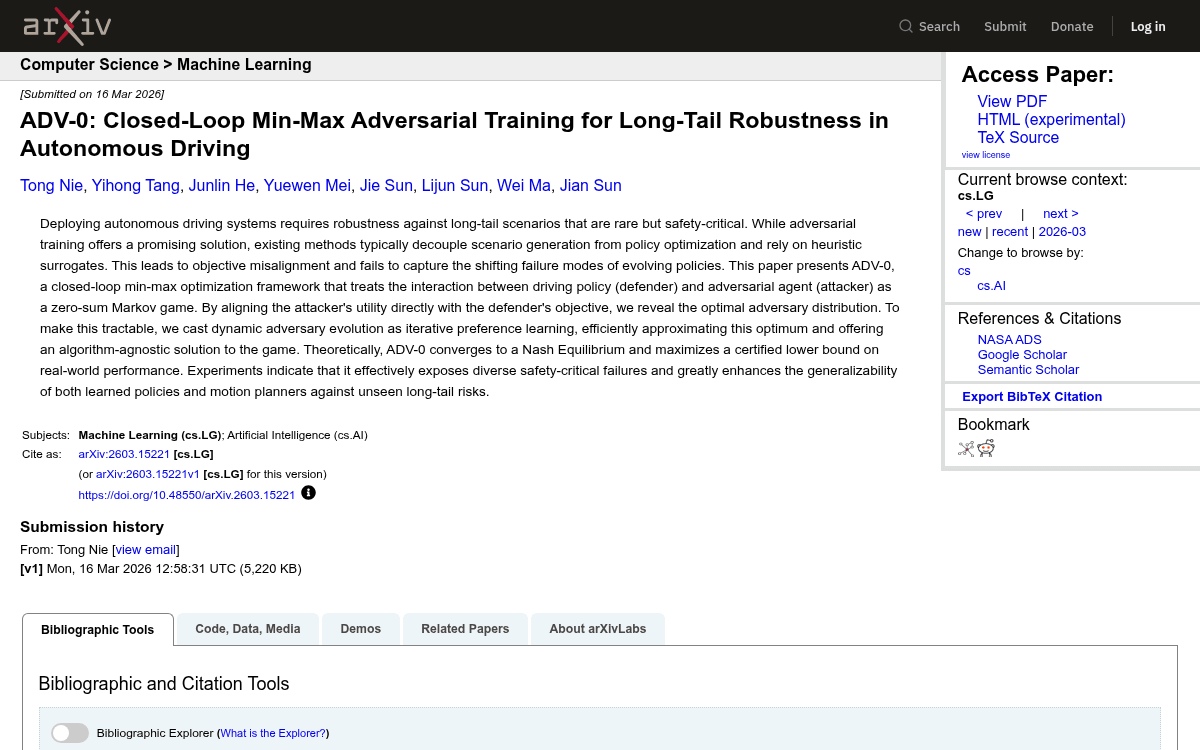
ADV-0 Forces Self-Driving AI to Train Against Its Own Worst Failures
A new framework couples adversarial scenario generation with policy training as a zero-sum game, boosting driving policy robustness against unseen long-tail risks.
 Pro
Takeaways
- ADV-0 couples adversarial scenario generation and driving policy training as a zero-sum Markov game with end-to-end optimization.
- Uses iterative preference learning, borrowed from DPO, to update the adversary against a plausibility prior.
- Proves convergence to Nash Equilibrium and a certified lower bound on real-world return via KL-controlled generalization.
- Beats CAT, KING, SAGE, and heuristic attackers on collision rate and ego reward across RL and log-replay defenders.
- Cross-validated across six RL algorithms, ADV-0-trained agents lead route completion and crash rate on unseen adversaries.
- Works on PlanTF and SMART planners, cutting crash rates by over 20% after fine-tuning.
Self-driving stacks train mostly on hours of boring highway logs, which is exactly why they still get surprised by the rare stuff: aggressive cut-ins, sudden brakes at odd geometries, weird occluded left turns. A new paper called ADV-0 tackles this long-tail problem head-on by turning adversarial training into a properly coupled game between the driving policy and a scenario generator, and it borrows a trick from preference-based LLM tuning to make the whole loop stable.
The core claim is that ADV-0 is the first closed-loop training framework for long-tail problems of AD that couples adversarial generation and policy optimization in an end-to-end way, and that it works whether your ego agent is a reinforcement-learning policy or a modern learned motion planner.
Why existing adversarial training keeps missing the tail
Most prior work splits the problem in two: generate a batch of nasty scenarios with some heuristic, then train the policy against that fixed set. The authors argue this decoupling breaks in three specific ways.
- Misaligned objectives. While the defender optimizes a comprehensive reward that accounts for safety, efficiency, and comfort, the attacker solely targets collisions, relying on heuristic surrogates such as collision probability. That means the attacker never learns to expose non-crash failures like stalling at an intersection or drifting off-road.
- Non-stationary weaknesses. As the driving policy improves, its failure modes shift deeper into the tail. Fixed adversarial priors can't track the moving frontier.
- No safety certificate. Training against static heuristics is essentially trial and error, with no formal bound on how the policy will behave in the real world.
The game-theoretic reframing
ADV-0 treats the whole thing as a two-player zero-sum Markov game. The outer loop maximizes the ego's performance, while the inner loop seeks an adversary that minimizes the current ego's reward. Crucially, the attacker's reward is set to the exact negation of the defender's reward, not a collision-probability surrogate, so the adversary is incentivized to find any kind of failure the ego cares about.
Solving that min-max directly is intractable because physical simulators aren't differentiable and rollouts are long. The authors' key move is showing that the optimal adversarial distribution has a closed form: it's a Gibbs distribution that re-weights a naturalistic traffic prior by an exponentiated adversarial utility. In plain terms, start from realistic driving behavior, then bias sampling toward trajectories that hurt the current policy the most, while staying close enough to plausible driving that the scenarios remain physically sensible.
Preference learning as the tractable solver
Sampling from that Gibbs distribution directly is still ugly because of the partition function. ADV-0 sidesteps this by casting adversary updates as Iterative Preference Learning (IPL), essentially the same trick behind Direct Preference Optimization for LLMs. For each scenario context, the generator produces K candidate adversarial trajectories, a proxy reward evaluator ranks them by how badly they hurt the current ego policy, and the generator is fine-tuned on preference pairs where the more damaging trajectory is preferred.
To avoid running full closed-loop simulations for every candidate, they use a lightweight rule-based proxy that computes geometric interactions (collisions, progress, off-road) against a small buffer of the ego's recent trajectories in that scenario. Surprisingly, the rule-based proxy achieves low and stable preference loss comparable to the oracle, outperforming other estimators. A learned reward model or historical-experience retrieval actually did worse, and the geometric proxy hit a Spearman correlation of 0.77 with true simulator returns.

Theoretical guarantees, in one sentence each
The paper backs the algorithm with two results worth knowing about:
- Convergence. The alternating updates form a contraction mapping on the value function space, so the game converges to a unique Nash Equilibrium.
- Generalization bound. Performance in the real world is lower-bounded by performance against the generated adversary, minus a term that shrinks with the KL divergence between the learned adversary and the naturalistic prior. Practically, this ties the IPL regularizer directly to a certified safety margin.
What the experiments actually show
All experiments run in the MetaDrive simulator on Waymo Open Motion Dataset scenarios. A few results stand out:
- Better attacks. Against a trained PPO agent, ADV-0 achieves a 40.68% collision rate versus 36.84% for CAT and 21.26% for KING, while pushing ego cumulative return down to 39.13. It also uncovers non-crash failures like intersection stalling that collision-only attackers miss.
- Better defense. When cross-validated across five different adversarial environments and averaged over six RL algorithms (GRPO, PPO, PPO-Lag, SAC, SAC-Lag, TD3), ADV-0-trained agents achieved the highest route completion (0.710) and lowest crash rate (0.240), beating CAT, SAGE, and heuristic training on every metric.
- Real-world long tail. On a held-out set of naturally rare scenarios mined by strict thresholds (min TTC below 0.4s, PET below 1.0s, hard dynamics, and rare behavior clusters), ADV-0 cuts near-miss rate to roughly 63% versus 83% for CAT and 89% for replay-only training.

It works on motion planners too
Beyond RL, the authors fine-tune two learning-based planners with ADV-0: PlanTF (multimodal scoring) and SMART (autoregressive token generation). Both improved substantially, with PlanTF's crash rate dropping 26.23% and reward improving 17.11%, and similar gains for SMART. The catch: fine-tuned planners still trail end-to-end RL agents slightly, which the authors attribute to covariate shift from behavior cloning and the latency introduced by the re-planning horizon.
The temperature knob and what breaks
The sampling temperature is the single most important hyperparameter. Push it toward zero and the attacker deterministically picks the worst case, which overwhelms the defender early in training. Push it too high and adversarial signal collapses into domain randomization. The sweet spot was around 0.1 for the softmax sampling step.
Limitations the authors flag honestly: the framework needs a high-fidelity simulator for online RL, which limits scaling, and extending to vision-based sensor inputs would require differentiable neural rendering, which nobody has solved cleanly yet. The proxy reward also depends on the geometry of physical interactions, so scenarios involving semantic reasoning (like traffic light behavior or gesture-based negotiation) aren't directly covered.
When you'd actually use this
If you're building any closed-loop training pipeline for driving, the algorithm-agnostic wrapping is the main selling point. ADV-0 slots in around your existing PPO, SAC, GRPO, or trajectory planner without requiring changes to the underlying learner, and the IPL loop is a general recipe for coupling adversarial data generation to policy improvement wherever you have a preference signal and a plausible prior. The paper is available on arXiv; the authors do not appear to have released code alongside the preprint.